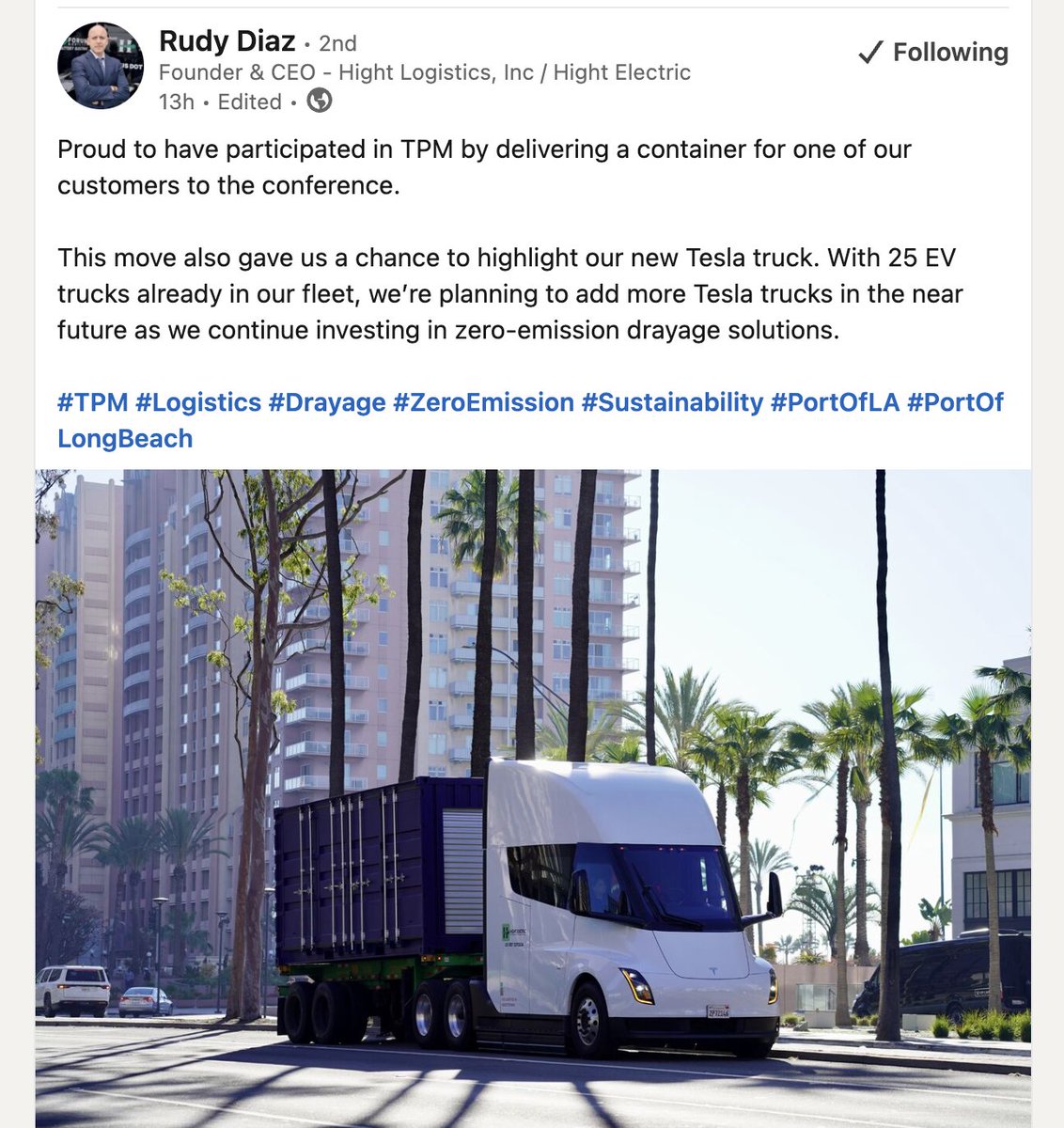
The News: Hight Logistics has taken delivery of a new Tesla Semi and says it plans to add more Tesla trucks to its fleet in the near future.
Why It Matters: With Tesla ramping Semi production toward 50,000 units per year at Gigafactory Nevada, fleet operators committing to future orders signals growing commercial confidence in the platform.
Source: @SawyerMerritt on X
Hight Logistics Joins the Tesla Semi Commercial Wave
Hight Logistics — the parent company behind Hight Electric, its all-electric trucking division — has taken delivery of a new Tesla Semi, with the company signaling this won't be its last. "We're planning to add more Tesla trucks in the near future," the company stated, a clear indication that this delivery is the beginning of a broader fleet transition rather than a one-off trial.

Hight Electric has been quietly building one of the more serious all-electric commercial trucking operations in the country. According to the company, it launched its EV fleet in 2022 and has since logged over 100,000 miles across its electric trucks. By October 2024, the division had grown to 20 electric trucks after adding nine new units — and it had already announced plans to expand further in 2025. The Tesla Semi delivery marks the next chapter of that expansion.
📊 Key Figures
| Metric | Value | Context |
|---|---|---|
| Hight Electric fleet size (Oct 2024) | 20 trucks | All-electric |
| Miles logged since 2022 | 100,000+ | EV fleet total |
| Tesla Semi annual production target | 50,000 units/yr | Gigafactory Nevada capacity |
| Semi charging speed | 60% range in 30 min | Via Tesla Semi Chargers |
| Efficiency (DHL real-world test) | 1.72 kWh/mile | 75,000 lb gross weight |
| Single-charge range (DHL test) | 390 miles | Fully loaded |
Why This Delivery Matters Beyond the Headlines
A single truck delivery might seem like a footnote, but the context makes it significant. Tesla only began volume production of the Semi at Gigafactory Nevada targeting March 2026 — meaning Hight Logistics is among the early commercial recipients of what is effectively the production-ramp Semi. The facility is designed to eventually produce up to 50,000 units per year, and every fleet operator that commits to future orders helps validate that production ramp.
Hight Electric's operational profile also makes it a credible real-world test case. The company focuses on port drayage and over-the-road trucking within a 230-mile operational range — precisely the duty cycle where the Tesla Semi's 300-mile range variant is most competitive. With dedicated on-site charging infrastructure already in place (six charging stations), Hight is operationally ready to absorb more Semis without the charging infrastructure headaches that have slowed other fleets.
The Broader Fleet Adoption Picture
Hight Logistics isn't operating in isolation. DHL Supply Chain took delivery of its first Tesla Semi in December 2025 and has committed to adding more in 2026 — and its pilot data is compelling. DHL's Tesla Semi completed over 5,000 km of live freight operations and achieved 1.72 kWh per mile while hauling a 75,000-pound gross combined weight over a 390-mile route on a single charge. That's real-world performance data that fleet operators can take to their CFOs.
The Semi's technical specs support the commercial case: three independent rear motors delivering up to 800 kW of drive power, a next-generation battery pack with 7% better energy efficiency than earlier prototypes, and the ability to recover 60% of range in just 30 minutes at Tesla's dedicated Semi Chargers. For operators like Hight that run predictable routes with return-to-base logistics, the economics are increasingly hard to ignore.
🔭 The BASENOR Take
Timeline: Tesla Semi volume production ramp — March 2026 onward
Impact Level: 🟡 Medium — Meaningful for Semi adoption trajectory; limited direct impact on passenger car owners
Confidence: 🟢 High — Confirmed delivery, stated expansion intent from operator
Analysis: The story here isn't just one truck — it's the pattern. PepsiCo in 2022, DHL in late 2025, Hight Logistics in early 2026. Each new fleet operator that commits to the Tesla Semi and publicly signals expansion plans adds another data point to the commercial viability argument. Hight Electric's track record (100,000 EV miles, dedicated charging infrastructure, port drayage focus) means this isn't a PR stunt — it's an operator that knows what it's doing choosing to double down on Tesla. As production ramps at Gigafactory Nevada, expect these announcements to accelerate. The question for the Semi is no longer whether it works — DHL's real-world numbers settled that — but how fast Tesla can build them.
📰 Deep Dive
Hight Logistics' expansion into the Tesla Semi reflects a broader shift in how commercial fleet operators are approaching electrification. Rather than waiting for the technology to mature further, operators with the right infrastructure and route profiles are moving now — and locking in relationships with Tesla before the production ramp makes allocation competitive. Hight Electric's existing charging setup and its focus on sub-230-mile routes means the Semi fits its operation without requiring significant infrastructure investment.
The timing is also notable from Tesla's perspective. Volume Semi production was targeted to begin at Gigafactory Nevada by March 2026, and deliveries to operators like Hight signal that the ramp is proceeding. With a facility designed for up to 50,000 units annually, Tesla needs committed fleet customers to absorb that output — and statements like "we're planning to add more Tesla trucks in the near future" are exactly the kind of forward demand signal that validates continued production investment.
For the broader EV trucking market, each real-world fleet deployment also generates operational data that benefits subsequent adopters. DHL's 1.72 kWh/mile efficiency figure at 75,000 pounds gross weight is the kind of verified performance benchmark that accelerates purchasing decisions across the industry. Hight's experience will add to that growing body of evidence — and its willingness to publicly commit to future orders suggests the early results are meeting expectations.

David covers the EV industry, regulatory developments, and accessory ecosystem. 15+ years writing about consumer tech. Based in London.
Sources verified at publish time. Spotted an inaccuracy? Email editorial@basenor.com.