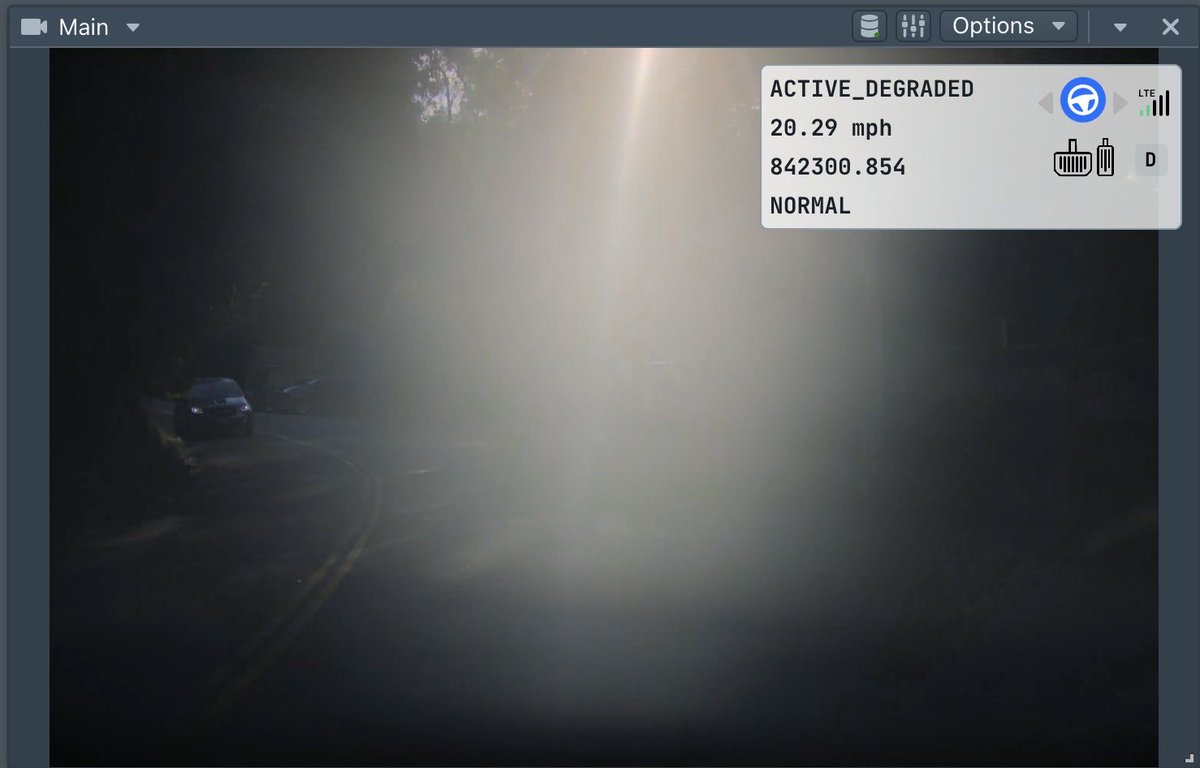
Elon Musk posted a side-by-side comparison today that stopped a lot of people mid-scroll: a standard RGB image as a human would see it, and what Tesla's AI actually processes. The difference is stark — and it explains something Tesla owners have noticed for years but couldn't quite articulate. Your car genuinely sees the road better than you do in the dark.

Tesla's official account amplified the point with a simple frame: "What you see vs what your Tesla is able to see." Here's what's actually happening under the hood.

What is photon-count reconstruction, exactly?
Traditional cameras — including the ones in most vehicles — run sensor data through an image signal processor (ISP) before it ever reaches the AI. That processor applies filters, compresses dynamic range, and converts raw light data into a standard RGB image. It's optimized for what looks good to human eyes. Tesla's approach bypasses this step entirely, feeding raw photon counts — the literal number of light particles hitting each sensor pixel — directly into its neural networks. The AI learns to interpret the world from that unfiltered data, not from a human-readable picture.
Why does skipping the image processor matter so much?
The ISP is a lossy step. When you compress raw sensor data into an RGB image, you discard information — particularly at the extremes of the brightness spectrum. A bright headlight in a dark scene will wash out surrounding detail in a standard image. Photon-count data preserves the full dynamic range, so the neural network can simultaneously resolve a pitch-black shadow and a blinding light source in the same frame. At the Q1 2025 earnings call, Musk described this as allowing FSD cameras to prevent image washout from glare and "see in what appears to be the blackest of night."
When did Tesla start doing this?
The groundwork goes back further than most people realize. In November 2021, Musk confirmed Tesla was moving toward training its vision system with "actual photon counts" and "removing the filters." The term "photon" first appeared in FSD Beta 10.8 in December 2021 in the context of photon-to-control latency. The architecture has been evolving since then — FSD (Supervised) v14.3.2, released in early May 2026, includes an upgraded neural network vision encoder specifically cited for improving performance in "rare and low-visibility scenarios."
Does this apply to all Tesla models with FSD?
The photon-count approach is tied to Tesla's neural network training pipeline and camera hardware, not a specific vehicle trim. Any Tesla running a current FSD (Supervised) build on Hardware 3 or Hardware 4 benefits from a vision system trained on raw sensor data. Hardware 4 cameras, introduced with the refreshed Model 3 and Cybertruck, offer higher resolution and improved low-light sensitivity — meaning they feed richer raw data into the same photon-aware neural networks.
What does this mean practically for night driving with FSD active?
In real-world terms: FSD can resolve pedestrians, cyclists, and road markings in conditions where a human driver — or a conventionally processed camera system — would be operating near the edge of visibility. Musk has also noted the system performs "probably slightly better than people" in fog. That's not a claim about perfection; FSD still has edge cases and regulatory scrutiny ongoing. But the underlying perceptual capability — the raw ability to detect what's in the scene — is genuinely superior to human vision in low-light and high-glare situations.

The comparison Musk posted today is a useful reminder that FSD's safety case isn't just about decision-making algorithms — it starts with perception. A system that sees more clearly in the conditions where human accidents are most likely to happen has a structural advantage that compounds as the AI matures. For owners using FSD on night commutes or in heavy rain, that foundation is already working in the background every time you drive.

Sarah focuses on Tesla Energy, SpaceX missions, and the broader Musk AI portfolio. Former data analyst in clean energy. Based in San Francisco.
Sources verified at publish time. Spotted an inaccuracy? Email editorial@basenor.com.