📌 UPDATE — May 9, 2026
New details have emerged from Elon Musk's visit to Intel's D1D/D1X fab in Hillsboro, Oregon: Musk shared a photo alongside Intel CEO Lip-Bu Tan, with the two notably holding an Optimus robot head — a striking visual signal that Tesla's humanoid robotics program may now be part of the broader Intel collaboration. While the original Terafab announcement centered on Tesla EVs and SpaceX, the Optimus prop strongly hints at chip discussions extending into robotics AI inference hardware. No official statement has been made about an Optimus-specific chip deal, but the optics suggest the partnership's scope could be wider than initially disclosed. 🔍

📸 via @TeslaNewswire · May 9, 2026
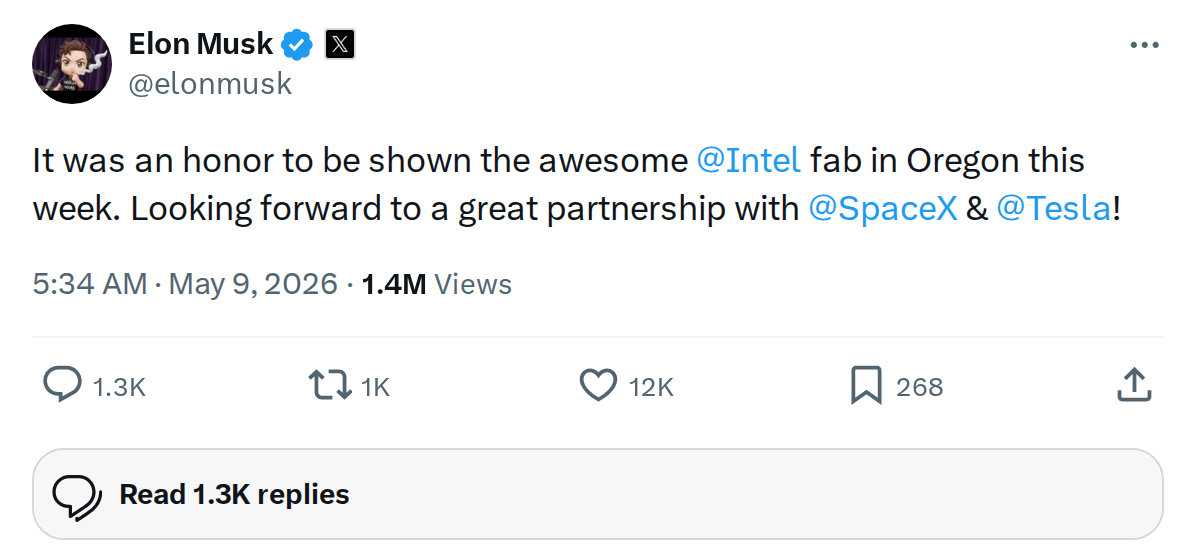
Elon Musk visited Intel's semiconductor fabrication facility in Oregon this week and publicly confirmed a coming partnership between Intel, Tesla, and SpaceX — a collaboration that turns out to be far more structured than a casual factory tour. The project at the center of it, called Terafab, is a joint initiative to build a dedicated chip fab in Austin, Texas, aimed at producing the next generation of processors for autonomous driving, humanoid robotics, and space-based computing.

What Terafab Actually Is
Terafab isn't a vague memorandum of understanding — it's a concrete manufacturing initiative involving Tesla, SpaceX, xAI, and now Intel, with a stated goal of establishing a chip fabrication plant in Austin, Texas. The facility is designed to design, fabricate, and package ultra-high-performance semiconductors at scale, targeting an annual output of one terawatt of computing power.
Intel CEO Lip-Bu Tan described the collaboration as a "step change in how silicon logic, memory, and packaging will get built in the future." Intel's role centers on its expertise in advanced chip fabrication and packaging — specifically its 14A process node, which Musk has confirmed will be used for xAI's next-generation AI chips.
Two Chips, Two Missions
The partnership has produced two distinct chip programs, each targeting a different part of Musk's empire:
AI5 — An edge-inference processor built for Tesla's autonomous driving stack. According to reports, Tesla claims the AI5 delivers a 50x performance improvement over the current AI4 chip. It's intended to power the Cybercab fleet and the Optimus humanoid robot program. Roughly 20% of Terafab's total output will be allocated to AI5 and its successor, AI6.
D3 — A radiation-hardened processor engineered for deployment inside SpaceX's satellite constellations. The D3 is designed to support xAI's orbital data centers, bringing AI compute directly into low Earth orbit. The remaining 80% of Terafab's capacity is earmarked for space-based applications using this chip.
Why This Matters for Tesla Owners
The AI5 chip is the most directly relevant development for anyone driving a Tesla today. The current AI4 hardware — present in vehicles built from late 2023 onward — is already capable of running Full Self-Driving. A 50x leap in edge-inference performance would represent a generational shift in what the onboard computer can process in real time, with implications for FSD reaction speed, scene understanding, and the eventual Robotaxi network's reliability at scale.
The Oregon fab visit this week signals that the partnership is moving from announcement to execution. Musk's framing — "looking forward to a great partnership" — suggests the formal groundwork is in place and manufacturing timelines are being worked through. For context, Intel officially joined the Terafab project in early April 2026, making this week's visit a follow-on step in an already-confirmed relationship.
The bigger picture here is vertical integration at an unprecedented scale. Tesla already designs its own chips in-house; pairing that capability with Intel's fabrication infrastructure and the shared demand from SpaceX and xAI creates a supply chain that none of these companies could build as efficiently on their own. Whether Terafab's Austin facility delivers on its terawatt-scale ambitions on schedule is the question that will define how quickly the AI5 reaches production vehicles.

Sarah focuses on Tesla Energy, SpaceX missions, and the broader Musk AI portfolio. Former data analyst in clean energy. Based in San Francisco.
Sources verified at publish time. Spotted an inaccuracy? Email editorial@basenor.com.