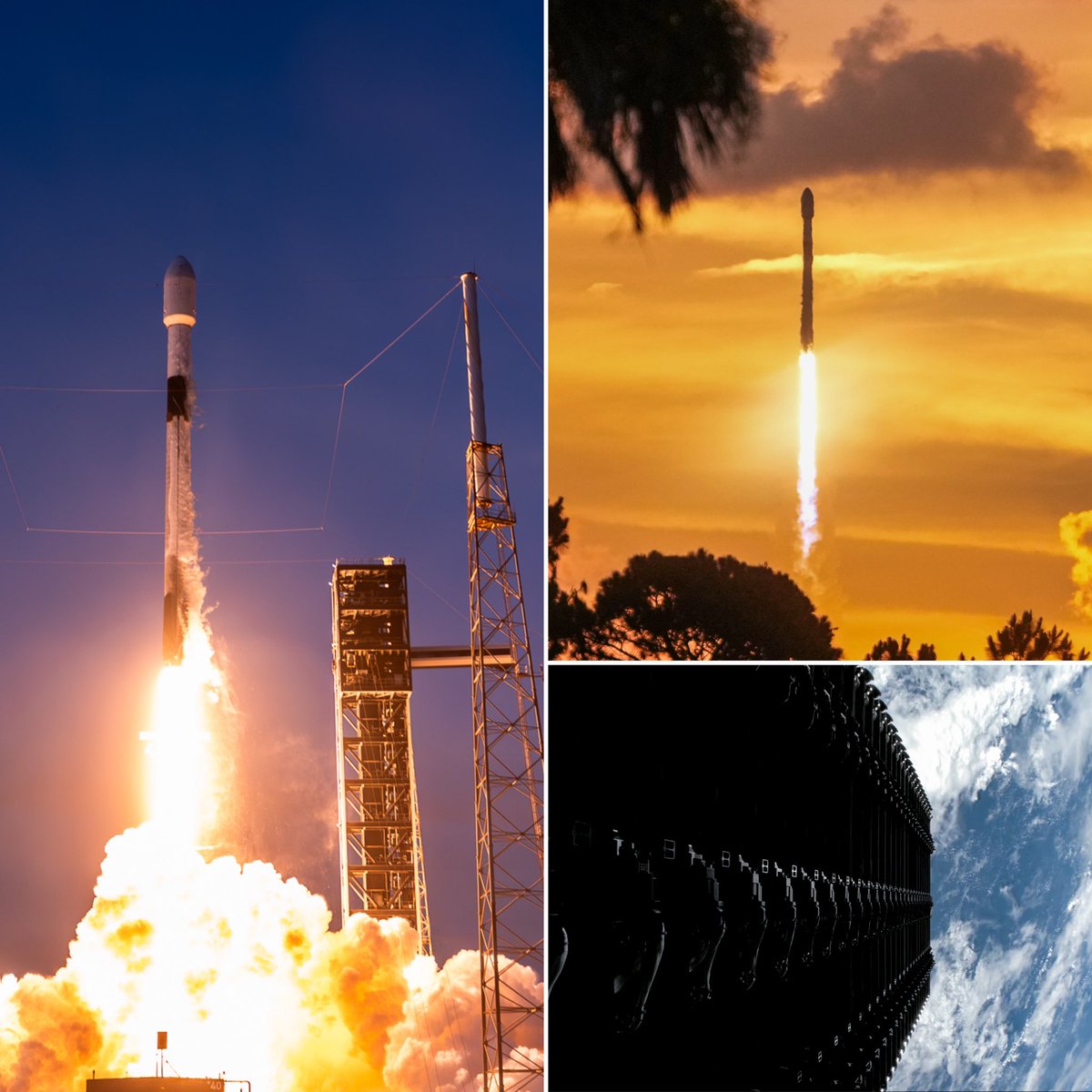
SpaceX pulled off back-to-back Falcon 9 launches from opposite coasts in under 19 hours this week — a quiet but telling demonstration of just how routine high-frequency orbital operations have become for the company.

The first rocket lifted off on June 3 at 11:40 a.m. EDT from Vandenberg Space Force Base in California, carrying 24 Starlink satellites. Its booster — on its 15th flight — landed cleanly on the droneship Of Course I Still Love You. Less than 19 hours later, a second Falcon 9 launched from Cape Canaveral at 6:26 a.m. EDT on June 4, deploying 29 more Starlink satellites before its booster (11th flight) touched down on A Shortfall of Gravitas. Combined, the two missions added 53 satellites to a constellation that now counts over 10,500 active spacecraft in low-Earth orbit.
These were SpaceX's 63rd and 64th Falcon 9 launches of 2026. For context, the company completed 165 missions across all of 2025 — itself a record — and is on pace to surpass that this year. A single booster reached its 33rd flight as recently as February, and the Falcon family is now averaging a launch roughly every two days. The Department of the Air Force has also agreed to increase SpaceX's annual launch cadence at Vandenberg, signaling that the operational ceiling is still rising.
The 19-hour gap between missions isn't just a logistical footnote. It reflects a supply chain, recovery operation, and launch range infrastructure that has been quietly optimized over years to treat orbital launches more like airline departures than Apollo-era events. Whether that pace continues to accelerate — and what it means for Starlink's coverage ambitions — will be worth watching through the rest of 2026. Follow our SpaceX coverage for the latest.
Sources & reporting notes
The links below identify the material source records used for this report.
- @elonmusk on X (2026-06-06T14:20:06.000Z) — Direct source
Source links are preserved as published or accessed. See our editorial standards and corrections policy.
The BASENOR Editorial Desk covers Tesla, SpaceX, and related technology, curating reporting from primary sources — official accounts, regulatory filings, and software release data. Every article passes source-record and fact-checking review before publication. About the newsroom.
This report was curated by the BASENOR Editorial Desk from the sources listed above. Read our editorial standards or email editorial@basenor.com to report an error.