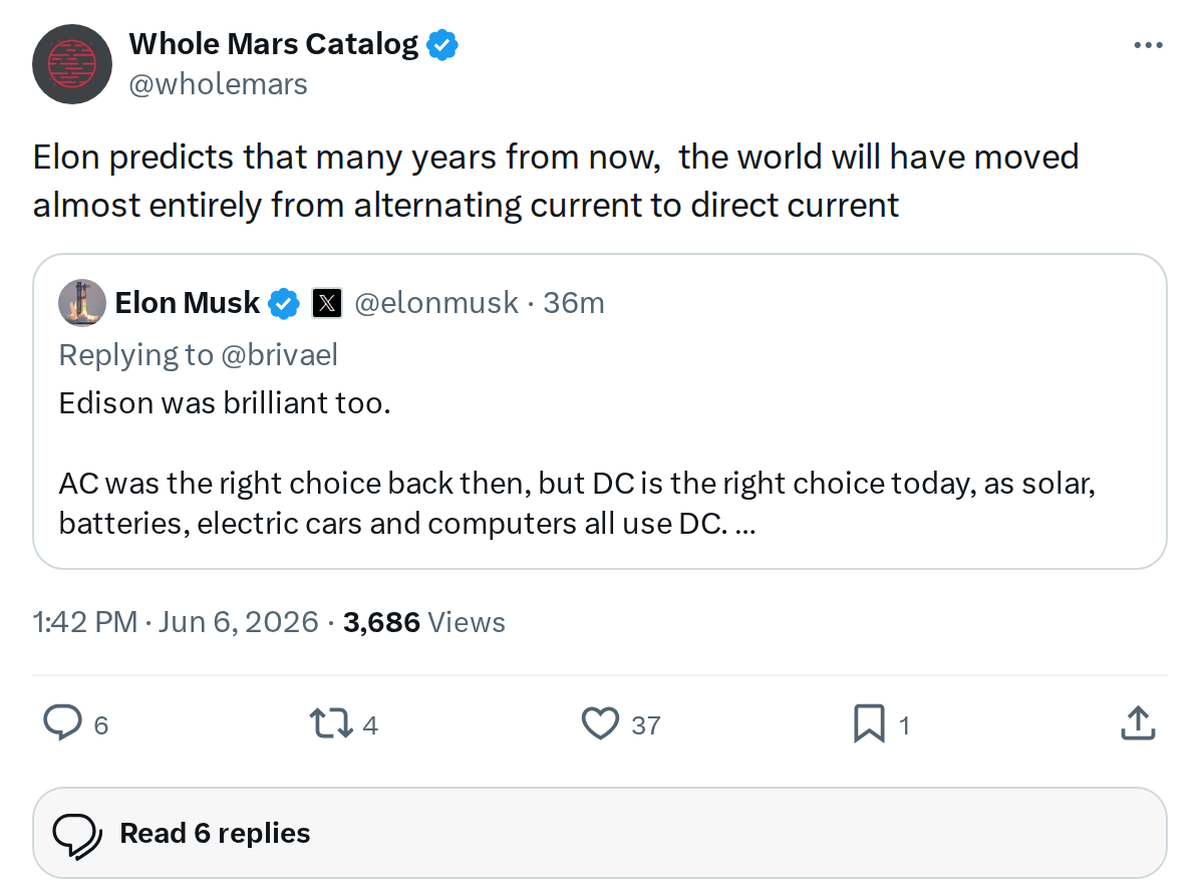
Elon Musk has made a bold long-range prediction: the global energy grid will eventually abandon alternating current in favor of direct current. The forecast, shared by @wholemars, isn't a near-term roadmap item — Musk frames it as a generational shift playing out over many years. But coming from someone whose companies are actively reshaping how the world generates and consumes electricity, it's worth taking seriously.

The AC vs. DC debate is older than Tesla the company — it goes back to the War of Currents between Edison and Westinghouse in the 1880s. AC won that battle because it could be stepped up to high voltages for long-distance transmission and then stepped back down for home use, something DC couldn't do efficiently at the time. That physics hasn't changed, but the economics and technology around it have shifted dramatically. Solar panels generate DC. EV batteries store DC. Modern power electronics — inverters, converters, rectifiers — have become cheap and efficient enough that the conversion losses between AC and DC are no longer the decisive factor they once were.
Musk's own companies are already deep in DC-native infrastructure. Tesla vehicles run entirely on DC. Powerwall and Megapack store DC. Solar installations generate DC before an inverter converts it for household use — a conversion step that, in a DC-native home or building, would simply disappear. xAI's data centers, which consume enormous amounts of power, are also candidates for DC distribution architectures that reduce conversion losses at scale. According to background research, Musk has warned that global electricity demand may need to triple by approximately 2045 to support AI and EV growth — a target that makes every percentage point of transmission efficiency matter.
The prediction is speculative by design. Rewiring the world's grid infrastructure is a multi-decade, multi-trillion-dollar undertaking, and AC transmission still holds real advantages for moving power over long distances. High-voltage DC transmission lines do exist and are growing, particularly in China and Europe, but they connect AC grids at either end rather than replacing them. A true end-to-end DC world would require rethinking substations, building codes, appliance standards, and utility regulation simultaneously. Musk is describing a destination, not a timetable.
For Tesla owners, the practical relevance is already visible in miniature: your car, your home battery, and your solar panels are all DC devices living inside an AC world. Every charge cycle involves at least one conversion. If Musk's long-run vision holds, that friction eventually goes away — and the efficiency gains compound across every device in the ecosystem.
Sources & reporting notes
The links below identify the material source records used for this report.
- @wholemars on X (2026-06-06T05:42:46.000Z) — Direct source
Source links are preserved as published or accessed. See our editorial standards and corrections policy.
The BASENOR Editorial Desk covers Tesla, SpaceX, and related technology, curating reporting from primary sources — official accounts, regulatory filings, and software release data. Every article passes source-record and fact-checking review before publication. About the newsroom.
This report was curated by the BASENOR Editorial Desk from the sources listed above. Read our editorial standards or email editorial@basenor.com to report an error.