
⚡ 30-Second Brief
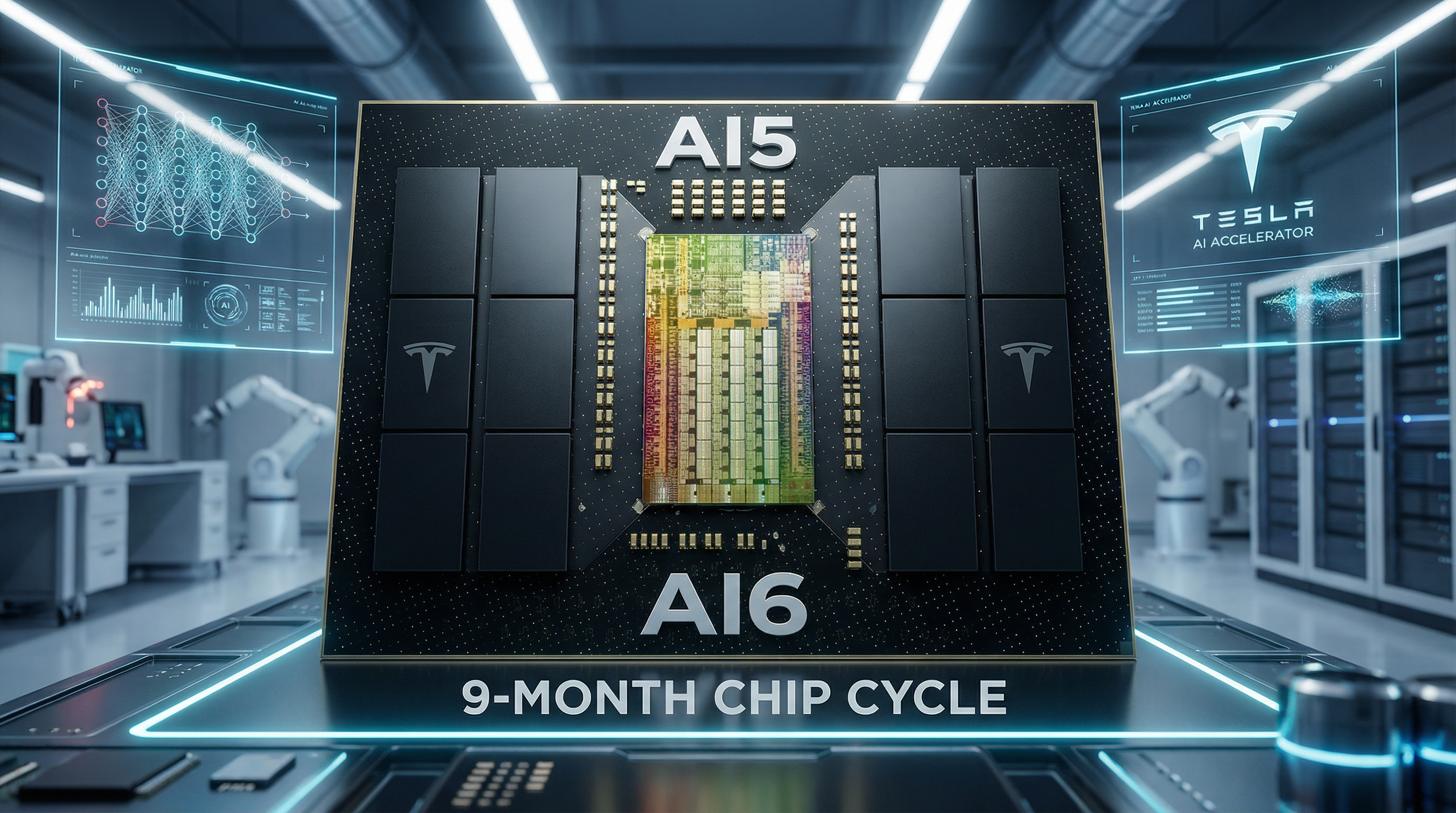
- The News: Elon Musk detailed Tesla's ambitious 9-month silicon development cycle, targeting rapid advancements from AI5 to AI6 and hinting at space-based AI compute.
- Why It Matters: This aggressive timeline underscores Tesla's commitment to leading AI hardware, directly impacting the future capabilities and rollout of FSD and Optimus.
📊 Key Figures
| Metric | Value | Context |
|---|---|---|
| Chip Development Cycle | 9 months | Musk's target for future AI hardware iterations (e.g., AI5, AI6). |
| Current AI Chip | AI5 (in development) | The next generation of Tesla's custom AI silicon. |
| Future AI Chip | AI6 (strategic focus) | The long-term goal, potentially integrating multiple AI6 SoCs. |
🔭 The Basenor Take
- Timeline: In Progress (Aggressive development cycle for AI hardware)
- Impact Level: 🔴 High
What This Means for You: Tesla's relentless pursuit of custom AI silicon is a direct investment in the future of FSD and other AI-driven features in your vehicle. A 9-month chip cycle means your Tesla's capabilities could evolve at an unprecedented pace, with each new chip generation unlocking more sophisticated autonomous driving, better infotainment, and potentially faster processing for future features like Optimus integration. While current owners won't receive hardware upgrades with every chip iteration, this rapid development ensures the underlying technology that powers Tesla's software, including your FSD subscription, is always at the bleeding edge. It signals a future where your Tesla's intelligence is not just software-defined, but hardware-accelerated to an extreme degree, eventually leading to more robust and reliable autonomous features.
🗣️ Community Pulse
Community discussions are still developing around this news. Past sentiment on Reddit has shown both excitement and skepticism regarding Tesla's ambitious AI hardware roadmap. There's a clear understanding that the in-car compute (like HW3 and HW4) is distinct from the training compute (Dojo), though there's speculation about how these might converge or leverage each other. Recent discussions also highlight the evolution of Dojo, with hints that Dojo 2 was an 'evolutionary dead end' and that Dojo 3 might involve multiple AI6 SoCs. The community acknowledges Tesla's continuous efforts in custom silicon development, from AI3 to AI5, and sees the necessity of this compute for FSD and future robotaxi networks, even considering scenarios where cars perform inference jobs while charging.
📰 Deep Dive
Elon Musk recently outlined Tesla's ambitious strategy for AI hardware development, targeting an aggressive nine-month cycle for new chip generations. This accelerated timeline is a testament to the company's commitment to leading in artificial intelligence, with specific mentions of the upcoming AI5 and the strategic focus on AI6. This rapid iteration is crucial for powering Tesla's burgeoning AI initiatives, including the full self-driving (FSD) stack and the Optimus humanoid robot.
The move towards a faster chip development cycle is not merely about incremental improvements; it represents a fundamental shift in how Tesla intends to maintain its technological edge. By designing its own custom silicon, Tesla can optimize hardware specifically for its AI models and workloads, ensuring maximum efficiency and performance. This tight integration between hardware and software is a hallmark of industry leaders and is expected to unlock significant advancements in FSD's capabilities, moving closer to true Level 5 autonomy.
Musk also alluded to the future of AI beyond ground-based operations, hinting at space-based AI. While details remain scarce, this futuristic vision underscores Tesla's long-term aspirations to push the boundaries of artificial intelligence. The rapid development of chips like AI5 and AI6 is foundational to these larger goals, providing the necessary computational power for both immediate applications in vehicles and more speculative, long-range projects.
This aggressive hardware roadmap comes amidst ongoing evolution within Tesla's AI infrastructure, including the strategic adjustments to the Dojo supercomputer program. The focus on AI5 and AI6 signals a clear direction for Tesla's in-house silicon, emphasizing rapid innovation to support its expanding AI ecosystem.


