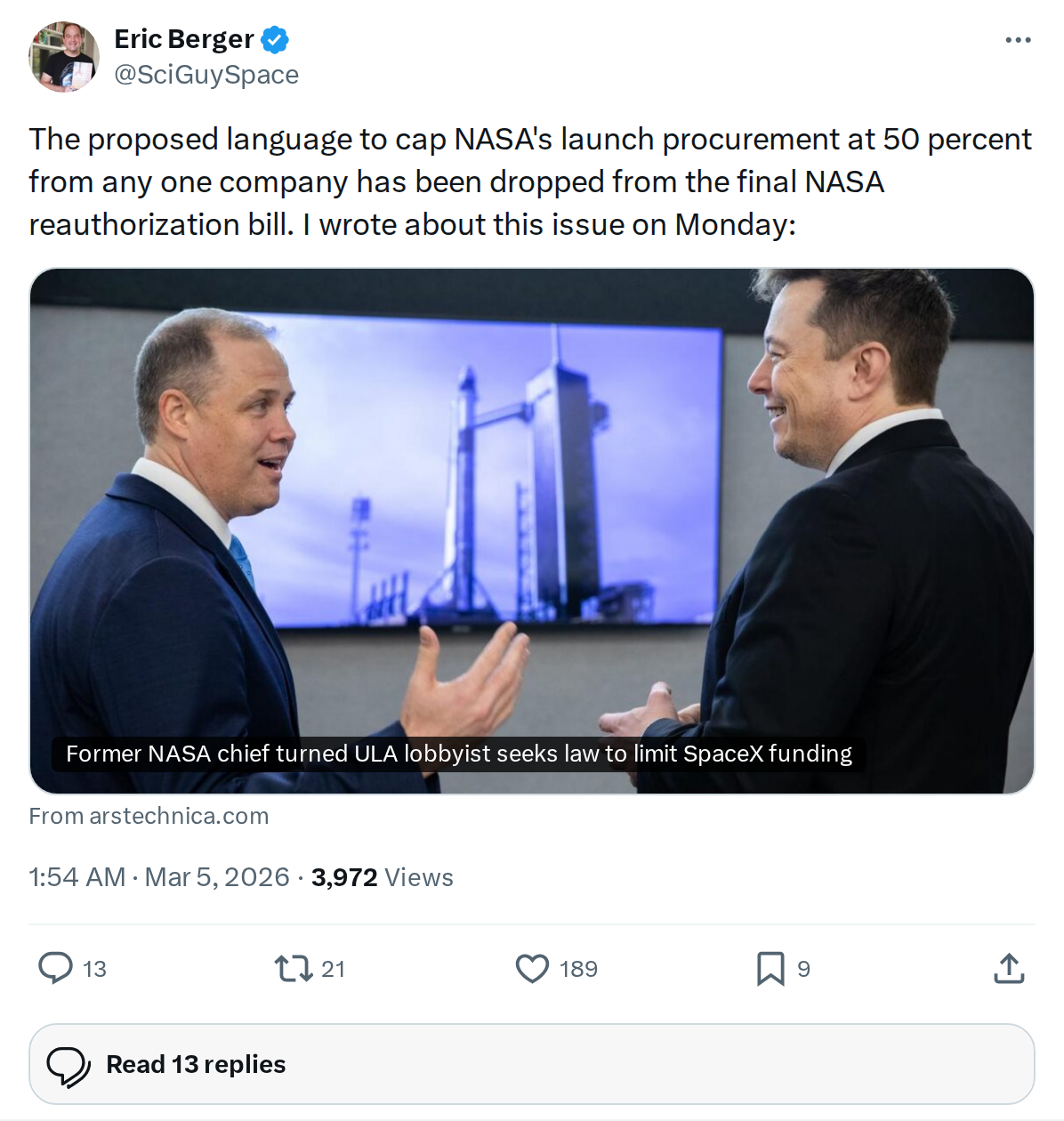
The News: The proposed language to cap NASA's launch procurement at 50% from any single company has been dropped from the final NASA reauthorization bill.
Why It Matters: The cap was widely understood to target SpaceX, which currently holds the dominant share of NASA launch contracts — including the only certified vehicle for crewed ISS missions. Its removal preserves SpaceX's ability to compete freely for future NASA business.
Source: @SciGuySpace (Eric Berger) on X
The Proposed Cap — And Why It Was Controversial
For months, Section 313 of the Senate's proposed NASA Authorization Act of 2026 (S. 933) contained a provision that would have capped any single launch provider at 50% of NASA's total launch contract value. On the surface, the language was framed as a pro-competition measure. In practice, critics argued it was a direct shot at SpaceX.
The timing was hard to ignore. SpaceX is currently the only provider certified to fly both crew and cargo to the International Space Station for NASA. Imposing a 50% cap in 2026 would have forced NASA to either reduce its reliance on the only vehicle it can actually use for crewed missions, or face a legislative compliance problem with no viable workaround.
Advocacy for the cap came from notable corners of the aerospace lobbying world. Former NASA Administrator Jim Bridenstine — now a lobbyist for United Launch Alliance (ULA) through the Artemis Group — publicly backed the provision, arguing it would reinforce competition and protect the broader U.S. space industrial base. ULA, which competes directly with SpaceX for government launch contracts, stood to benefit directly from any constraint on SpaceX's market share.

What Changed in the Final Bill
According to Eric Berger — one of the most reliable reporters covering the U.S. space industry — the cap language has been dropped from the final version of the NASA reauthorization bill. The Senate Committee on Commerce, Science, and Transportation is currently holding an Executive Session to consider the NASA Authorization Act of 2026, and the procurement cap did not survive into the final text.
The House version of the bill (H.R. 7273), which passed the House Science, Space, and Technology Committee unanimously on February 4, 2026, had already embraced a more commercially flexible approach — emphasizing NASA's ability to procure services across crew and cargo transport, deep space destinations, and commercial space stations without hard market-share constraints.
The removal of the Senate cap aligns the two chambers more closely and clears a significant hurdle for the bill's path to passage.
📊 Key Figures
| Metric | Value | Context |
|---|---|---|
| Proposed procurement cap | 50% | Max share from any single provider — now removed |
| House bill approval | Feb 4, 2026 | Unanimous committee vote; no cap language included |
| NASA share of SpaceX revenue (2026 est.) | <5% | Per Elon Musk, Feb 2026; Starlink is largest contributor |
| Certified ISS crew/cargo providers | 1 | SpaceX is currently the only NASA-certified option for crewed missions |
🔭 The BASENOR Take
Timeline: Senate Executive Session underway — March 4, 2026
Impact Level: 🟠 Medium-High — Significant for U.S. space policy and SpaceX's long-term government business
Confidence: High — Reported by Eric Berger, a primary source with a strong track record covering NASA and SpaceX
What to Watch: Whether the full bill passes committee and advances to a floor vote; any renewed attempts to reintroduce competitive procurement constraints in amendments
📰 Deep Dive
The fight over the 50% cap was really a proxy war over a bigger question: should Congress be in the business of engineering market outcomes in the commercial space sector? Supporters of the cap framed it as protecting competition. But competition requires viable competitors — and right now, for crewed NASA missions, there is effectively one certified option. Legislating a cap doesn't create a second provider; it just constrains the one that exists.
It's worth noting the scale of what's actually at stake for SpaceX here. Elon Musk stated as recently as February 2026 that NASA contracts represent less than 5% of SpaceX's total revenue, with Starlink's commercial business dwarfing government work. So while the cap's removal is a win for SpaceX's government relations, it's not existential either way — SpaceX's business model has long since diversified beyond NASA dependency.
The more consequential angle is what this signals for U.S. space policy direction. The House bill's unanimous approval and its embrace of commercial flexibility, combined with the Senate now dropping the cap language, suggests a legislative consensus is forming around letting NASA buy the best available service rather than mandating artificial market balance. That approach has historically produced faster timelines and lower costs — the Commercial Crew program being the clearest example.
For the broader space industry, the bill's trajectory matters beyond SpaceX. A NASA reauthorization that passes cleanly and without market-distorting procurement rules gives the agency clearer authority to engage commercial partners for deep space missions, lunar logistics, and post-ISS commercial station transitions. That's a rising tide with implications well beyond any single launch provider. Follow our SpaceX coverage for updates as the bill advances.
Sources & reporting notes
The links below identify the material source records used for this report.
- @SciGuySpace on X (2026-03-04T17:54:29.000Z) — Direct source
Source links are preserved as published or accessed. See our editorial standards and corrections policy.
The BASENOR Editorial Desk covers Tesla, SpaceX, and related technology, curating reporting from primary sources — official accounts, regulatory filings, and software release data. Every article passes source-record and fact-checking review before publication. About the newsroom.
This report was curated by the BASENOR Editorial Desk from the sources listed above. Read our editorial standards or email editorial@basenor.com to report an error.