📌 UPDATE — March 24, 2026
NASA has now unveiled a detailed, multi-phase Moon Base architecture with a full mission manifest spanning Phase 1, 2, and 3 — giving the clearest picture yet of how a permanent lunar presence will be built out. Notably, the Gateway lunar outpost appears to have undergone a significant strategic pivot, with NASASpaceflight summarizing the situation as "Gateway is dead, long live Gateway" — suggesting a major redesign or rebranding of the program rather than outright cancellation. The new architecture also introduces lunar drones as a key surface mobility and operations technology, an unexpected addition to the Moon Base toolkit. Each phase of the manifest carries direct implications for SpaceX Starship, which remains the primary human landing system and heavy cargo vehicle underpinning these increasingly ambitious surface operations.


Source: @NASASpaceflight · March 24, 2026
30-Second Brief
The News: A NASA post-event press conference has revealed dedicated program executives for both a 'Moon Base' initiative and a 'Fission Surface Power' program — signaling that lunar infrastructure planning has moved well beyond concept phase.
Why It Matters: SpaceX Starship is NASA's designated Human Landing System for Artemis missions, meaning every step toward a permanent lunar base is a direct milestone for SpaceX — and for the long-term roadmap Elon Musk has staked Tesla's energy and autonomy ambitions on.
Source: @NASASpaceflight on X
NASA Names Program Executives for Moon Base and Nuclear Surface Power
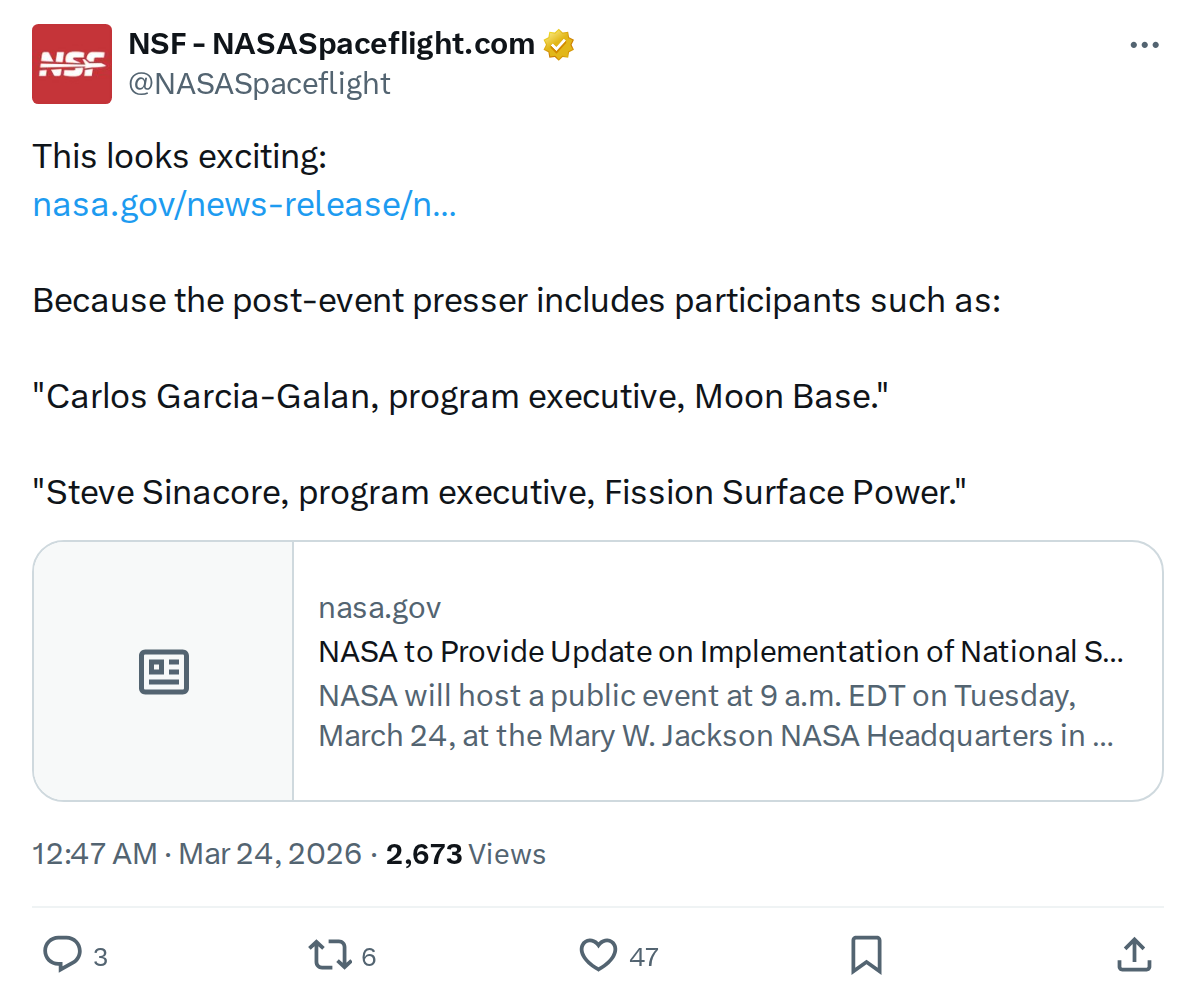
It is one thing for NASA to talk about returning to the Moon. It is another thing entirely to assign named program executives to a project called 'Moon Base.' That is exactly what a post-event press conference agenda — flagged by NASASpaceflight.com — has revealed, and the implications for SpaceX's Starship program are hard to overstate.

The press conference participant list names Carlos Garcia-Galan as program executive for Moon Base, and Steve Sinacore as program executive for Fission Surface Power. These are not advisory roles or working-group titles — these are operational program leads. NASA does not create those positions for programs that exist only on a whiteboard.
🔭 The BASENOR Take
| Signal | What It Tells Us |
|---|---|
| Named Program Executives | Moon Base has moved from concept to active program management inside NASA |
| Fission Surface Power | Nuclear power on the lunar surface is now a named, staffed program — not a research idea |
| Artemis + Starship Link | SpaceX Starship is NASA's contracted Human Landing System; lunar base progress = Starship demand |
| 2030 Infrastructure Target | The US aims for early permanent Moon base infrastructure by 2030 under Artemis — this staffing aligns with that timeline |
Impact Level: 🟡 Medium-term | Confidence: High (named officials confirmed via press conference agenda) | Timeline: 2026–2030
Why Fission Surface Power Changes Everything
The inclusion of a dedicated Fission Surface Power executive is arguably the more significant detail here. Solar power on the lunar surface is severely limited — the Moon's poles, where water ice exists and where any permanent base would logically be sited, experience long periods of darkness. Nuclear fission is the only power source that can reliably sustain a permanent crew and the energy-intensive systems a real base requires: life support, communications, in-situ resource utilization (ISRU), and propellant production.
Propellant production is the critical link to SpaceX. Starship's architecture depends on the ability to refuel in space or on planetary surfaces. A lunar base with fission power capable of producing propellant from lunar water ice would transform Starship from a point-to-point Earth-Moon vehicle into a genuine deep-space platform — the stepping stone to Mars that Elon Musk has publicly described as SpaceX's core mission.
SpaceX Starship's Role in the Lunar Base Pipeline
NASA selected SpaceX's Starship as the Human Landing System (HLS) for the Artemis program. That contract means Starship is the vehicle that will deliver astronauts — and eventually cargo — to the lunar surface for any Moon Base program. As NASA formalizes its Moon Base organizational structure, Starship's mission manifest becomes more concrete, not less.
For SpaceX, a permanent lunar base is not just a government contract — it is validation of the entire Starship development thesis. Every Starship test flight, every Mechazilla catch, every incremental improvement to the vehicle's heat shield and propellant systems is building toward this operational requirement. The appointment of a Moon Base program executive at NASA is, in effect, a signal that the customer is getting serious about placing orders.
You can follow our ongoing SpaceX coverage for the latest on Starship's development and its intersection with NASA's lunar ambitions.
What We Don't Know Yet
The NASASpaceflight tweet is a signal, not a full briefing. The press conference itself will contain the substance — specific program timelines, budget allocations, contractor selections, and technical milestones. Until that information is public, the key facts are: NASA has named program leads for Moon Base and Fission Surface Power, and those names appeared on an official press conference agenda. That is a meaningful organizational step, but the details that matter most — schedule, funding, and Starship's specific role in the build-out — are still to come.
📰 Deep Dive
The framing of 'Moon Base' as a named NASA program with an assigned executive is a bureaucratic signal that carries real weight. In large government agencies, program executive roles are created when leadership has committed resources and intends to deliver. The parallel appointment of a Fission Surface Power executive suggests NASA is treating power infrastructure as a co-equal priority to habitat — which makes engineering sense, since without reliable power, no base can function.
For the broader SpaceX ecosystem, this matters beyond Starship contracts. Elon Musk has consistently framed SpaceX's lunar and Mars ambitions as the long-term strategic rationale for the company's existence. A NASA that is actively organizing around Moon Base construction is a NASA that needs Starship to work — and work at scale. That alignment of government intent with SpaceX's commercial roadmap is exactly the kind of institutional momentum that accelerates timelines and unlocks funding.
The Fission Surface Power angle also has an indirect relevance to Tesla's energy business. The engineering challenges of deploying reliable power in extreme, resource-constrained environments — whether on the lunar surface or in remote terrestrial locations — push the boundaries of energy storage and distribution technology. The cross-pollination between NASA's lunar power research and terrestrial energy innovation has historically produced real-world applications, and that dynamic is unlikely to change as these programs mature.

Sarah focuses on Tesla Energy, SpaceX missions, and the broader Musk AI portfolio. Former data analyst in clean energy. Based in San Francisco.
Sources verified at publish time. Spotted an inaccuracy? Email editorial@basenor.com.