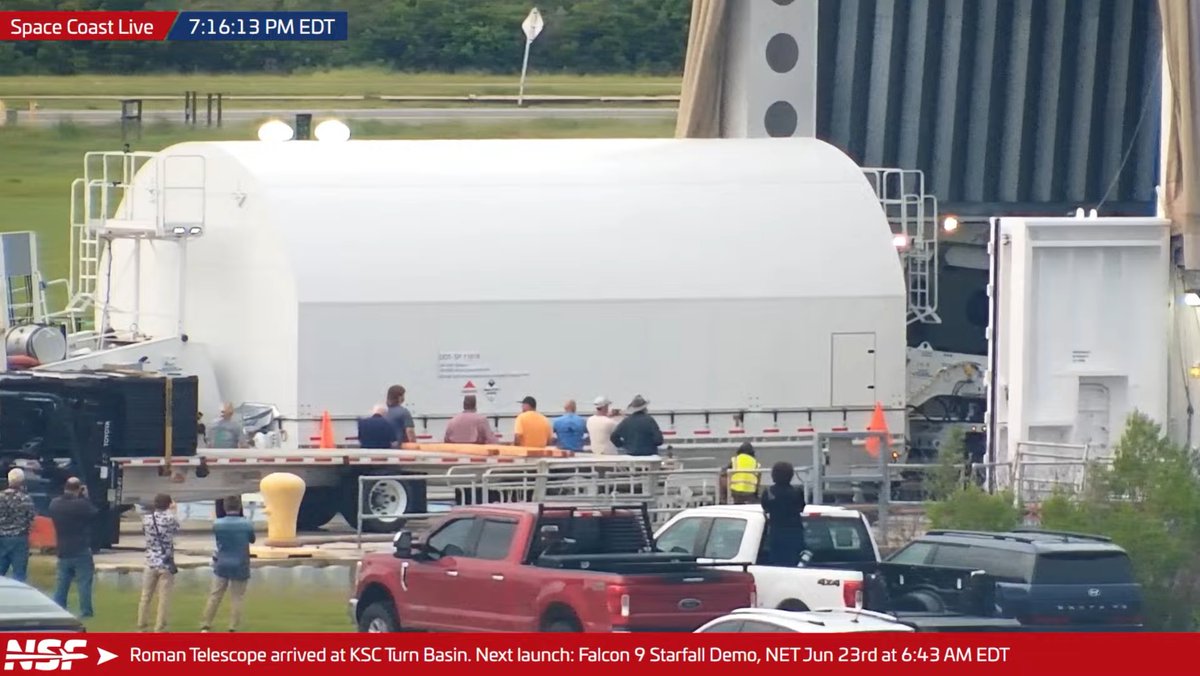
NASA's Nancy Grace Roman Space Telescope touched down at Kennedy Space Center on June 21, 2026, marking the start of its final prelaunch countdown. The observatory — arriving via NASA's Pegasus barge from Goddard Space Flight Center in Maryland — is now inside the Payload Hazardous Servicing Facility (PHSF), where technicians will prepare it for liftoff aboard a SpaceX Falcon Heavy no earlier than August 30, 2026.

The telescope weighs roughly 8,000 kilograms dry — growing to about 10,500 kg once approximately 290 gallons of hydrazine propellant are loaded. That fuel load is notable: according to NASA, the propellant supply is sized to support at least twice the planned five-year primary mission lifetime, meaning Roman could operate well into the 2040s if hardware holds up. The PHSF itself recently underwent upgrades specifically to accommodate the observatory's size and hazardous fueling requirements.
The August 30 target date represents a meaningful acceleration. Earlier projections had placed the launch as late as May 2027, so the current schedule reflects real momentum in the program. The launch services contract — covering the Falcon Heavy ride from Launch Complex 39A and mission-related expenses — totals approximately $255 million, according to NASA.

Next up for the team at KSC: removing the protective transport container cover, moving Roman into the PHSF high bay, and positioning it on its work platform. From there, the months-long processing campaign — including fueling and final checkouts — will run toward the late-August window. If the schedule holds, Falcon Heavy will carry one of the most powerful space observatories ever built into orbit, with a mission designed to map the universe's dark energy and image billions of galaxies in a single wide field of view.
Sources & reporting notes
The links below identify the material source records used for this report.
- @NASASpaceflight on X (2026-06-21T23:16:28.000Z) — Direct source
- @NASASpaceflight on X (2026-06-21T23:16:29.000Z) — Direct source
Source links are preserved as published or accessed. See our editorial standards and corrections policy.
The BASENOR Editorial Desk covers Tesla, SpaceX, and related technology, curating reporting from primary sources — official accounts, regulatory filings, and software release data. Every article passes source-record and fact-checking review before publication. About the newsroom.
This report was curated by the BASENOR Editorial Desk from the sources listed above. Read our editorial standards or email editorial@basenor.com to report an error.