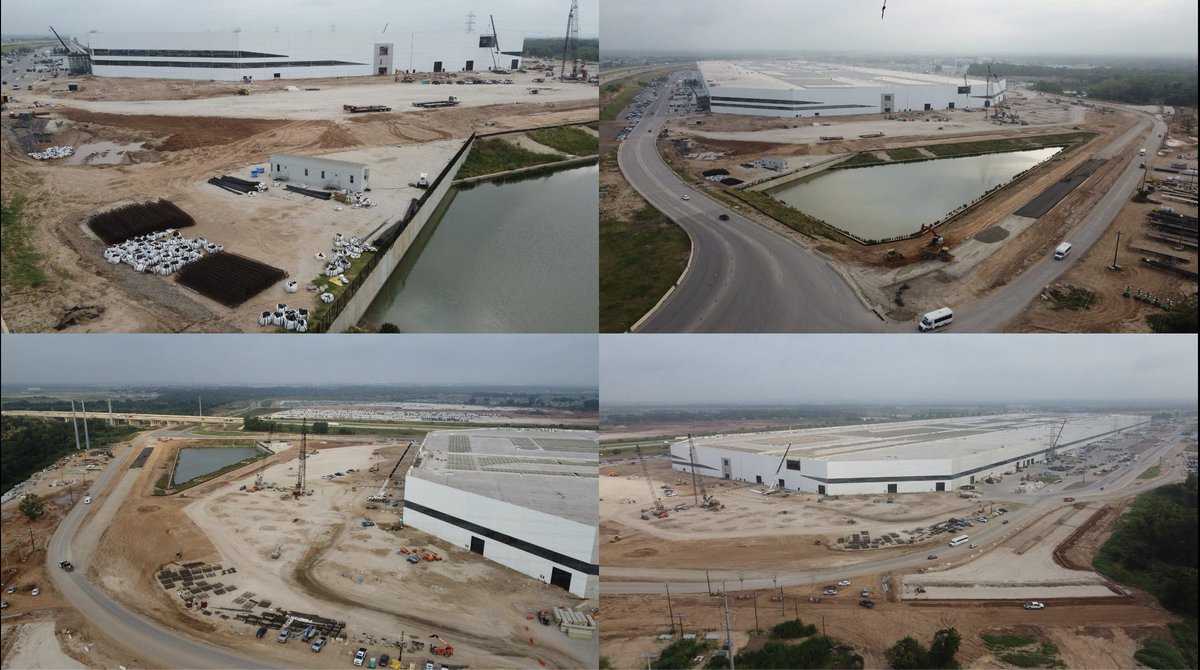
Three years ago this week, Giga Texas was just getting its footing — a sprawling new factory on the outskirts of Austin cranking out its first Model Y units. Today, aerial observer Joe Tegtmeyer shared a side-by-side look at the site that makes the transformation impossible to ignore: the factory footprint has exploded, construction cranes haven't left, and the ambitions attached to this address have grown far beyond anything Tesla originally announced at the April 2022 "Cyber Rodeo" opening.

How Far It's Actually Come
The numbers tell a story that aerial photos can only hint at. By May 2023 — just over a year into full production — Giga Texas was building 5,000 Model Y vehicles per week. The factory subsequently hit a single-week record of 10,000 Model Y units and has been targeting 12,500 per week. On the cumulative side, the plant rolled out its 400,000th vehicle in April 2025 and crossed 500,000 total units — Model Y and Cybertruck combined — by October 2025.
Cybertruck added a new dimension entirely. Limited production began in 2023, with customer deliveries launching on November 30 of that year. Since then, Cybertruck volumes have ramped considerably, turning Giga Texas into a dual-line operation that no other Tesla factory currently replicates.
The 4680 battery cell program, which sits inside the same campus, produced its 10 millionth cell by mid-2023. As recently as June 17, 2026 — just four days before Tegtmeyer's post — concrete work for the next phase of the 4680 factory buildout was actively underway, according to on-site observations.
The Expansion That Changes Everything
What makes the current construction pace notable isn't just scale — it's what's being built. Tesla filed detailed site plans with Travis County on March 24, 2026, projecting more than 5.2 million square feet of new industrial space to be added by the end of this year. That's not a long-term vision document; that's an active construction schedule.
The most consequential piece is the Terafab North Campus — a joint semiconductor fabrication venture between Tesla, SpaceX, and xAI with a projected cost of $20–25 billion. The facility is focused on 2-nanometer AI chip production, with first silicon targeted for early 2027. The initial phase alone covers 2 million square feet dedicated to research, development, and fabrication.
In other words, Giga Texas is no longer just a car factory. It's becoming the physical infrastructure for Tesla's AI and energy ambitions — a campus where vehicles, batteries, and the chips that will eventually run autonomous systems are all produced under one expanding roof.
What Three Years Actually Means
When Tegtmeyer posts a three-year comparison photo and notes that "massive construction continues today," it's worth sitting with that observation. Most factories reach a steady state — they build out, staff up, and settle into a production rhythm. Giga Texas hasn't done that. The site plans filed this spring suggest it won't for years to come.
For Tesla owners, the practical implication is that the vehicles rolling off this line — and the technology being developed on this campus — will continue to evolve faster than any single factory snapshot can capture. The three-year mark is less a milestone to celebrate than a checkpoint on a trajectory that's still accelerating.
Related Gear
Gear up your Model Y with tested, custom-fit BASENOR accessories — shop Model Y accessories →
Sources & reporting notes
The links below identify the material source records used for this report.
- @JoeTegtmeyer on X (2026-06-21T22:03:14.000Z) — Direct source
Source links are preserved as published or accessed. See our editorial standards and corrections policy.
The BASENOR Editorial Desk covers Tesla, SpaceX, and related technology, curating reporting from primary sources — official accounts, regulatory filings, and software release data. Every article passes source-record and fact-checking review before publication. About the newsroom.
This report was curated by the BASENOR Editorial Desk from the sources listed above. Read our editorial standards or email editorial@basenor.com to report an error.