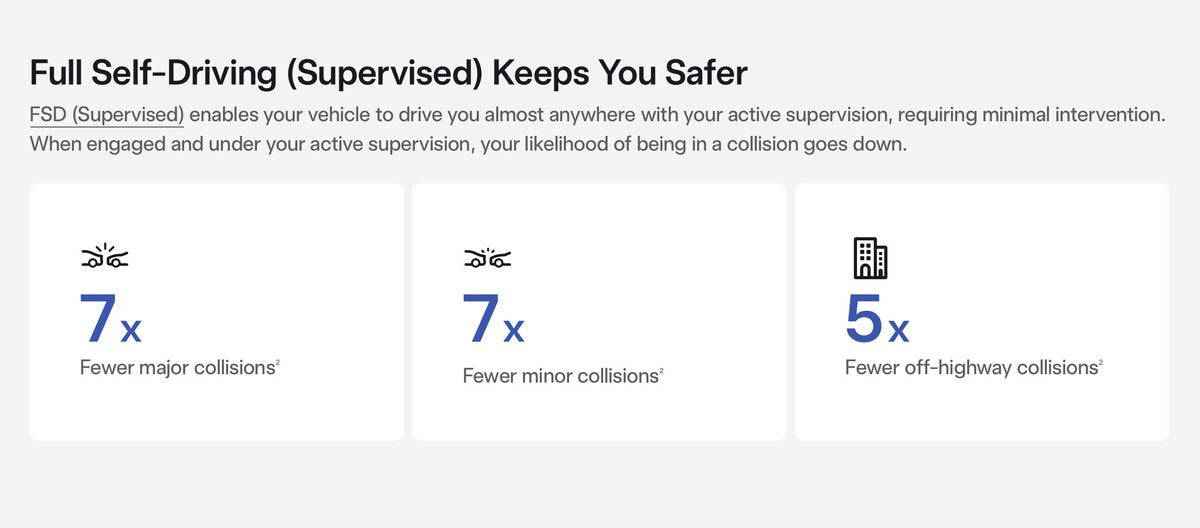
Tesla's Cybertruck has officially become the only pickup truck to earn the Insurance Institute for Highway Safety's Top Safety Pick+ award under the tougher 2026 criteria — a designation Tesla is now leaning into as a headline safety credential, paired with its claim that FSD Supervised delivers 'superhuman' crash avoidance. The award, announced by IIHS earlier this year and re-promoted by Tesla's official Cybertruck account this week, applies to Cybertrucks built after April 2025 following structural revisions to the front underbody and footwell area.
Below is what the rating actually covers, who it applies to, and the concrete steps Cybertruck owners should take to make sure their truck is getting the full benefit of the safety hardware and software behind it.

What the 2026 Top Safety Pick+ Actually Means
The 2026 IIHS criteria are notably harder to clear than in prior years. According to IIHS, vehicles now need a 'Good' rating in the updated pedestrian front crash prevention evaluation and at least an 'Acceptable' score in vehicle-to-vehicle front crash prevention — on top of good crashworthiness scores across the small overlap front (driver and passenger), updated moderate overlap front, and updated side tests.
According to IIHS test results reported by Teslarati and IIHS.org, the Cybertruck earned 'Good' in all core crashworthiness categories and its standard front crash prevention system avoided every pedestrian collision scenario in testing — including daytime child crossings, nighttime adult crossings, and nighttime parallel adult scenarios. It is the only full-size pickup to earn Top Safety Pick+ for 2026, and one of only two pickups overall to receive the top honor this cycle.
Key Figures
| Metric | Result |
|---|---|
| 2026 IIHS Rating | Top Safety Pick+ |
| Qualifying Build Date | After April 2025 |
| Small Overlap Front (Driver/Passenger) | Good |
| Updated Moderate Overlap Front | Good |
| Updated Side Test | Good |
| Pedestrian Front Crash Prevention | Good (all scenarios avoided) |
| Autopilot Tech Collision Rate (Q3 2025) | 1 crash per 6.36M miles (Tesla data) |
Does Your Cybertruck Qualify? Action Plan
The single most important detail buried in the announcement: the Top Safety Pick+ rating applies to Cybertrucks built after April 2025. Earlier trucks received structural upgrades — front underbody reinforcements and footwell modifications — that the IIHS specifically references when awarding this rating. Here's how to check where your truck stands and what to do next.
1. Verify your build date
Open the Tesla app, tap your vehicle, then scroll to the vehicle details / VIN section. The 10th character of your VIN encodes the model year, but the more reliable check is the build date sticker on the driver's door jamb. If your truck was built in May 2025 or later, the IIHS rating applies to your specific vehicle. Earlier builds are not covered by the 2026 award, even if they share the same trim name.
2. Confirm Automatic Emergency Braking and pedestrian detection are enabled
The IIHS rating hinges on the standard front crash prevention system performing correctly. On the touchscreen, go to Controls → Autopilot → Collision Avoidance Assist and confirm Automatic Emergency Braking is set to ON and Forward Collision Warning is set to Medium or Early. These are on by default, but any owner who disabled them for towing or off-road use should re-enable them for daily driving.
3. Keep the front sensor suite clean
Cybertruck's crash avoidance relies on the forward-facing camera cluster behind the windshield and the front bumper camera. Bug splatter, ice, or road grime on either can degrade pedestrian detection at night — the exact scenario IIHS scored. Wipe both areas during every wash and after any highway drive in bad weather.
4. Stay current on software
The crash avoidance behavior IIHS tested reflects the software version present on qualifying trucks. When your Cybertruck prompts for an OTA update, install it — pedestrian detection tuning and AEB thresholds ship in these updates. Check Controls → Software to confirm you're on the latest available version.
5. If you use FSD Supervised, treat it as an assist — not an autopilot
Tesla's Q3 2025 Vehicle Safety Report, cited by the company, records one crash per 6.36 million miles with Autopilot technology engaged, compared to a U.S. national average of roughly one crash per 702,000 miles. Independent researchers have flagged methodology concerns with that comparison — road-type mismatch, vehicle-age mismatch, and driver demographics all skew the numbers. The rating and the data both reward attentive supervised use; neither endorses hands-off driving.
What to Watch Next
Two things worth tracking. First, whether Tesla files any additional structural revisions for later Cybertruck build years — the April 2025 cutoff suggests the IIHS-qualifying configuration is a living target. Second, whether IIHS separately evaluates FSD Supervised as a partial-automation system; IIHS has been building out a partial-automation safeguards rating, and Tesla's systems have historically fared poorly there despite strong crashworthiness scores. A Top Safety Pick+ on the vehicle and a weak partial-automation grade can coexist, and owners should read them as two different reports.
For now, if your Cybertruck was built after April 2025, you own the only pickup on the U.S. market with the 2026 IIHS Top Safety Pick+. Keeping the sensors clean and the collision-avoidance settings on is how you keep that rating meaningful in the real world.
Related Gear
Gear up your Cybertruck with tested, custom-fit BASENOR accessories — shop Cybertruck accessories →
Sources & reporting notes
The links below identify the material source records used for this report.
- @cybertruck on X (2026-08-13T22:02:40.000Z) — Direct source
Source links are preserved as published or accessed. See our editorial standards and corrections policy.
The BASENOR Editorial Desk covers Tesla, SpaceX, and related technology, curating reporting from primary sources — official accounts, regulatory filings, and software release data. Every article passes source-record and fact-checking review before publication. About the newsroom.
This report was curated by the BASENOR Editorial Desk from the sources listed above. Read our editorial standards or email editorial@basenor.com to report an error.