The News: NASA and SpaceX are in active disagreement over whether Starship's proposed landing approach satisfies the Agency's mandatory manual control requirements for human-rated spacecraft.
Why It Matters: This dispute directly threatens the timeline and certification of Starship as NASA's Human Landing System for the Artemis program — the vehicle intended to return astronauts to the Moon.
Source: @SciGuySpace (Eric Berger) on X
NASA and SpaceX Clash Over Starship's Manual Landing Controls — Artemis Timeline at Risk
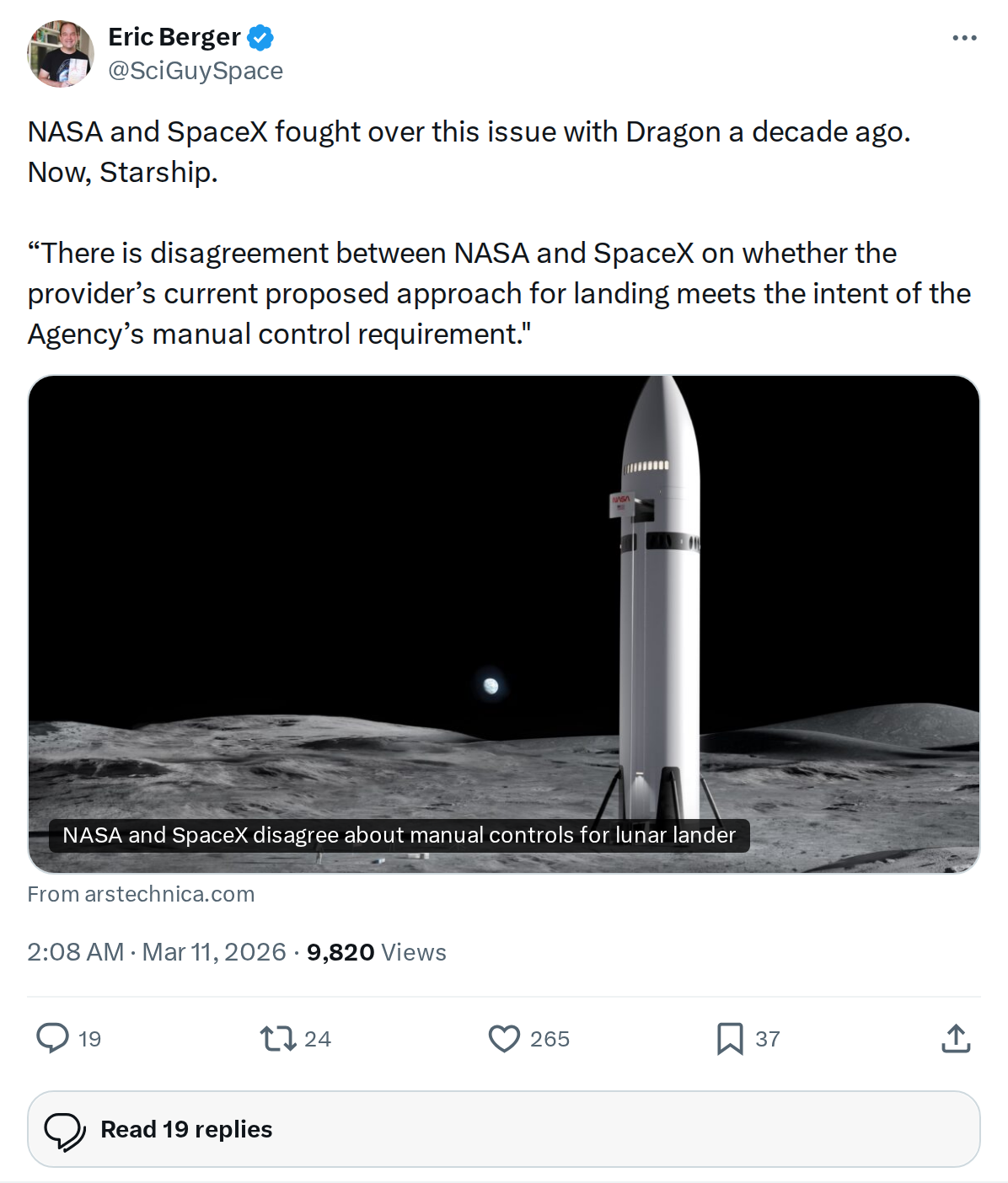
A significant technical and contractual dispute has surfaced between NASA and SpaceX over Starship's Human Landing System (HLS) design. The core issue: NASA believes SpaceX's current proposed approach for landing does not meet the Agency's requirement for manual crew control during a lunar descent. According to aerospace journalist Eric Berger — one of the most reliable sources on NASA-SpaceX relations — the disagreement is now formally on record.

Berger's report quotes the disagreement directly: "There is disagreement between NASA and SpaceX on whether the provider's current proposed approach for landing meets the intent of the Agency's manual control requirement." That language — formal, measured, and buried in what is likely a program review document — is the kind of sentence that quietly signals a serious certification problem.
This Fight Has Happened Before — With Dragon
Berger pointedly notes this is not the first time NASA and SpaceX have locked horns over manual control. A nearly identical dispute played out roughly a decade ago with the Dragon spacecraft. In that case, the two sides eventually reached a resolution — but it required significant negotiation and design accommodation. The fact that Berger is drawing the direct parallel suggests the Starship situation is following a familiar, and potentially protracted, playbook.
NASA's Human-Rating Requirements (NPR 8705.2C) are explicit: crewed spacecraft must provide the crew with the capability to manually control the vehicle's flight path and attitude. The HLS contract SpaceX was awarded — originally at $2.9 billion in April 2021, later revised to approximately $4 billion — includes this as a specific requirement. SpaceX's Starship HLS, designed to ferry astronauts from lunar orbit to the Moon's surface and back, must satisfy it before any crew can board.
📊 Key Figures
| Metric | Value | Context |
|---|---|---|
| HLS Contract Value | ~$4 billion | ~$2.7B paid to date |
| HLS Milestones Completed | 49 | Per SpaceX |
| Artemis III Target (current) | Mid-2027 | Revised Feb 2026; no lunar landing |
| Original Artemis III Target | 2024 | Slipped multiple times |
What the Dispute Actually Means
Starship's landing architecture is unlike anything NASA has certified before. The vehicle is enormous — far larger than Dragon — and its lunar descent profile involves highly automated systems managing propellant, attitude, and trajectory in ways that may leave limited meaningful opportunity for crew intervention. SpaceX's position appears to be that its proposed approach satisfies the intent of the requirement, even if it doesn't match a traditional stick-and-throttle interpretation. NASA, it seems, is not yet convinced.
It's worth noting that the revised Artemis III mission — as of February 2026 — will no longer attempt a lunar surface landing. Instead, it will focus on demonstrating technologies in low Earth orbit, including rendezvous and docking between Orion and commercial landers. That restructuring may provide some breathing room, but it does not eliminate the underlying certification requirement for any future crewed lunar landing attempt.
🔭 The BASENOR Take
Timeline: Dispute surfaced publicly March 10, 2026 — program has been under pressure since at least September 2025 (ASAP warning)
Impact Level: 🔴 High — certification disputes of this nature can add months or years to a program timeline
Confidence in Resolution: Moderate — the Dragon precedent shows these disputes can be resolved, but not quickly
Precedent: The Dragon manual control dispute took multiple years to fully resolve and required both design changes and negotiated waivers
Eric Berger is not an alarmist. When he surfaces language like this — direct quotes from what appear to be program review documents — it reflects a real, documented impasse, not a routine technical discussion. The Dragon parallel he invokes is instructive: that dispute was eventually resolved, but it required SpaceX to make accommodations and NASA to accept some degree of operational compromise. Expect the same negotiation here, just with far higher stakes given Starship's complexity.
NASA's Aerospace Safety Advisory Panel had already flagged the HLS schedule as "significantly challenged" in September 2025. Former administrators Charles Bolden and Jim Bridenstine publicly urged NASA to reconsider its dependence on Starship in October 2025. This manual control dispute adds another layer of technical risk on top of an already strained program. SpaceX has stated it is working on a "simplified" version of the lunar lander in response to NASA concerns — whether that simplification addresses the manual control question remains to be seen.
The bottom line: two of the most technically capable organizations in aerospace are in a formal disagreement over a safety-critical requirement. History says they'll find a path forward. But history also says it won't be fast. For anyone tracking the Artemis program, this is the kind of friction that quietly reshapes timelines — and this one is now on the record. Follow our SpaceX coverage for updates as this develops.

Sarah focuses on Tesla Energy, SpaceX missions, and the broader Musk AI portfolio. Former data analyst in clean energy. Based in San Francisco.
Sources verified at publish time. Spotted an inaccuracy? Email editorial@basenor.com.