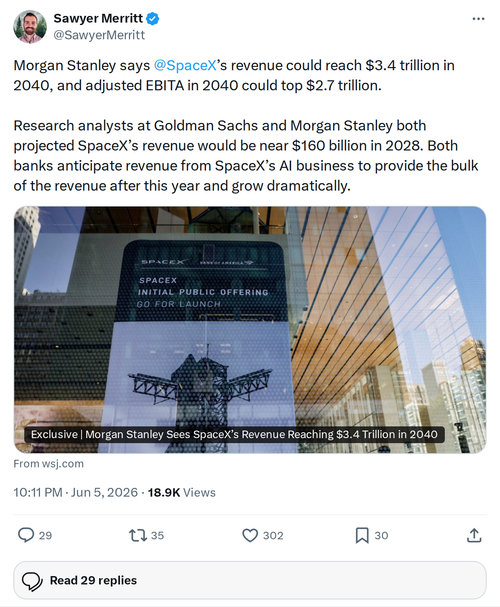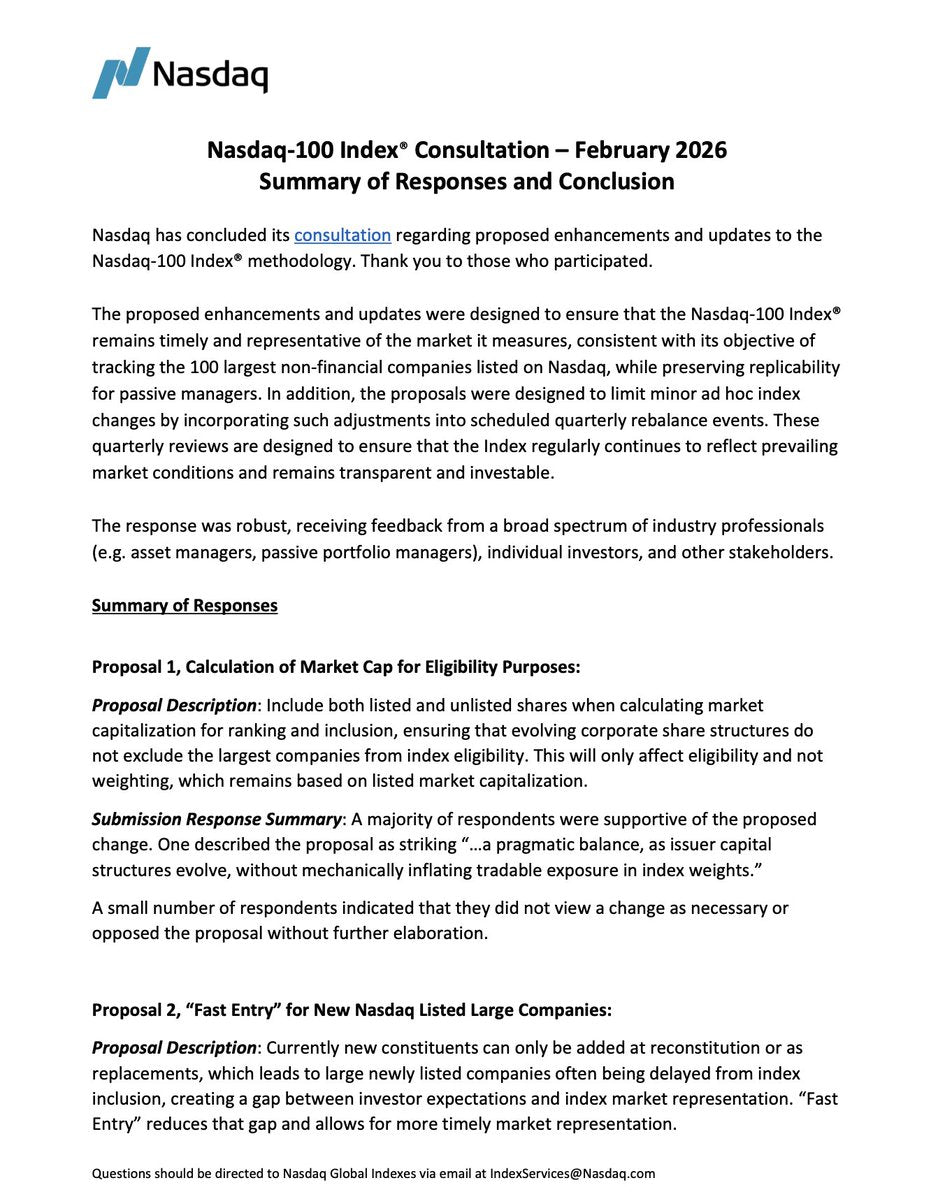
The News: Nasdaq has officially overhauled its Nasdaq-100 inclusion rules, introducing a 'Fast Entry' mechanism that allows large IPOs to join the index roughly 15 trading days after going public — down from a previous wait of at least three months.
Why It Matters: This rule change clears a major structural hurdle for a potential SpaceX IPO, meaning the company could enter the Nasdaq-100 within weeks of listing rather than sitting on the sidelines for a quarter or more.
Source: @SawyerMerritt on X | @wholemars on X
Nasdaq's 'Fast Entry' Rule Could Fast-Track a SpaceX IPO — What Tesla Investors Need to Know
Nasdaq just rewrote the rulebook for how major companies enter its flagship index — and the timing couldn't be more interesting for anyone watching the SpaceX IPO story. On March 30, 2026, Nasdaq announced a sweeping overhaul of its Nasdaq-100 methodology, and the headline change is a new 'Fast Entry' provision that dramatically compresses the timeline for large-cap newcomers to join the index.

📊 Key Figures
| Metric | Before | After (May 1, 2026) |
|---|---|---|
| Index entry wait time | 3+ months (up to 1 year) | ~15 trading days |
| Eligibility check starts | After seasoning period | Day 7 post-listing |
| Market cap threshold | N/A (seasoning required) | Top 40 Nasdaq-100 constituents (~$100B+) |
| Minimum free-float requirement | 10% | Eliminated |
| Rules effective date | — | May 1, 2026 |
| Index composition impact | — | Starting June 2026 |
What Actually Changed — and Why It's a Big Deal
Under the old rules, even a company worth hundreds of billions of dollars had to sit out at least three months — and sometimes up to a year — before it could be considered for Nasdaq-100 inclusion. That seasoning requirement existed to ensure price stability, but it also meant that index funds and ETFs tracking the Nasdaq-100 couldn't touch a hot new listing until well after the initial excitement had passed.
The new 'Fast Entry' rule flips that logic entirely. Starting May 1, 2026, a newly listed company's eligibility will be assessed as early as its seventh trading day. If its market capitalization ranks within the top 40 current Nasdaq-100 constituents — a bar that sits at roughly $100 billion based on year-end figures — it can be added to the index approximately 15 trading days after its IPO. No seasoning requirement. No waiting quarter.
Critically, Nasdaq also announced that a 'Fast Entry' addition won't force another company out of the index immediately. The index can temporarily expand until the next annual reconstitution, which removes a significant political obstacle that previously made index committees reluctant to add large newcomers mid-cycle.
Two other methodology changes are worth noting: the minimum 10% free-float requirement is being eliminated (companies with lower floats will simply receive a reduced weighting), and market cap calculations will now incorporate both listed and unlisted share classes. That second point is particularly relevant for companies like SpaceX that have complex, multi-class share structures.

The SpaceX IPO Connection
The community reaction was immediate. The moment the Nasdaq announcement dropped, the conversation pivoted directly to SpaceX. And it's not hard to see why.
SpaceX is widely considered one of the most anticipated IPOs in market history. While no official filing timeline has been confirmed, the company's private valuation has soared to levels that would comfortably clear the ~$100 billion threshold required for 'Fast Entry' eligibility — by a wide margin. Under the old rules, even after going public, SpaceX would have spent months locked out of the Nasdaq-100 and the massive passive fund flows that come with it. Under the new rules, index inclusion could follow within three weeks of listing.
That matters enormously for price dynamics. Inclusion in the Nasdaq-100 triggers automatic buying from every ETF and index fund that tracks it — including the $300B+ QQQ. The faster that buying pressure arrives post-IPO, the more it compresses the typical post-listing volatility window that often punishes retail investors who buy in early.
🔭 The BASENOR Take
Timeline: Rules effective May 1, 2026. Index composition changes begin June 2026. SpaceX IPO timing remains unconfirmed.
Impact Level: 🔴 High — structural market change with direct implications for any mega-cap IPO
Confidence: ✅ High — Nasdaq announcement is confirmed and official
Here's the honest read: Nasdaq didn't announce this rule change because of SpaceX specifically. These kinds of methodology overhauls take months of committee work and SEC review. But the timing — with SpaceX's IPO speculation at a fever pitch — means the new rules land at a moment when they're maximally relevant to the most-watched private company on the planet.
For Tesla investors, this is worth tracking for a specific reason. Elon Musk's compensation, attention, and strategic priorities are distributed across Tesla, SpaceX, xAI, and other ventures. A SpaceX IPO — especially one that generates immediate Nasdaq-100 inclusion and the institutional buying frenzy that follows — could reshape how the market values the entire Musk ecosystem. It could also provide Musk with liquidity and optionality that has downstream effects on his Tesla involvement and share activity.
The bottom line: Nasdaq just removed one of the last structural friction points standing between SpaceX and a seamless public market debut. Whether SpaceX chooses to use that runway is still an open question — but the door is now considerably wider than it was 24 hours ago. Check out our SpaceX coverage for ongoing updates as this story develops.

Sarah focuses on Tesla Energy, SpaceX missions, and the broader Musk AI portfolio. Former data analyst in clean energy. Based in San Francisco.
Sources verified at publish time. Spotted an inaccuracy? Email editorial@basenor.com.