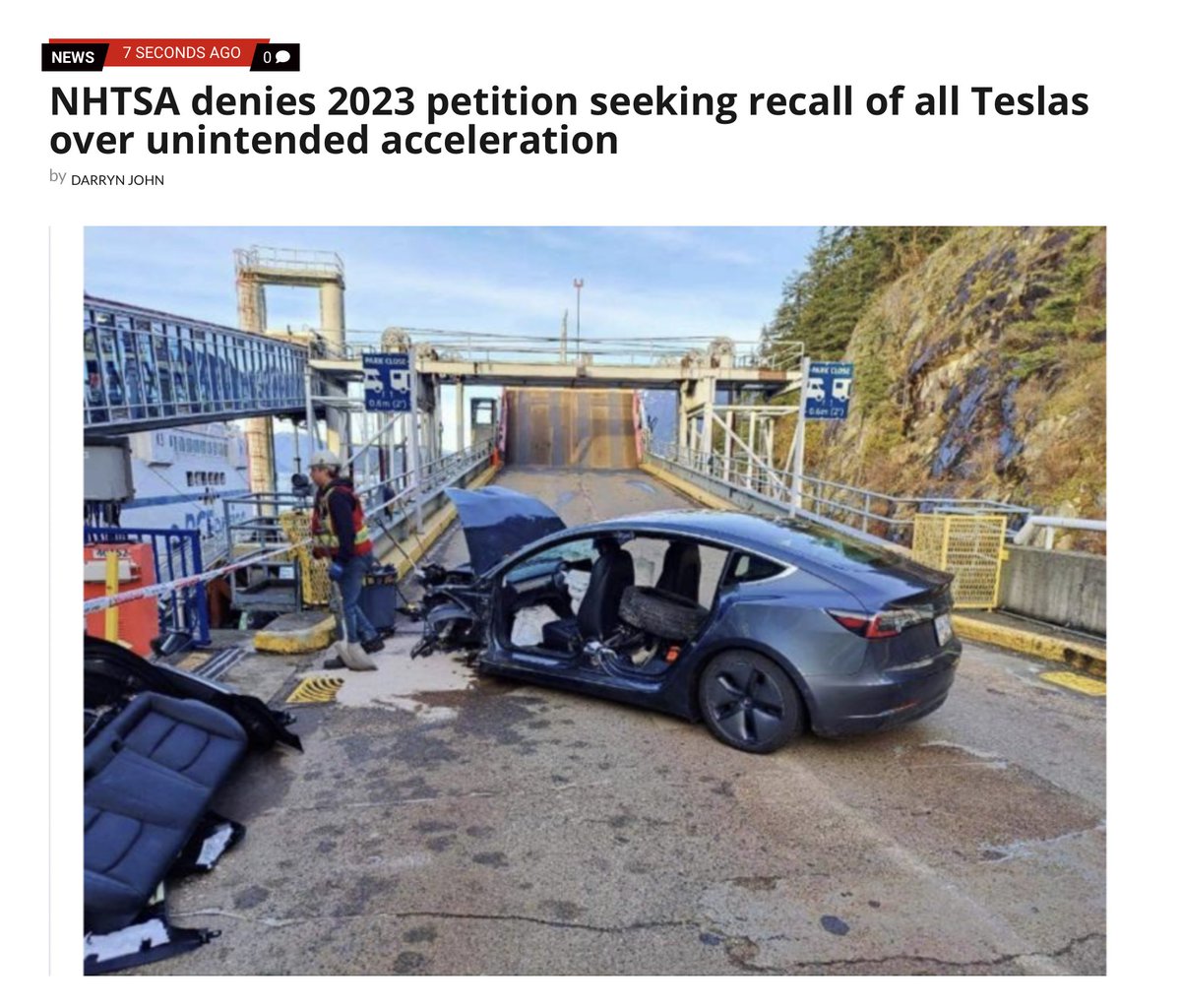
The News: The National Highway Traffic Safety Administration (NHTSA) has officially denied a petition filed in March 2023 that sought a recall of approximately 2.26 million Tesla vehicles over alleged unintended acceleration.
Why It Matters: After a three-year review, the federal safety regulator found no evidence of any defect — concluding that reported incidents were caused by driver pedal misapplication, not a vehicle flaw. This closes the book on one of the most sweeping recall petitions ever filed against Tesla.
Source: @SawyerMerritt on X
NHTSA Finds No Defect in Tesla Unintended Acceleration Claims
The NHTSA has put to rest one of the longest-running safety controversies surrounding Tesla vehicles. In a decision published today, March 20, 2026, the federal agency officially denied a petition that had called for a sweeping recall of every Tesla manufactured since 2013 — an estimated 2.26 million vehicles across all models.
The petition, originally submitted in March 2023, alleged that Tesla vehicles suffered from sudden unintended acceleration (SUA), a safety claim that has surfaced periodically over the years. The petitioner urged regulators to order a mandatory recall covering Model S, Model 3, Model X, Model Y, and Cybertruck.

What NHTSA Found After Three Years of Review
After conducting a thorough review spanning three years, the NHTSA concluded there was simply no evidence of a safety-related flaw or defect in Tesla vehicles related to unintended acceleration. The agency's findings were unambiguous:
- No malfunction detected: Vehicle data and records indicated that Tesla vehicles functioned as designed during the reported incidents.
- Very few relevant accidents: The number of actual accidents linked to the SUA claims was extremely small relative to the millions of Tesla vehicles on the road.
- Driver error identified: NHTSA determined that reported sudden unintended acceleration incidents were caused by pedal misapplication — drivers pressing the accelerator when they intended to press the brake.
This finding is consistent with how the vast majority of SUA complaints across all automakers are resolved. Pedal misapplication has been identified by safety researchers as the most common cause of perceived unintended acceleration events across the entire automotive industry, not just Tesla.
📊 Key Figures
| Detail | Value |
|---|---|
| Vehicles Covered by Petition | ~2.26 million |
| Model Years in Scope | 2013–2023 |
| Petition Filed | March 2023 |
| Decision Date | March 20, 2026 |
| NHTSA Finding | No defect — pedal misapplication |
| Review Duration | ~3 years |
🔭 The BASENOR Take
Impact Level: Moderate — removes a regulatory overhang but no vehicle changes result
Confidence: High — this is a final NHTSA decision, not a preliminary finding
What Happens Next: Nothing. The petition is closed. No recall, no further investigation.
This decision is significant not because it changes anything about Tesla vehicles — they were never found to have a defect — but because it formally eliminates a talking point that has circulated for years. Unintended acceleration claims have been a recurring feature of Tesla criticism, and having the federal safety regulator definitively state that no defect exists carries real weight.
For Tesla owners, the practical implications are straightforward: your vehicle does not have an acceleration defect, and you will not be receiving a recall notice related to this issue. The pedal misapplication finding also underscores the importance of features like Tesla's regenerative braking system and the cabin camera, both of which can help reconstruct what actually happened during an incident.
It is worth noting that NHTSA does not shy away from holding Tesla accountable when genuine issues arise — the agency has issued multiple Tesla recalls in recent years, particularly around Autopilot and Full Self-Driving behaviors. The denial of this petition signals that the agency is applying consistent standards: when data supports a defect, it acts; when data does not, it says so.
📰 Deep Dive
The sudden unintended acceleration narrative around Tesla has deep roots. Claims of SUA have followed nearly every major automaker at some point — most famously Toyota in 2009–2010, when a massive recall and congressional hearings ultimately found that most incidents were caused by floor mat interference and, in many cases, pedal misapplication. Tesla's SUA saga has followed a similar trajectory, with sensational claims eventually running into the hard wall of vehicle telemetry data.
What makes Tesla's situation somewhat unique is the available data. Unlike traditional vehicles, Teslas log granular telemetry — including pedal position, motor torque commands, and braking inputs — that can reconstruct precisely what the vehicle was doing at the time of any incident. This data has consistently shown that in reported SUA events, the accelerator pedal was being pressed, not the brake. The NHTSA's conclusion aligns with what Tesla's own data has indicated for years.
The three-year timeline for this review is notable but not unusual. NHTSA evaluates petitions thoroughly, and a scope covering 2.26 million vehicles across more than a decade of production requires significant analysis. The decisive nature of the denial — no defect, no safety hazard, clear identification of driver error — suggests the evidentiary bar for the petitioner's claims was never close to being met.
For the broader EV industry, this decision reinforces that electric vehicle drivetrains are not inherently prone to unintended acceleration. The instant torque delivery of electric motors can feel unfamiliar to drivers transitioning from internal combustion vehicles, which may contribute to the perception of unintended acceleration. But perception and engineering defect are two very different things — and NHTSA's ruling makes that distinction clear.
Related Gear
Gear up your Tesla with tested, custom-fit BASENOR accessories — shop Tesla accessories →
Sources & reporting notes
The links below identify the material source records used for this report.
- @SawyerMerritt on X (2026-03-20T15:24:46.000Z) — Direct source
Source links are preserved as published or accessed. See our editorial standards and corrections policy.
The BASENOR Editorial Desk covers Tesla, SpaceX, and related technology, curating reporting from primary sources — official accounts, regulatory filings, and software release data. Every article passes source-record and fact-checking review before publication. About the newsroom.
This report was curated by the BASENOR Editorial Desk from the sources listed above. Read our editorial standards or email editorial@basenor.com to report an error.