
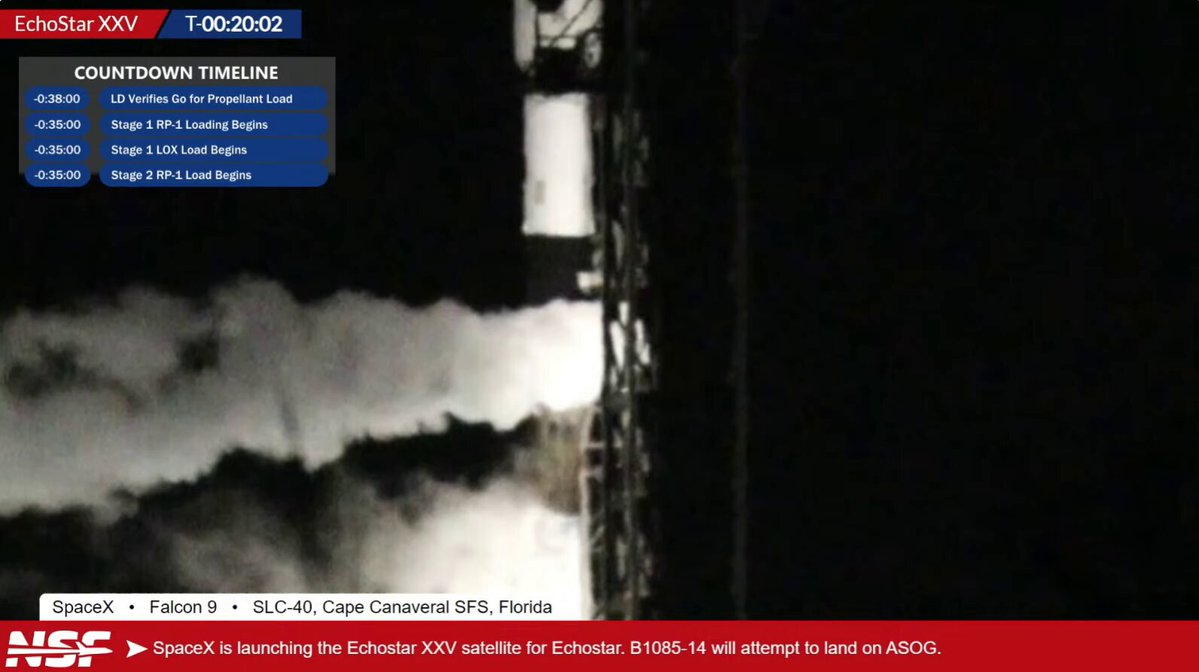
📌 UPDATE — March 10, 2026
Mission complete. SpaceX's Falcon 9 (B1085-14) lifted off from SLC-40 at 04:21 UTC, carrying the EchoStar XXV satellite. The first stage executed a successful landing on the A Shortfall of Gravitas droneship approximately 8 minutes after liftoff, and satellite deployment was confirmed at 04:56 UTC — marking a full mission success. This was the 14th flight for booster B1085.


The News: NASASpaceflight reported a T-20 minute vent following a hold, signaling an active countdown sequence for a SpaceX operation on March 10, 2026.
Why It Matters: Two major SpaceX milestones are converging tonight — the EchoStar XXV commercial satellite launch and Starship Booster 19 pad testing ahead of Flight 12.
Source: @NASASpaceflight on X

What's Happening at the Pad Right Now
NASASpaceflight's T-20 minute vent call — posted at 04:00 UTC on March 10 — is a textbook sign of an active, pressurized countdown. A vent at this point in the sequence means propellant loading is well underway and the vehicle is being brought to flight pressure. The brief hold that preceded it is routine; what matters is that the count resumed.
Based on background research, the most likely candidate for this countdown is the EchoStar XXV Falcon 9 launch from Space Launch Complex 40 (SLC-40) at Cape Canaveral Space Force Station, which was scheduled for liftoff at 03:19 UTC on March 10. The slight timing offset between the scheduled T-0 and the T-20 vent tweet is consistent with a hold and recycle scenario — exactly what NASASpaceflight's language confirms.
📊 Key Figures
| Metric | Value | Context |
|---|---|---|
| EchoStar XXV Scheduled T-0 | 03:19 UTC, Mar 10 | SLC-40, Cape Canaveral |
| Booster | B1085-14 | 14th flight of this core |
| EchoStar XXV Orbit Target | GEO — 110° West | DISH Network slot |
| Starship Flight 12 Target | Mid-March 2026 | Elon Musk indication |
| Starship Booster | Booster 19 | Rolled to Pad 2, Mar 9 |
| Starship Version | V3 (Version 3) | Debut flight for V3 config |
EchoStar XXV: The Commercial Mission at the Center of Tonight's Count
The EchoStar XXV direct broadcast satellite is destined for geostationary orbit at the 110° West longitude slot — prime real estate for DISH Network's broadcast footprint over North America. Falcon 9 booster B1085-14 is carrying the payload, marking the 14th flight for that particular first stage. A 14-flight booster is well into proven territory for SpaceX, which has pushed cores well past 20 flights in recent years.
A hold followed by a T-20 vent is not unusual for a GTO mission of this complexity. Geostationary transfer orbit launches carry heavier payloads and tighter trajectory windows than Starlink runs, making the countdown more sensitive to range and weather constraints. The fact that the count resumed is the key data point here.
Starship Flight 12: The Bigger Story Building in the Background
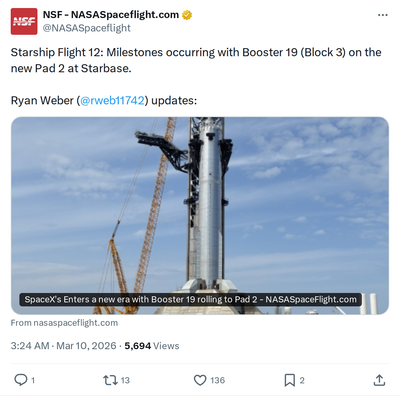
While Falcon 9 commands tonight's immediate attention, the more consequential SpaceX story of the week is unfolding at Starbase in South Texas. According to NASASpaceflight's own reporting from March 9, Super Heavy Booster 19 rolled to Pad 2 — and pad testing was scheduled for March 10, the same day as the EchoStar launch.
Booster 19 will fly the debut of SpaceX's Version 3 (V3) Starship configuration. Ship 39 is also advancing through pre-flight test objectives. Elon Musk has pointed to mid-March 2026 as the target window for Flight 12, which means the pad test happening today is a critical gate in that schedule. If Booster 19 clears its static fire or pressure test without anomalies, the path to a mid-March launch attempt becomes much clearer.
For context on the broader Starship program and what Flight 12 means for SpaceX's long-term roadmap, see our SpaceX coverage.
🔭 The BASENOR Take
Timeline: EchoStar XXV launch attempt — March 10, 2026 (tonight). Starship Flight 12 — mid-March 2026 window.
Impact Level: Medium (commercial launch) + High (Starship V3 debut)
Confidence: High — NASASpaceflight is the gold standard for real-time launch coverage. The T-20 vent call is a direct observation, not speculation.
Tonight is a useful reminder of just how relentless SpaceX's operational tempo has become. A veteran Falcon 9 booster on its 14th flight is almost routine at this point — the real headline is what's happening 1,400 miles away in Texas, where the next generation of Starship hardware is being put through its paces ahead of what could be a historic mid-March test flight.
The V3 designation for Flight 12 matters. Each Starship iteration has brought meaningful structural and propulsion changes, and Version 3 is expected to push the vehicle closer to the performance envelope required for actual payload delivery — including the NASA Artemis lunar lander contract that remains one of SpaceX's most high-profile commitments.
For Tesla owners tracking SpaceX: the connection isn't just Elon Musk's name on both companies. SpaceX's Starlink constellation is increasingly relevant to Tesla's vehicle connectivity roadmap, and the manufacturing and engineering lessons from Starbase's rapid iteration cycles directly inform how Tesla approaches production challenges at its own gigafactories. A healthy, fast-moving SpaceX is good signal for Tesla's operational ambitions as well.
Watch NASASpaceflight's feed closely over the next 48-72 hours. If Booster 19 completes its pad test cleanly, expect a Flight 12 launch date announcement to follow quickly.

![BASENOR Phone Mount for 2025 2026 Tesla Model Y Juniper/Model 3 Highland, Dashboard Phone Holder Does Not Block View [No Adhesive][Dual Arms][360° Adjustable] Tesla Accessories Fit All Smartphone](http://www.basenor.com/cdn/shop/files/basenor-phone-mount-for-2025-2026-tesla-model-y-juniper-model-3-highland.jpg?v=1768393169&width=400)


