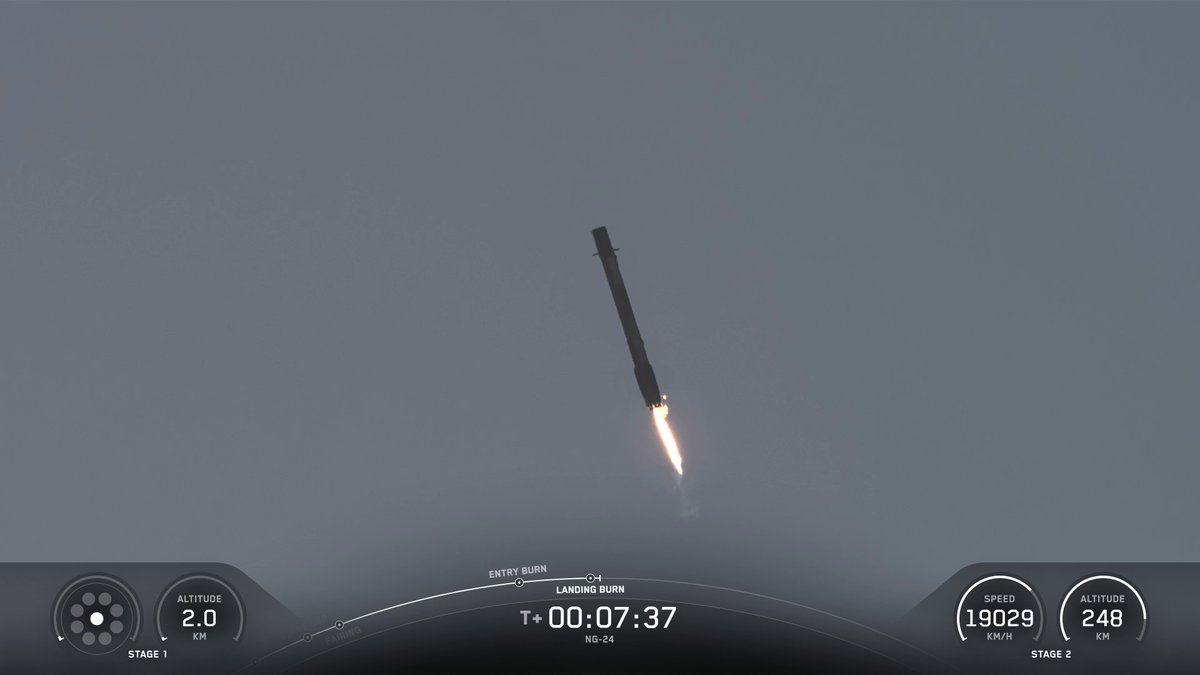
The News: SpaceX's Falcon 9 first stage successfully landed at Landing Zone 40 (LZ-40) at Cape Canaveral following the launch of Northrop Grumman's NG-24 Cygnus cargo spacecraft to the International Space Station.
Why It Matters: With 595 successful landings in 608 attempts, SpaceX's reusable rocket program continues to set the global standard for orbital launch economics — and every successful mission keeps that cadence locked in.
Source: @elonmusk on X
SpaceX Falcon 9 Sticks Another Landing After NG-24 ISS Mission — 595 and Counting
Three words. That's all Elon Musk needed this morning. "Falcon has landed" — posted at 9:40 a.m. ET on April 11, 2026 — confirmed yet another successful booster recovery for SpaceX. Behind those three words is one of the most consequential engineering achievements in modern aerospace history, playing out again with routine precision.

📊 Key Figures
| Metric | Value | Context |
|---|---|---|
| Launch Time | 7:41 a.m. ET | SLC-40, Cape Canaveral |
| Landing Zone | LZ-40 | Return-to-launch-site |
| Booster Flight Number | 7th flight | Same booster, reused |
| Total Falcon Landings | 595 | Out of 608 attempts |
| Fleet Landing Success Rate | 97.9% | Across all Falcon attempts |
| Payload | NG-24 Cygnus | Northrop Grumman ISS cargo |
Falcon 9 Fleet Landing Success Rate
97.9% — 595 successful landings in 608 attempts • Source: Background Research / SpaceX
🔭 The BASENOR Take
Timeline: Booster launched at 7:41 a.m. ET from SLC-40, Cape Canaveral. Landing confirmed at LZ-40 shortly after. Elon Musk posted confirmation at 9:40 a.m. ET.
Impact Level: Medium — operationally routine, strategically significant.
Confidence: High — confirmed by launch telemetry, Musk's post, and multiple independent sources.
What looks routine from the outside is anything but. This booster had already flown six times before today. SpaceX reflew it a seventh time — recovered it again — and is almost certainly going to fly it an eighth. That's the economics of reusability in practice, not in a press release.
The NG-24 mission itself is a commercial contract with Northrop Grumman to resupply the International Space Station. SpaceX is the launch vehicle. The fact that a NASA-adjacent ISS resupply mission now routinely uses a booster on its seventh flight tells you everything about how far the industry has shifted in the last decade.
For context on our broader SpaceX coverage: the Falcon family's 97.9% landing success rate across 608 attempts isn't just a statistic — it's the foundation that makes Starship development financially viable. Every Falcon 9 mission that flies and lands is revenue that funds the next generation.
📰 Deep Dive
The Falcon 9's return-to-launch-site landing at LZ-40 is the more demanding recovery profile — it requires the booster to flip, relight its engines, and fly back to the coast rather than coasting downrange to a drone ship. SpaceX opts for RTLS when the payload is light enough and the trajectory allows it. For a Cygnus cargo run to the ISS, the geometry works. The booster comes home fast, lands hard on the legs, and the turnaround clock starts immediately.
Seven flights for a single booster used to be a milestone worth a press release. Now it's Tuesday. SpaceX has been quietly pushing booster reuse limits — some cores have flown well beyond ten times — and each additional flight drives down the per-launch cost. For customers like Northrop Grumman, that cost pressure eventually flows through to contract pricing. For SpaceX, it widens the margin that funds Starship, Starlink constellation expansion, and the Falcon 9's eventual successor.
Musk's three-word confirmation — "Falcon has landed" — carries a specific weight for anyone who watched the early landing attempts. The first successful Falcon 9 landing was in December 2015. Less than eleven years later, SpaceX has done it 595 times. The cadence is now so high that individual landings rarely make front pages. That normalization is itself the achievement — it means the technology has matured past the point of spectacle and into the realm of infrastructure.
What's worth watching next: whether this booster gets reflown again, and how quickly. Turnaround time between flights has been compressing. A booster that flew this morning could, in principle, be back on the pad within weeks. That kind of tempo — if sustained across the fleet — is what gives SpaceX its structural launch cadence advantage heading into the second half of the decade.
Sources & reporting notes
The links below identify the material source records used for this report.
- @elonmusk on X (2026-04-11T13:40:39.000Z) — Direct source
Source links are preserved as published or accessed. See our editorial standards and corrections policy.
The BASENOR Editorial Desk covers Tesla, SpaceX, and related technology, curating reporting from primary sources — official accounts, regulatory filings, and software release data. Every article passes source-record and fact-checking review before publication. About the newsroom.
This report was curated by the BASENOR Editorial Desk from the sources listed above. Read our editorial standards or email editorial@basenor.com to report an error.