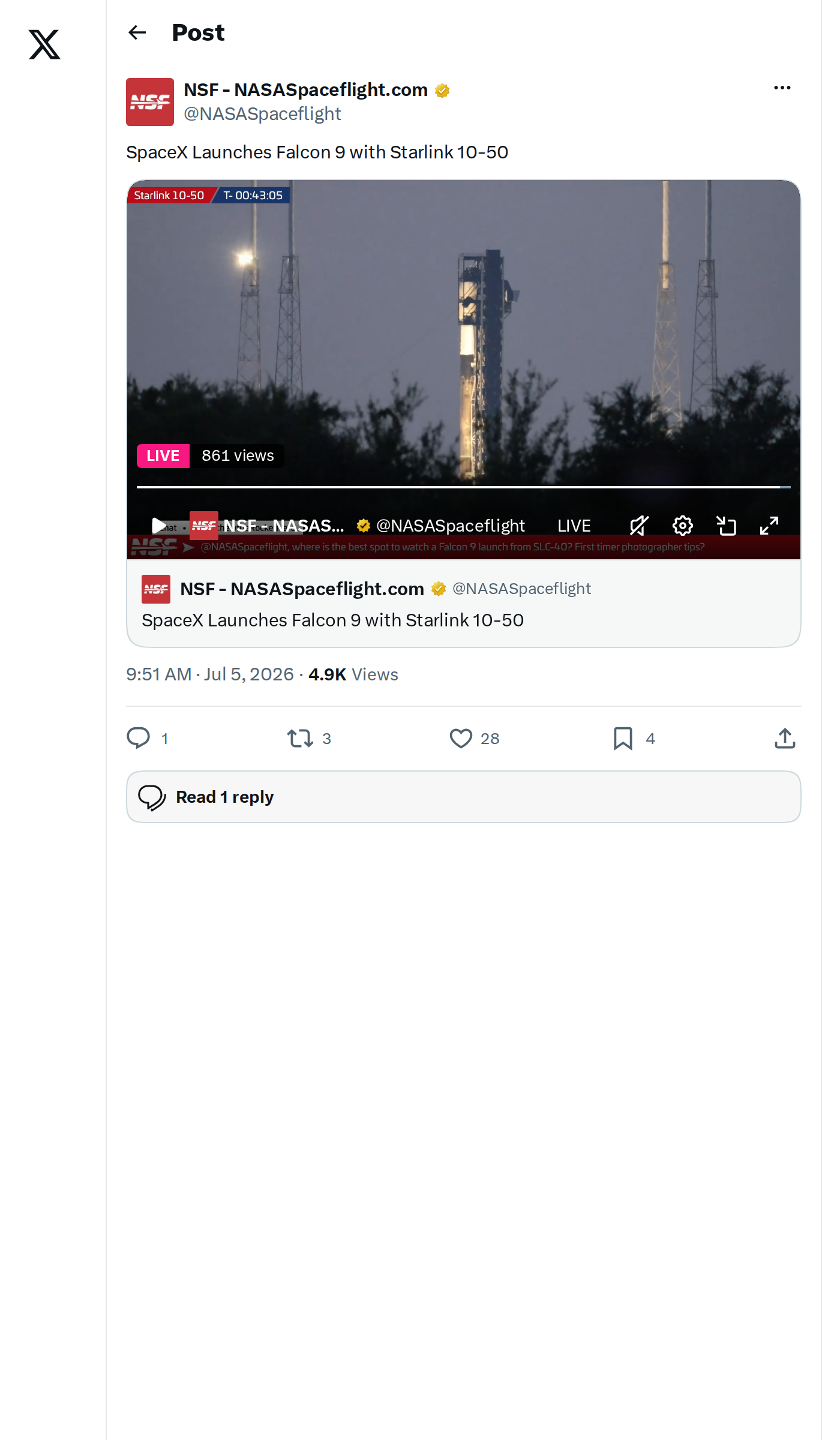
SpaceX successfully launched its Falcon 9 rocket carrying the Starlink 10-50 mission on Sunday, July 5, 2026, lifting off from Space Launch Complex 40 at Cape Canaveral Space Force Station at 10:46 AM UTC. The mission deployed 29 Starlink V2 Mini Optimized satellites into Low Earth Orbit, adding another layer to the already vast Starlink constellation.

This flight carried a notable secondary payload alongside the Starlink batch: two customer payloads from Besxar, a company testing its Fabships pilot reusable manufacturing pods under real launch and re-entry conditions. It's a reminder that Falcon 9 missions increasingly serve multiple customers in a single ride, a model that keeps per-launch economics sharp.
The first stage booster, B1090, completed its 13th flight and stuck the landing on drone ship A Shortfall of Gravitas in the Atlantic — another routine recovery that SpaceX has made look anything but. Weather cooperated, with an 85% favorable forecast driven by the Cumulus Cloud Rule holding through the window.

With Starlink coverage continuing to expand, each successive batch brings the network closer to seamless global broadband — including the remote and maritime routes where traditional infrastructure simply doesn't reach. For more on SpaceX's launch cadence and constellation progress, see our SpaceX coverage.
Sources & reporting notes
The links below identify the material source records used for this report.
- @NASASpaceflight on X (2026-07-05T09:51:46.000Z) — Direct source
- @NASASpaceflight on X (2026-07-05T09:51:15.000Z) — Direct source
Source links are preserved as published or accessed. See our editorial standards and corrections policy.
The BASENOR Editorial Desk covers Tesla, SpaceX, and related technology, curating reporting from primary sources — official accounts, regulatory filings, and software release data. Every article passes source-record and fact-checking review before publication. About the newsroom.
This report was curated by the BASENOR Editorial Desk from the sources listed above. Read our editorial standards or email editorial@basenor.com to report an error.