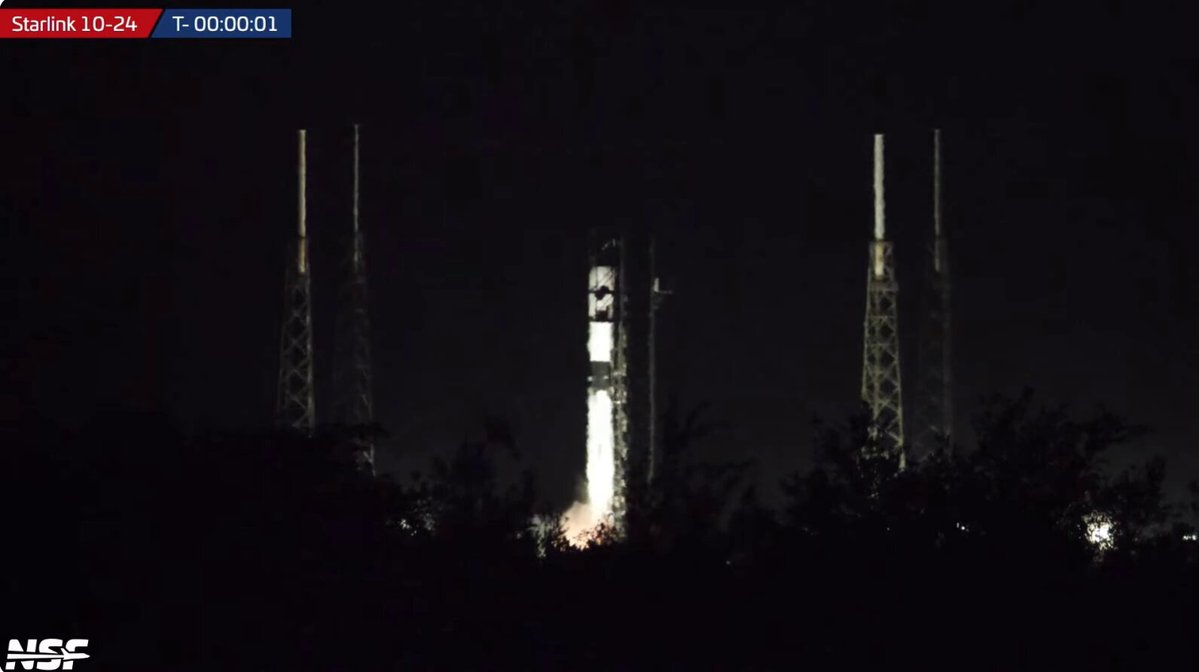
The News: SpaceX Falcon 9 booster B1080-26 launched 29 Starlink satellites to orbit from SLC-40 at Cape Canaveral, Florida, with a successful first-stage landing to follow.
Why It Matters: Every successful Starlink mission expands the constellation that powers in-car connectivity for Tesla owners — more satellites means better coverage and higher reliability.
Sources: @SpaceX · @NASASpaceflight
SpaceX Falcon 9 Launches 29 Starlink Satellites and Nails the Landing — Again
SpaceX added another 29 satellites to its Starlink constellation this morning, with Falcon 9 booster B1080-26 lifting off from Space Launch Complex 40 (SLC-40) at Cape Canaveral, Florida. The first stage completed a successful landing shortly after, keeping SpaceX's reusability record intact and the Starlink network on its relentless expansion trajectory.

📊 Key Figures
| Metric | Value | Context |
|---|---|---|
| Satellites Deployed | 29 | Starlink Group 10-24 |
| Booster | B1080-26 | 26th flight for this core |
| Launch Site | SLC-40 | Cape Canaveral, Florida |
| First Stage Landing | ✅ Successful | Booster recovered |
From Liftoff to Touchdown
NASASpaceflight confirmed the launch of Starlink Group 10-24 at 9:35 AM UTC, with the booster — designated B1080-26 — lifting off from SLC-40 on its 26th flight. That flight count is a remarkable testament to SpaceX's reusability program: the same hardware flying more than two dozen times is now routine rather than remarkable.

Just over eight minutes after liftoff, the first stage stuck its landing — confirmed by NASASpaceflight's terse but satisfying "And touchdown." post at 9:43 AM UTC. The satellites were subsequently deployed to their target orbit, adding to the Group 10 shell of the Starlink constellation.

🔭 The BASENOR Take
Timeline: Launch confirmed 9:35 AM UTC · Landing confirmed 9:43 AM UTC · April 14, 2026
Impact Level: 🟡 Moderate — routine expansion mission with meaningful long-term network implications
Confidence: ✅ High — confirmed by both @SpaceX and @NASASpaceflight with video evidence
B1080-26 flying for the 26th time is the kind of number that deserves a moment of appreciation. When SpaceX first proposed reusable rockets, the aerospace industry was deeply skeptical. A booster flying 26 missions isn't just an engineering achievement — it's the economic engine that makes rapid Starlink expansion financially viable. Lower launch costs per mission mean more satellites, more often.
For Tesla owners specifically, a growing Starlink constellation translates directly to the quality and reach of Tesla's in-car connectivity features. Tesla's vehicles use Starlink infrastructure for over-the-air updates, real-time traffic data, and streaming services — particularly in areas where terrestrial cell coverage is sparse. Each batch of satellites added to the network improves redundancy and capacity across the board.
The Group 10 shell in particular targets mid-inclination orbits designed to improve coverage across densely populated mid-latitude regions — which is where the majority of Tesla vehicles operate. This isn't a mission that changes anything overnight, but it's another brick in the wall of what SpaceX is building: a global, low-latency internet backbone that Tesla's ecosystem increasingly depends on. For our full SpaceX coverage, see our SpaceX coverage.
Sources & reporting notes
The links below identify the material source records used for this report.
- @NASASpaceflight on X (2026-04-14T09:43:02.000Z) — Direct source
- @NASASpaceflight on X (2026-04-14T09:35:00.000Z) — Direct source
- @SpaceX on X (2026-04-14T09:24:12.000Z) — Direct source
Source links are preserved as published or accessed. See our editorial standards and corrections policy.
The BASENOR Editorial Desk covers Tesla, SpaceX, and related technology, curating reporting from primary sources — official accounts, regulatory filings, and software release data. Every article passes source-record and fact-checking review before publication. About the newsroom.
This report was curated by the BASENOR Editorial Desk from the sources listed above. Read our editorial standards or email editorial@basenor.com to report an error.