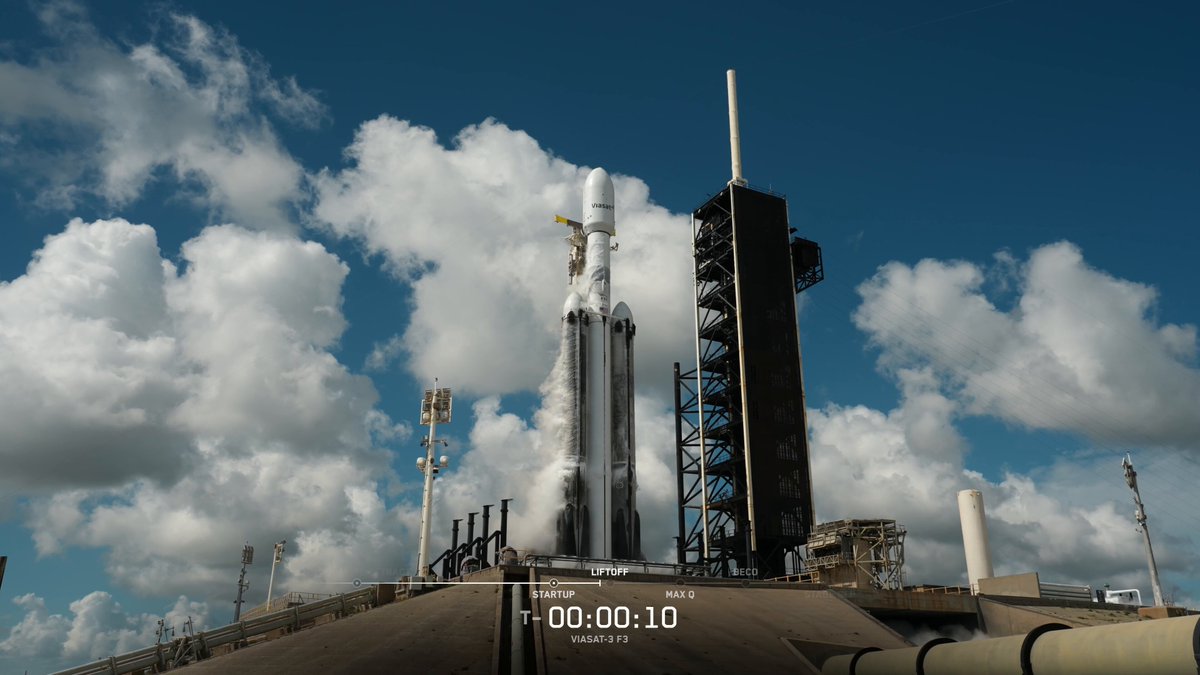
The News: SpaceX launched the ViaSat-3 F3 mission on a Falcon Heavy from Launch Complex 39A — and both side boosters landed simultaneously at two different landing zones for the first time ever.
Why It Matters: The split landing at LZ-2 and LZ-40 is a genuine first in spaceflight history, demonstrating a new level of operational flexibility for Falcon Heavy's booster recovery program.
Source: @SpaceX · @NASASpaceflight — April 29, 2026
Falcon Heavy Lifts Off with ViaSat-3 F3
At 14:13 UTC on April 29, 2026, SpaceX's Falcon Heavy rocket roared off Launch Complex 39A at Kennedy Space Center, carrying the ViaSat-3 F3 communications satellite into orbit. The liftoff was clean, and the mission proceeded exactly as planned through booster separation and center core staging.


Booster Separation and the Road Back
Roughly four minutes after liftoff, Falcon Heavy's two side boosters separated from the vehicle and began their return to Earth. SpaceX confirmed the targets: Landing Zone 2 and Landing Zone 40 — two distinct pads on Florida's Space Coast.


The entry burn phase followed — a critical deceleration maneuver where the boosters fire their engines to shed speed before hitting the lower atmosphere.

The Historic Split Landing
At approximately 14:22 UTC — just eight minutes after liftoff — both side boosters touched down. One at LZ-40, one at LZ-2. Simultaneously. It was the first time in Falcon Heavy's history that the two boosters landed at different, split landing zones rather than the same pad or the same complex.


📊 Key Figures
| Metric | Value | Context |
|---|---|---|
| Liftoff Time | 14:13 UTC | Launch Complex 39A, KSC |
| Booster Landing Time | ~14:22 UTC | ~8 minutes after liftoff |
| Landing Zones | LZ-2 and LZ-40 | First-ever split between these two pads |
| Mission | ViaSat-3 F3 | Communications satellite |
| Booster Landing Views | 1.45M+ | On the SpaceX landing confirmation tweet alone |
🔭 The BASENOR Take
| Timeline | April 29, 2026 — mission complete within 10 minutes of liftoff for booster recovery |
| Impact Level | 🔴 High — operational milestone with real implications for launch cadence |
| Confidence | ✅ Confirmed — dual primary sources (@SpaceX + @NASASpaceflight) |
📰 Deep Dive
The split landing at LZ-2 and LZ-40 is more than a visual spectacle — it signals a meaningful operational evolution for SpaceX's Falcon Heavy program. Previously, Falcon Heavy side boosters have always targeted the same landing complex, touching down in the iconic synchronized twin-booster landing that became one of the most recognizable images in modern spaceflight. Using two separate pads simultaneously means SpaceX is exercising greater flexibility in how it manages its landing infrastructure, which could reduce turnaround bottlenecks when both pads need to be cleared and refurbished quickly for back-to-back missions.
For the ViaSat-3 F3 mission itself, the successful launch continues SpaceX's role as the dominant commercial launch provider for high-throughput communications satellites. The Falcon Heavy remains the go-to vehicle for heavy-lift GTO missions, and today's clean execution — from liftoff through center core staging and dual booster recovery — reinforces that reliability record.
The 1.45 million views on SpaceX's booster landing confirmation tweet within the first hour tells its own story: the public appetite for Falcon Heavy milestones remains enormous, even as the vehicle matures into routine operations. That tension — between the routine and the record-breaking — is exactly what today's split landing captures. SpaceX just made something unprecedented look completely matter-of-fact. For those following the broader SpaceX coverage, that's the real headline.
Sources & reporting notes
The links below identify the material source records used for this report.
- @NASASpaceflight on X (2026-04-29T14:14:09.000Z) — Direct source
- @NASASpaceflight on X (2026-04-29T14:22:09.000Z) — Direct source
- @NASASpaceflight on X (2026-04-29T14:20:28.000Z) — Direct source
- @NASASpaceflight on X (2026-04-29T14:18:06.000Z) — Direct source
- @NASASpaceflight on X (2026-04-29T14:16:21.000Z) — Direct source
- @SpaceX on X (2026-04-29T14:22:32.000Z) — Direct source
- @SpaceX on X (2026-04-29T14:17:39.000Z) — Direct source
- @SpaceX on X (2026-04-29T14:14:13.000Z) — Direct source
- @SpaceX on X (2026-04-29T14:13:55.000Z) — Direct source
Source links are preserved as published or accessed. See our editorial standards and corrections policy.
The BASENOR Editorial Desk covers Tesla, SpaceX, and related technology, curating reporting from primary sources — official accounts, regulatory filings, and software release data. Every article passes source-record and fact-checking review before publication. About the newsroom.
This report was curated by the BASENOR Editorial Desk from the sources listed above. Read our editorial standards or email editorial@basenor.com to report an error.