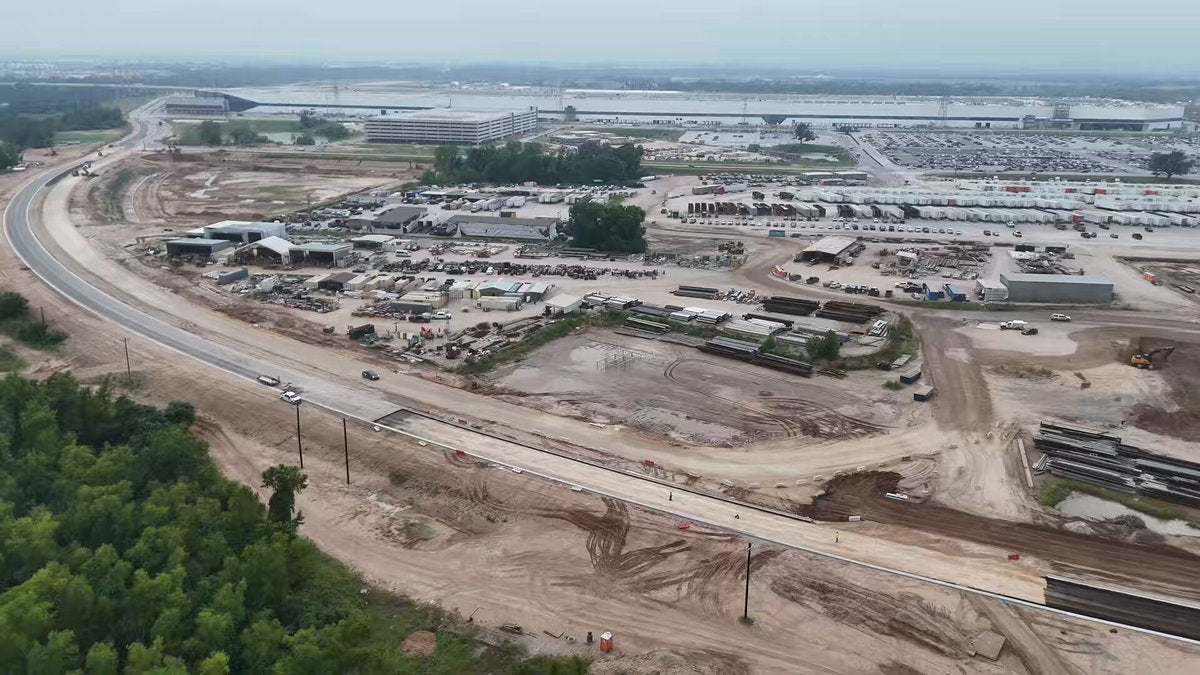
Fresh drone footage from Giga Texas shows ground crews actively clearing and grading the east-side construction site where Tesla, SpaceX, and xAI are jointly building what may be the most ambitious semiconductor project in American history. Known internally as Terafab, the facility is designed to manufacture advanced chips for everything from Full Self-Driving and Cybercab robotaxis to radiation-hardened processors destined for orbital satellites — all under one Texas roof.

According to aerial observer Joe Tegtmeyer, today's activity on the east side of Giga Texas is focused on grade preparation, land clearing, and the relocation of temporary workshops, material storage areas, and heavy equipment. It's the unglamorous but essential groundwork that precedes any large-scale industrial build — and it confirms the project has moved well past the planning phase.
What Terafab Actually Is
Elon Musk announced the Terafab venture in late March 2026, framing it as a direct response to surging chip demand across Tesla's AI and robotics programs. The joint venture brings together three Musk-led entities — Tesla, SpaceX, and xAI — in a shared semiconductor research and fabrication facility on the North Campus of Giga Texas in Austin.
The facility is targeting two distinct chip families:
- Automotive and AI chips — processors for Tesla's FSD stack, Cybercab robotaxi fleet, and Optimus humanoid robots
- Radiation-hardened space chips — high-reliability processors for SpaceX satellites, orbital data centers, and deep-space missions
That dual mandate is what makes Terafab unusual. Most chip fabs specialize in one process node or market segment. Building a single facility capable of serving both terrestrial automotive-grade and space-qualified production is a significant engineering and regulatory challenge — and a potential competitive moat if it works.
The Investment Scale
| Item | Detail |
|---|---|
| Joint venture partners | Tesla, SpaceX, xAI |
| Prototype location | Giga Texas North Campus, Austin |
| Larger-scale site | Gibbons Creek Reservoir area, Grimes County, TX |
| Initial cost estimate (Terafab) | $20B–$25B |
| SpaceX Grimes County plant (initial) | $55B, up to $119B across all phases |
| Tesla Q1 2026 SpaceX equity investment | $2B disclosed alongside fab groundbreaking |
| Announced | March 21–24, 2026 |
Tesla's Q1 2026 earnings report disclosed a $2 billion equity stake in SpaceX, timed to coincide with the formal groundbreaking of the joint semiconductor research fab at Giga Texas. That financial entanglement signals this isn't a loose partnership — it's a deeply integrated capital commitment between the two companies.
Why Vertical Integration in Chips Matters for Tesla Owners
Tesla has already demonstrated what in-house silicon can do: the custom HW3 and HW4 chips in your vehicle outperform off-the-shelf alternatives at a fraction of the cost per inference. Terafab takes that logic to its extreme conclusion — not just designing chips internally, but fabricating them domestically, reducing dependence on TSMC and other third-party foundries.
For Tesla owners, the downstream implications are real. A domestic fab with dedicated capacity means Tesla could accelerate HW upgrades, reduce supply-chain bottlenecks that have historically delayed vehicle production, and potentially bring the next generation of FSD hardware to market faster. For Cybercab specifically — a vehicle whose entire business model depends on compute density and reliability — having a captive chip supply could be the difference between a 2027 launch and a 2029 one.
Where Things Stand Today
Today's drone footage is a reminder that Terafab is still in its earliest physical phase. Site grading and clearing are prerequisites, not milestones — the real construction clock starts when foundation work begins and specialized cleanroom equipment arrives on site. Chip fabs of this scale typically take three to five years from groundbreaking to first wafer output, even under aggressive timelines.
The Grimes County site, which carries the larger investment figures, represents the longer-term ambition. The Giga Texas North Campus prototype facility is where the technology will be validated first — a proving ground before the larger build scales up.
Whether Terafab ultimately reshapes the semiconductor landscape or becomes a cautionary tale about vertical integration overreach remains an open question. But the dirt is moving, the capital is committed, and the drone footage doesn't lie. This project is real, and it's accelerating.
🚕 Following the Robotaxi rollout? See every operating city, launch date and announced market in our Tesla Robotaxi Tracker.
Related Gear
Gear up your Tesla with tested, custom-fit BASENOR accessories — shop Tesla accessories →
Sources & reporting notes
The links below identify the material source records used for this report.
- @JoeTegtmeyer on X (2026-06-19T15:31:02.000Z) — Direct source
Source links are preserved as published or accessed. See our editorial standards and corrections policy.
The BASENOR Editorial Desk covers Tesla, SpaceX, and related technology, curating reporting from primary sources — official accounts, regulatory filings, and software release data. Every article passes source-record and fact-checking review before publication. About the newsroom.
This report was curated by the BASENOR Editorial Desk from the sources listed above. Read our editorial standards or email editorial@basenor.com to report an error.