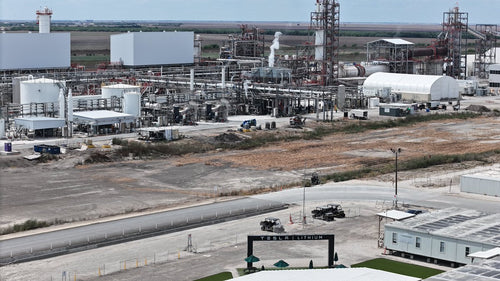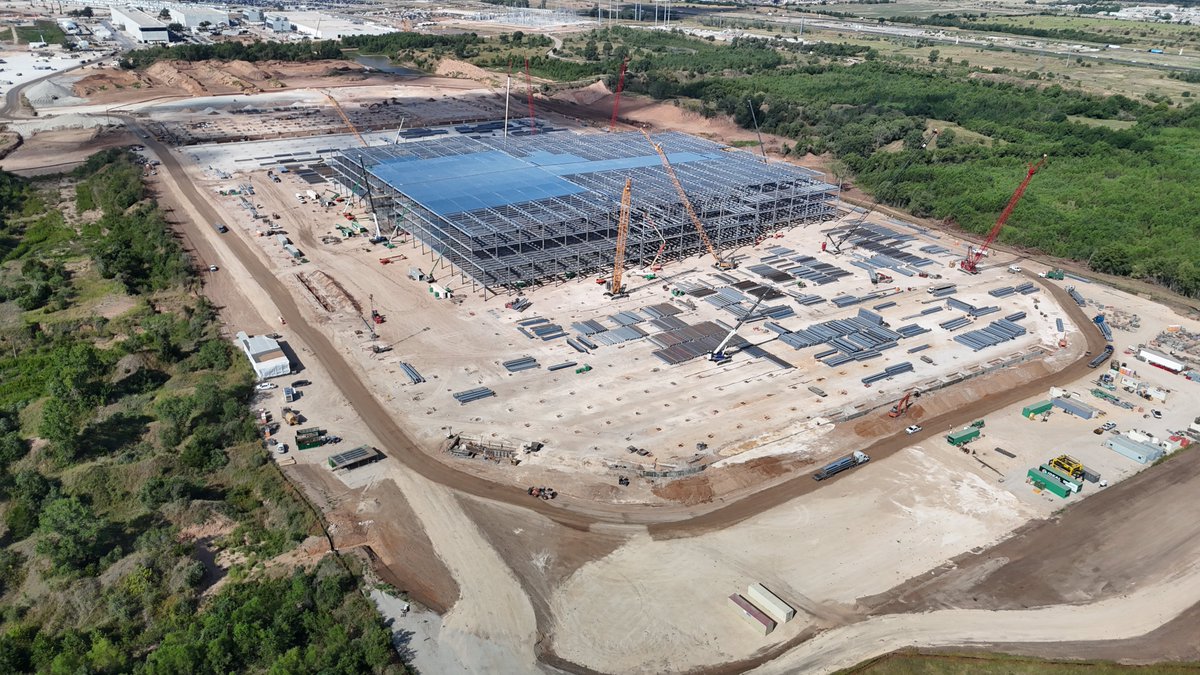
Giga Texas is wearing two hats right now: electric vehicle factory and emerging hub for some of the most ambitious infrastructure Tesla has ever attempted. Aerial footage captured on August 7, 2026 by drone journalist Joe Tegtmeyer shows construction crews actively laying the foundation for an E Support Facility Advanced Tech Chip Fab on the North Campus, while a fresh wave of Megapack units continues to fill out the Cortex 2 energy storage footprint in the Central area of the site.

The Chip Fab Piece: What's Being Built
The foundation work visible in today's snapshots is tied to what Tesla is calling an "E Support Facility" for its Advanced Tech Chip Fab — a prototype fabrication facility that broke ground on the North Campus in April 2026. This is distinct from the larger Terafab project, though the two are closely related.
Terafab itself is a joint venture between Tesla, SpaceX, and xAI, formally announced in Austin on March 21, 2026. According to public filings and reporting, the main Terafab manufacturing complex has been confirmed for Grimes County, Texas, north of Houston, with an initial investment of $16.8 billion and total potential spending that could reach $119 billion across multiple build-out phases. Elon Musk has described the completed facility as targeting over 100 million square feet of manufacturing space and more than 1 terawatt of AI compute capacity per year.
What's going up at Giga Texas is the prototype and support layer — a facility designed for rapid iteration in chip manufacturing before volume production scales elsewhere. According to previous reporting, the fab will produce two categories of chips: one line serving Tesla vehicles (Model Y, Cybertruck), Optimus robots, and autonomous driving systems including Cybercabs; and a second line for SpaceX's space-based AI infrastructure and satellites. Tesla's AI5 chips are expected to enter small-batch production by late 2026, with volume production anticipated in 2027.
Megapack Expansion at Cortex 2
The second major story visible in today's footage is the continued buildout of energy storage at the Cortex 2 datacenter site. This isn't a new project — the first 250 MW phase of Cortex 2 went live in April 2026 — but the current installation wave is pushing toward the site's full design capacity.
| Metric | Figure |
|---|---|
| Target Megapack count (full buildout) | ~260 units |
| Energy per Megapack unit | ~3.9 MWh |
| Total on-site storage at full deployment | ~975 MWh |
| Phase 1 power capacity (live since April 2026) | 250 MW |
| Full cluster power capacity | 500 MW |
| GPUs at full deployment | ~100,000 (H100/H200) |
According to permit filings from May 2026, crews have been working to roughly double the installed Megapack count — from an initial ~125 units toward the 250-260 unit target. The current installation wave is also tied to Phase 2 cooling towers at the site, which are reported to be nearing operational status. Together, the Megapacks and cooling infrastructure are the backbone that allows Cortex 2 to sustain continuous high-density GPU compute.
Why This Matters Beyond Giga Texas
Taken together, these two construction threads — the chip fab support facility and the Megapack datacenter expansion — illustrate how Giga Texas has evolved well beyond its original vehicle manufacturing mandate. The site is now simultaneously a prototype semiconductor facility, a large-scale AI datacenter, and a Tesla Energy deployment showcase, all within the same campus footprint.
For Tesla Energy specifically, Cortex 2 functions as a live proof-of-concept: a 500 MW, ~975 MWh storage-backed datacenter cluster is exactly the kind of reference project that supports Megapack sales pitches to external customers. Every unit installed at Cortex 2 is also a unit Tesla Energy manufactured, shipped, and commissioned — real operational data at scale.
The chip fab timeline is the harder variable to track. Small-batch AI5 production by late 2026 is an ambitious target given that the support facility foundation is still being poured in August. Progress at the North Campus prototype fab will be a leading indicator of whether that schedule holds — and Tegtmeyer's regular aerial coverage remains one of the most reliable ways to watch it unfold in real time.
Related Gear
Gear up your Tesla with tested, custom-fit BASENOR accessories — shop Tesla accessories →
Sources & reporting notes
The links below identify the material source records used for this report.
- @JoeTegtmeyer on X (2026-08-07T15:35:14.000Z) — Direct source
Source links are preserved as published or accessed. See our editorial standards and corrections policy.
The BASENOR Editorial Desk covers Tesla, SpaceX, and related technology, curating reporting from primary sources — official accounts, regulatory filings, and software release data. Every article passes source-record and fact-checking review before publication. About the newsroom.
This report was curated by the BASENOR Editorial Desk from the sources listed above. Read our editorial standards or email editorial@basenor.com to report an error.