30-Second Brief
The News: Analyst and Tesla bull Whole Mars Catalog argues that Tesla and SpaceX are functionally converging — and that a SpaceX IPO, paired with the newly launched Terafab joint venture, will provide the capital firepower needed to win the AGI race and scale Robotaxi globally.
Why It Matters: If this thesis plays out, Tesla shareholders could benefit from a capital injection that accelerates Cybercab deployment, Optimus production, and AI infrastructure — all without Tesla itself diluting equity.
Source: @wholemars on X
SpaceX Is Tesla: Why the Musk Empire Convergence Could Fund the Global Robotaxi Rollout
By BASENOR Editorial · March 29, 2026
For years, the conventional wisdom has been simple: Tesla makes cars, SpaceX launches rockets, and xAI builds chatbots. Keep them separate. Manage the conflicts. Let each stand alone. Whole Mars Catalog — one of the most-followed Tesla analysts on X — thinks that framing is already obsolete.
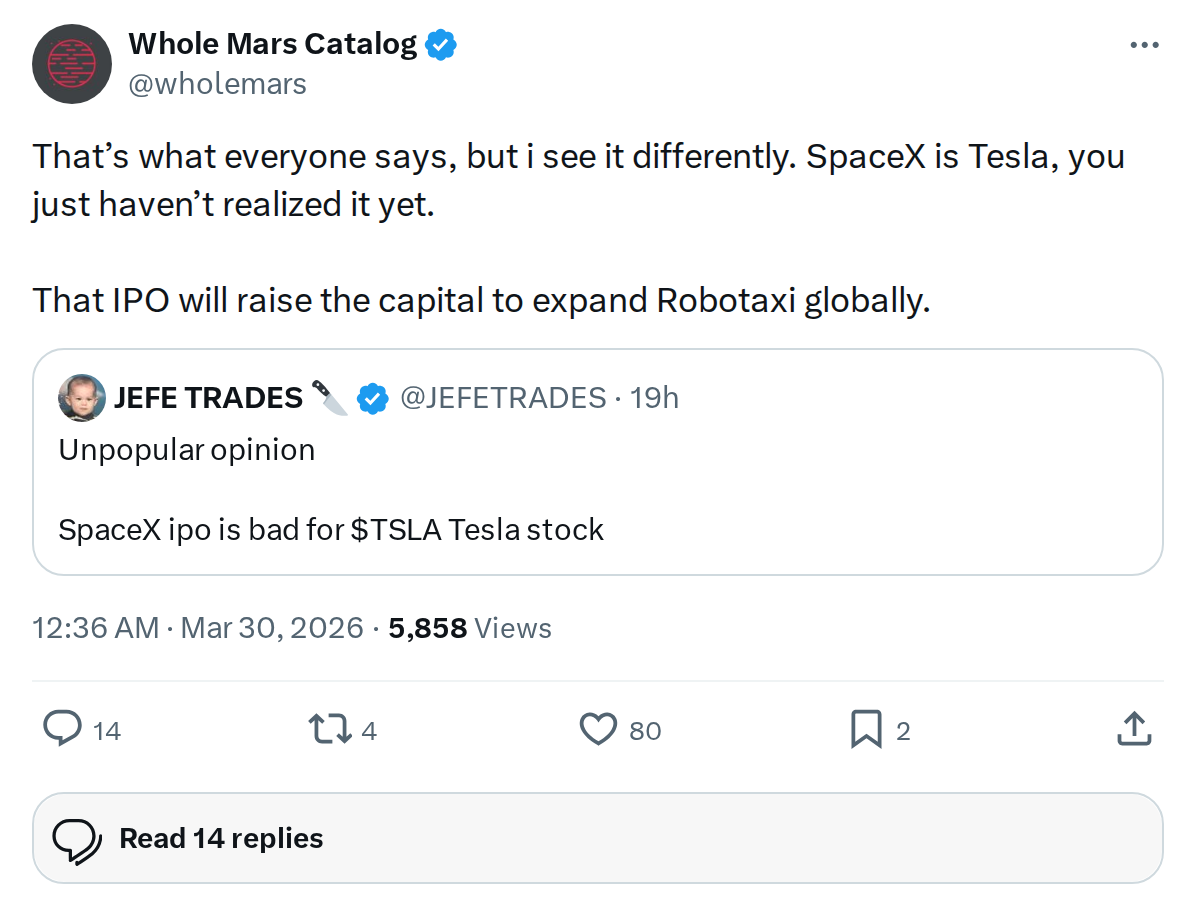
In a pair of posts this afternoon, he made a case that is blunt and worth taking seriously: SpaceX is Tesla, you just haven't realized it yet.

The argument isn't that a formal merger is imminent. It's that the companies are already functionally integrating at the infrastructure level — and that the next phase requires bringing them together formally, backed by a massive capital raise, to compete in what he calls the race to build AGI.

📊 Key Figures
| Metric | Value | Context |
|---|---|---|
| Terafab Investment | $20–25B | Joint Tesla/SpaceX/xAI chip fab, Austin TX |
| Terafab Chip Output Target | 100–200B chips/yr | 2nm process; supports FSD, Cybercab, Optimus, D3 |
| Tesla 2026 CapEx | >$20B | More than 2× the $8.5B spent in 2025 |
| Tesla Investment in xAI | $2B | Confirmed; xAI also acquired by SpaceX in all-stock deal |
| Cybercab Production Start | April 2026 | No steering wheel or pedals; dedicated robotaxi |
| Robotaxi U.S. Coverage Goal | 25–50% of U.S. | By end of 2026, pending regulatory approval |
| New Robotaxi Cities (H1 2026) | 7 cities | Dallas, Houston, Phoenix, Miami, Orlando, Tampa, Las Vegas |
Terafab: The First Domino
The concrete anchor for this thesis is Terafab — a joint chip fabrication facility formally launched on March 21, 2026, by Tesla, SpaceX, and xAI. The $20–25 billion facility, based in Austin, Texas, is designed to produce 100–200 billion custom AI and memory chips annually using 2-nanometer process technology.
What makes Terafab significant isn't just the scale — it's the shared ownership. Three companies that have historically operated with separate balance sheets and separate supply chains are now co-investing in shared physical infrastructure. That's not a partnership. That's integration.
The chips produced there will serve Tesla's Full Self-Driving software, the Cybercab robotaxi program, Optimus humanoid robots, and D3 chips designed for orbital AI satellites — which is a SpaceX domain. The supply chain is already cross-company by design.
Why Separation Made Sense — And Why It Might Not Anymore
Whole Mars Catalog's second point is arguably the more interesting one: keeping these companies separate made sense when they were early-stage and burning cash. Investors, regulators, and lenders needed clean corporate structures. Conflicts of interest needed to be managed carefully.
That calculus is shifting. SpaceX is profitable. Tesla is profitable. xAI is now folded into SpaceX via an all-stock acquisition. The argument for separation — financial fragility and regulatory optics — weakens when all three entities are mature, cash-generating, and already sharing infrastructure.
The argument for convergence, meanwhile, is getting stronger. Competing to build AGI requires compute at a scale that no single company can easily self-fund. Tesla's 2026 capital expenditure is confirmed to exceed $20 billion — more than double the $8.5 billion spent in 2025. That's a significant acceleration, but the AGI race may demand even more.
The SpaceX IPO as a Capital Event for Tesla Owners
Here's where the thesis gets directly relevant to Tesla shareholders and owners: a SpaceX IPO, if it happens, would be one of the largest capital raises in market history. Whole Mars Catalog's argument is that this capital wouldn't just benefit SpaceX — it would flow into the shared infrastructure that underpins Tesla's most ambitious programs.
Robotaxi global expansion is expensive. Building AI compute centers is expensive. Scaling Optimus to mass production is expensive. If SpaceX goes public and raises tens of billions, and if the companies continue to integrate operationally, Tesla's programs could effectively benefit from that liquidity without Tesla itself having to dilute shareholders.
It's a speculative thesis — Whole Mars Catalog is clear that this is his read, not an official announcement. But the factual scaffolding underneath it is real: Terafab exists, xAI is inside SpaceX, Tesla has confirmed a $2 billion investment in xAI, and Cybercab production is starting in April 2026.
🔭 The BASENOR Take
Timeline: Terafab launched March 21, 2026. Cybercab production begins April 2026. Seven new Robotaxi cities targeted for H1 2026. SpaceX IPO: no confirmed date.
Impact Level: 🔴 High — if the convergence thesis is correct, this reshapes how Tesla's long-term growth is funded and structured.
Confidence Rating: Medium. The infrastructure integration (Terafab, xAI acquisition) is confirmed. The SpaceX IPO and formal corporate convergence remain speculative.
Our Read: Whole Mars Catalog is connecting real dots. The companies are already sharing infrastructure, capital, and supply chains. Whether that leads to a formal merger or simply a tighter operational alliance is the open question — but Tesla owners should watch the SpaceX IPO story closely. It may matter to your investment more than most Tesla-specific news this year.
📰 Deep Dive
The most underappreciated element of this story is the xAI acquisition. When SpaceX absorbed xAI in an all-stock deal, it quietly created a structure where the AI research engine that powers Grok — and potentially future FSD iterations — sits inside the same corporate entity as the rocket company. Tesla then invested $2 billion into xAI. The result is a triangle of cross-ownership and shared incentives that didn't exist two years ago.
Terafab formalizes the infrastructure layer of that triangle. Producing chips at the 2-nanometer node, at volumes targeting 100 billion units annually, isn't something you build for one product line. It's a bet on a shared compute future — one where Tesla's FSD, SpaceX's orbital AI satellites, and xAI's model training all draw from the same silicon pool. That's not three companies cooperating. That's a vertically integrated AI stack spanning ground, software, and orbit.
The Robotaxi expansion timeline adds urgency to the capital question. Tesla is targeting 25–50% U.S. coverage by end of 2026, with seven new cities launching in the first half of the year alone. Cybercab — a purpose-built robotaxi with no steering wheel or pedals — enters production in April. Scaling that globally, as Whole Mars Catalog suggests a SpaceX IPO could fund, would require a capital base that dwarfs what Tesla's current cash generation can support alone. The IPO thesis isn't just financial engineering — it's a practical answer to a real funding gap.
None of this is guaranteed. A SpaceX IPO could be years away, or never. Regulatory approval for Robotaxi expansion in new cities remains uncertain. But the direction of travel — toward integration, toward shared infrastructure, toward a single AGI-oriented capital stack — is visible in the decisions already being made. Terafab isn't a rumor. It's a $20 billion commitment. That's the clearest signal yet that the separation era may be ending.
🚕 Following the Robotaxi rollout? See every operating city, launch date and announced market in our Tesla Robotaxi Tracker.
🤖 Tracking Tesla's humanoid robot? See every Optimus production milestone and appearance in our Tesla Optimus Tracker.
Related Gear
Gear up your Tesla with tested, custom-fit BASENOR accessories — shop Tesla accessories →
Sources & reporting notes
The links below identify the material source records used for this report.
- @wholemars on X (2026-03-29T16:41:39.000Z) — Direct source
- @wholemars on X (2026-03-29T16:36:37.000Z) — Direct source
Source links are preserved as published or accessed. See our editorial standards and corrections policy.
The BASENOR Editorial Desk covers Tesla, SpaceX, and related technology, curating reporting from primary sources — official accounts, regulatory filings, and software release data. Every article passes source-record and fact-checking review before publication. About the newsroom.
This report was curated by the BASENOR Editorial Desk from the sources listed above. Read our editorial standards or email editorial@basenor.com to report an error.