

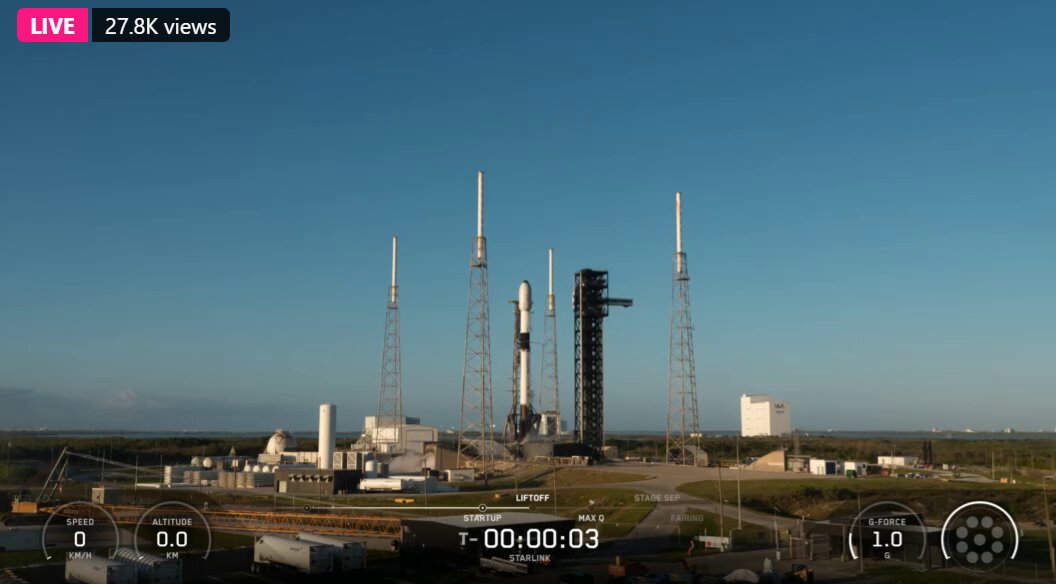
The News: SpaceX launched 29 Starlink V2 Mini Optimized satellites to low Earth orbit aboard a Falcon 9 from Cape Canaveral, Florida on April 2, 2026.
Why It Matters: Each Starlink batch pushes global broadband coverage further — more satellites means better speeds, lower latency, and expanded availability for Tesla owners using Starlink connectivity.
Source: @SpaceX | @NASASpaceflight
Another Falcon 9 Launch, Another Flawless Execution
At 7:55 a.m. EDT (11:55 UTC) on April 2, 2026, a Falcon 9 Block 5 rocket lifted off from Space Launch Complex 40 (SLC-40) at Cape Canaveral Space Force Station, carrying 29 Starlink V2 Mini Optimized satellites to low Earth orbit. The mission, designated Starlink Group 10-58, is the latest chapter in SpaceX's relentless push to blanket the globe with high-speed internet.

Booster B1085: 15 Flights and Counting
The real headline here isn't just the payload — it's the rocket. Booster B1085 completed its 15th flight with this mission, a remarkable demonstration of SpaceX's reusability engineering. This same booster has previously carried some of the most high-profile payloads in recent memory, including Crew-9 (NASA astronauts), Firefly Blue Ghost Mission 1, Fram2, SXM-10, MTG-S1, EchoStar XXV, and RRT-1, in addition to seven prior Starlink missions.
Following stage separation, B1085 executed a precision landing on the Just Read the Instructions droneship stationed in the Atlantic Ocean — right on schedule, right on target.

📊 Key Figures
| Metric | Value | Context |
|---|---|---|
| Satellites Deployed | 29 | Starlink V2 Mini Optimized variant |
| Mission Designation | Starlink Group 10-58 | Part of Shell 10 orbital plane |
| Booster | B1085 — Flight 15 | Previously flew Crew-9, Fram2, Blue Ghost & more |
| Launch Site | SLC-40, Cape Canaveral | Cape Canaveral Space Force Station, Florida |
| Booster Landing | ✅ Successful | Just Read the Instructions droneship, Atlantic Ocean |
| Launch Time | 7:55 a.m. EDT | April 2, 2026 (11:55 UTC) |
🔭 The BASENOR Take
Timeline: Launched April 2, 2026 — satellites expected to begin raising to operational orbit over the coming days.
Impact Level: 🟡 Moderate — routine expansion mission, but cumulative effect on network quality is significant.
Confidence: ✅ High — confirmed by SpaceX official account and NASASpaceflight independent tracking.
What makes this launch notable beyond the numbers is the booster story. B1085 at 15 flights is a walking advertisement for SpaceX's core economic thesis: reuse the rocket, slash the cost per kilogram to orbit, launch more often. The fact that a booster which carried NASA astronauts on Crew-9 is now routinely flying Starlink batches illustrates just how normalized rapid reusability has become.
The V2 Mini Optimized satellites being deployed here carry roughly four times the capacity of the original Starlink V1 satellites, meaning each successful batch has an outsized impact on total network throughput compared to early constellation builds. For Starlink subscribers — including those using it in remote areas where traditional ISPs don't reach — this translates directly into more consistent speeds and reduced congestion.
📰 Deep Dive
SpaceX's cadence in 2026 continues to be relentless. Missions like Starlink 10-58 are no longer headline events in isolation — they're infrastructure deployments, the orbital equivalent of laying fiber cable. The Starlink constellation is now large enough that each new batch is less about turning the service on and more about making it better: higher throughput, lower latency, and geographic redundancy that supports uninterrupted coverage even during satellite handoffs.
Booster B1085's 15-flight record also deserves a closer look. SpaceX has publicly stated ambitions to push boosters well beyond 20 flights, and B1085's history — spanning crewed missions, commercial satellites, and now routine Starlink runs — is a real-world stress test of that goal. Each successful landing on Just Read the Instructions reduces the marginal cost of the next launch, compounding the economic advantage SpaceX holds over any would-be competitor trying to build a rival broadband constellation.
For the broader Tesla ecosystem, Starlink's growth matters because Tesla and SpaceX share a common owner and increasingly share a strategic vision around connectivity. As Tesla vehicles evolve toward greater autonomy and data dependency, a robust, low-latency satellite network becomes less of a consumer product and more of a foundational piece of infrastructure. Today's launch is one more brick in that wall. You can follow our SpaceX coverage for the latest on constellation growth and what it means for the Tesla ecosystem.
Sources & reporting notes
The links below identify the material source records used for this report.
- @NASASpaceflight on X (2026-04-02T11:56:04.000Z) — Direct source
- @SpaceX on X (2026-04-02T11:45:14.000Z) — Direct source
Source links are preserved as published or accessed. See our editorial standards and corrections policy.
The BASENOR Editorial Desk covers Tesla, SpaceX, and related technology, curating reporting from primary sources — official accounts, regulatory filings, and software release data. Every article passes source-record and fact-checking review before publication. About the newsroom.
This report was curated by the BASENOR Editorial Desk from the sources listed above. Read our editorial standards or email editorial@basenor.com to report an error.






