30-Second Brief
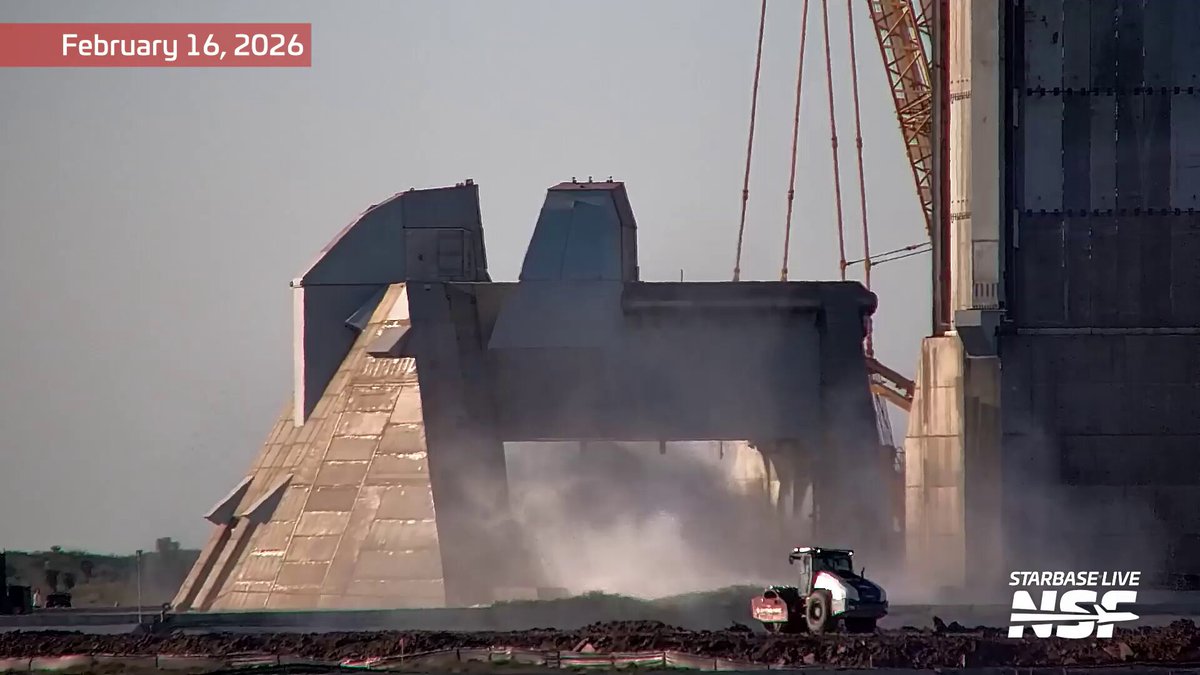
The News: SpaceX successfully completed a full water deluge system test at Starbase Orbital Launch Pad 2 around February 16–17, 2026, validating the pad's readiness to support Booster 19's upcoming static fire sequence ahead of Starship Flight 12.
Why It Matters: This milestone clears one of the final infrastructure hurdles before Pad 2 hosts its first-ever Starship launch — and keeps the early March 2026 Flight 12 target alive.
Source: @NASASpaceflight on X
SpaceX Completes Full Water Deluge Test at Starbase Pad 2 — Starship Flight 12 Path Clears
SpaceX has reached a pivotal infrastructure milestone at Starbase, successfully completing a full-scale water deluge system test at Orbital Launch Pad 2. The test, which took place around February 16–17, 2026, validates the pad's readiness to host the Starship Flight 12 stack — and brings SpaceX one significant step closer to an early March launch attempt.

📊 Key Figures
| Metric | Value | Context |
|---|---|---|
| Water Deluge Capacity | ~350,000 gallons | Deployed during full-scale activation to suppress heat and acoustic energy |
| Raptor 3 Engines (Booster 19) | 33 engines | Nearly 17 million lbs of combined thrust at liftoff |
| Booster 19 Cryo Tests | 4 tests completed | Conducted February 2–4, 2026; passed successfully |
| Flight 12 Target Window | Early March 2026 | Subject to static fire completion and regulatory clearance |
Why the Water Deluge Test Is a Big Deal
The water deluge system isn't a minor piece of hardware — it's the critical shield between a Starship launch and catastrophic pad damage. When Booster 19's 33 Raptor 3 engines ignite simultaneously, they generate nearly 17 million pounds of thrust, unleashing extreme heat and acoustic shockwaves powerful enough to destroy launch infrastructure without proper mitigation.
The system works by flooding the launch mount and flame deflector with roughly 350,000 gallons of water in the moments before and during ignition. This rapidly absorbs thermal energy and dampens the acoustic waves that would otherwise reflect back into the vehicle and the pad structure. At Pad 1 — the original Starbase orbital launch site — SpaceX learned this lesson the hard way during early Starship tests before the deluge system was operational. Pad 2 has had the benefit of those hard-won lessons baked into its design from day one.
A successful full-scale test means the system performed as designed under real-world conditions, not just simulations. That's the green light engineers needed before committing Booster 19 to the pad for its static fire.
Where Booster 19 and Ship 39 Stand Right Now
Booster 19 is a Block 3 variant — the first of the new generation to fly — and it has already cleared its cryogenic proof testing across four separate tests conducted between February 2–4, 2026. That process verifies structural integrity under the thermal and pressure stresses of propellant loading. It's passed.
The next step is engine installation. Booster 19 is awaiting the fitment of its 33 Raptor 3 engines before it can be rolled to Pad 2 for the static fire — a full-duration engine test where all 33 engines light simultaneously while the vehicle remains bolted to the pad. The static fire is the penultimate test before a flight attempt is formally declared.
Ship 39 will pair with Booster 19 to form the first complete Block 3 Starship stack. Together, they represent SpaceX's most advanced and capable Starship configuration to date, incorporating the upgraded Raptor 3 engines designed for higher thrust and improved efficiency over previous versions.
🔭 The BASENOR Take
Timeline: Deluge test complete (Feb 16–17) → Engine installation on Booster 19 (ongoing) → Static fire at Pad 2 → Flight 12 attempt (target: early March 2026)
Impact Level: 🟡 High — Pad 2 is a second launch site that dramatically increases SpaceX's launch cadence capability. A successful inaugural flight from Pad 2 doubles potential Starship launch throughput.
Confidence Rating: Moderate-High. All major pad infrastructure tests have passed. The remaining variable is the static fire outcome and any regulatory timing from the FAA.
📰 Deep Dive
Pad 2's significance extends well beyond Flight 12. SpaceX built the second orbital launch pad specifically to increase launch frequency — a single pad requires extensive refurbishment after each flight, creating a natural bottleneck. With two pads operational, SpaceX can process one vehicle while launching from the other, which is essential to achieving the high-cadence Starship manifest the company has been working toward.
The Block 3 designation on both Booster 19 and Ship 39 is also meaningful. Each hardware block represents a generational leap in performance and reliability. The Raptor 3 engines fitted to this stack are engineered to deliver meaningfully more thrust than their predecessors while simplifying the engine's design — fewer parts typically means higher reliability and lower cost per flight. SpaceX has historically been tight-lipped about exact Raptor 3 thrust figures, but the combination of 33 engines capable of producing nearly 17 million pounds collectively makes the Super Heavy the most powerful rocket booster ever built.
For the broader SpaceX mission, every successful Starship milestone is a rung on the ladder toward point-to-point Earth travel, lunar missions under NASA's Artemis program, and ultimately Mars. The pace at which SpaceX is moving through these infrastructure checkboxes — cryo testing, deluge validation, static fire, flight — suggests the program has found a rhythm that earlier iterations struggled to achieve.
Watch the static fire. That's the next major event that will confirm or revise the early March Flight 12 timeline. If it goes cleanly, the countdown to Starship's most capable launch attempt yet begins in earnest.
🚀 Following the Starship program? See every test flight, official outcome and the next launch window in our SpaceX Starship Tracker.
Sources & reporting notes
The links below identify the material source records used for this report.
- @NASASpaceflight on X (2026-02-19T01:34:51.000Z) — Direct source
Source links are preserved as published or accessed. See our editorial standards and corrections policy.
The BASENOR Editorial Desk covers Tesla, SpaceX, and related technology, curating reporting from primary sources — official accounts, regulatory filings, and software release data. Every article passes source-record and fact-checking review before publication. About the newsroom.
This report was curated by the BASENOR Editorial Desk from the sources listed above. Read our editorial standards or email editorial@basenor.com to report an error.