30-Second Brief
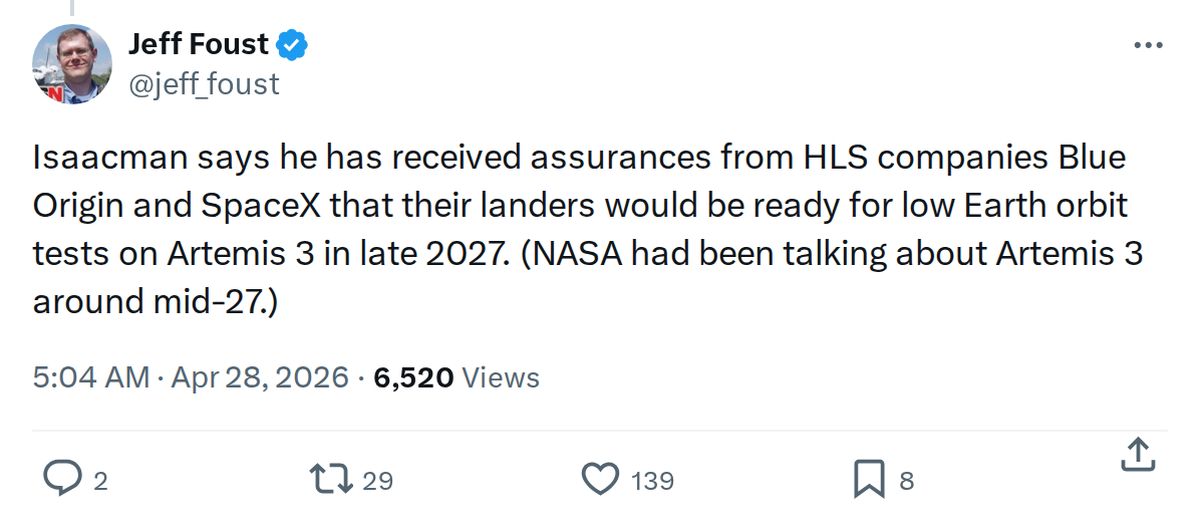
The News: NASA Administrator Jared Isaacman says SpaceX and Blue Origin have assured him their Human Landing System landers will be ready for low Earth orbit tests on Artemis 3 by late 2027 — a modest slip from NASA's previous mid-2027 target.
Why It Matters: Starship HLS is the vehicle that will put the next humans on the Moon. Any shift in its readiness timeline directly affects when that mission launches — and how much confidence NASA can place in its commercial partners.
Source: @jeff_foust on X
The Artemis 3 Timeline Just Shifted — Here's the Full Picture
NASA's Artemis 3 mission — the one that will return humans to the lunar surface for the first time since Apollo 17 — has been operating on a fluid schedule for years. The latest data point: NASA Administrator Jared Isaacman has received direct assurances from both SpaceX and Blue Origin that their Human Landing System landers will be ready for low Earth orbit (LEO) tests by late 2027.
That's a few months later than the mid-2027 window NASA had previously been working toward, but it's a confirmation rather than a warning sign — two commercial partners telling the agency's top official, on the record, that they can deliver.

📊 Key Figures
| Metric | Value | Context |
|---|---|---|
| Previous Artemis 3 target | Mid-2027 | NASA's prior internal planning date |
| Updated HLS LEO test target | Late 2027 | Confirmed by SpaceX and Blue Origin to Isaacman |
| HLS providers | 2 | SpaceX (Starship HLS) and Blue Origin (Blue Moon) |
| Timeline slip | ~3–6 months | From mid-2027 to late 2027 for LEO test readiness |
What Is the HLS LEO Test, Exactly?
Before either lander touches the Moon, NASA requires a demonstration in low Earth orbit — a shakedown of the spacecraft's systems, life support, docking interfaces, and propulsion in a controlled environment where rescue is still possible. Think of it as the final dress rehearsal before the real thing.
For SpaceX, that means flying a crewed-configuration Starship HLS variant to LEO and validating it can support astronauts. The LEO test is a prerequisite gate — no test, no Moon landing. Isaacman's confirmation that SpaceX has committed to late 2027 for this milestone is the clearest public signal yet that the program is moving forward on a concrete schedule.
Why the Slight Slip Isn't Necessarily Bad News
A few months of schedule adjustment on a program of this complexity is, frankly, unremarkable. What matters more is the nature of the update: this is a proactive assurance from the contractors to the NASA administrator, not a reactive admission after a missed deadline. That's a meaningfully different posture than what NASA watchers have grown accustomed to from large government space programs.
It also reflects a broader shift in how NASA is managing Artemis under Isaacman's leadership — tighter direct communication with commercial partners, faster acknowledgment of schedule realities, and less institutional inertia around preserving optimistic public timelines.
🔭 The BASENOR Take
Timeline: LEO test readiness confirmed for late 2027 | Lunar surface mission follows after successful test campaign
Impact Level: 🟡 Medium — A modest slip, but a firm commitment from two major contractors
Confidence: 🟢 High — Direct assurance to the NASA Administrator, reported by Jeff Foust, one of the most reliable aerospace journalists covering the sector
Analysis: The fact that Isaacman is publicly citing specific assurances from both SpaceX and Blue Origin suggests NASA is running a tighter accountability loop than in previous Artemis phases. For SpaceX specifically, Starship HLS represents one of the most complex configurations of the vehicle ever attempted — it requires on-orbit propellant transfer and extended life support capability that standard Starship flights do not. Late 2027 for a LEO test remains an aggressive target by any historical standard for crewed spacecraft development. If SpaceX hits it, it will be a landmark achievement for commercial human spaceflight.
📰 Deep Dive
Artemis 3 has been through multiple schedule revisions since NASA awarded SpaceX the HLS contract in 2021. The program's complexity stems partly from the dual-provider structure — both SpaceX and Blue Origin are developing independent landers, giving NASA redundancy but also doubling the coordination challenge. Isaacman's decision to seek and publicly cite direct assurances from both companies signals that he's treating schedule transparency as a priority from the outset of his tenure.
For SpaceX, the late 2027 commitment lands against a backdrop of rapid Starship development. The vehicle has now completed multiple full-stack test flights, with each iteration demonstrating meaningfully improved performance. The HLS variant, however, introduces requirements — long-duration crewed operations, propellant depot rendezvous, and a specialized lunar descent stage — that go well beyond what any Starship flight has demonstrated to date. The LEO test is designed to validate exactly those systems before committing a crew to a lunar trajectory.
The roughly three-to-six-month slip from mid- to late 2027 is worth watching but not alarming in isolation. The more significant question is whether the LEO test, once completed, can generate enough data for NASA to certify the vehicle for a crewed lunar descent within a reasonable window. That certification process — not the hardware readiness — has historically been where ambitious timelines compress into reality. For now, though, two commercial partners have put a stake in the ground, and the NASA administrator is holding them to it publicly. That's a different dynamic than Artemis has operated under before.
🚀 Following the Starship program? See every test flight, official outcome and the next launch window in our SpaceX Starship Tracker.
Sources & reporting notes
The links below identify the material source records used for this report.
- @jeff_foust on X (2026-04-27T21:04:59.000Z) — Direct source
Source links are preserved as published or accessed. See our editorial standards and corrections policy.
The BASENOR Editorial Desk covers Tesla, SpaceX, and related technology, curating reporting from primary sources — official accounts, regulatory filings, and software release data. Every article passes source-record and fact-checking review before publication. About the newsroom.
This report was curated by the BASENOR Editorial Desk from the sources listed above. Read our editorial standards or email editorial@basenor.com to report an error.