30-Second Brief
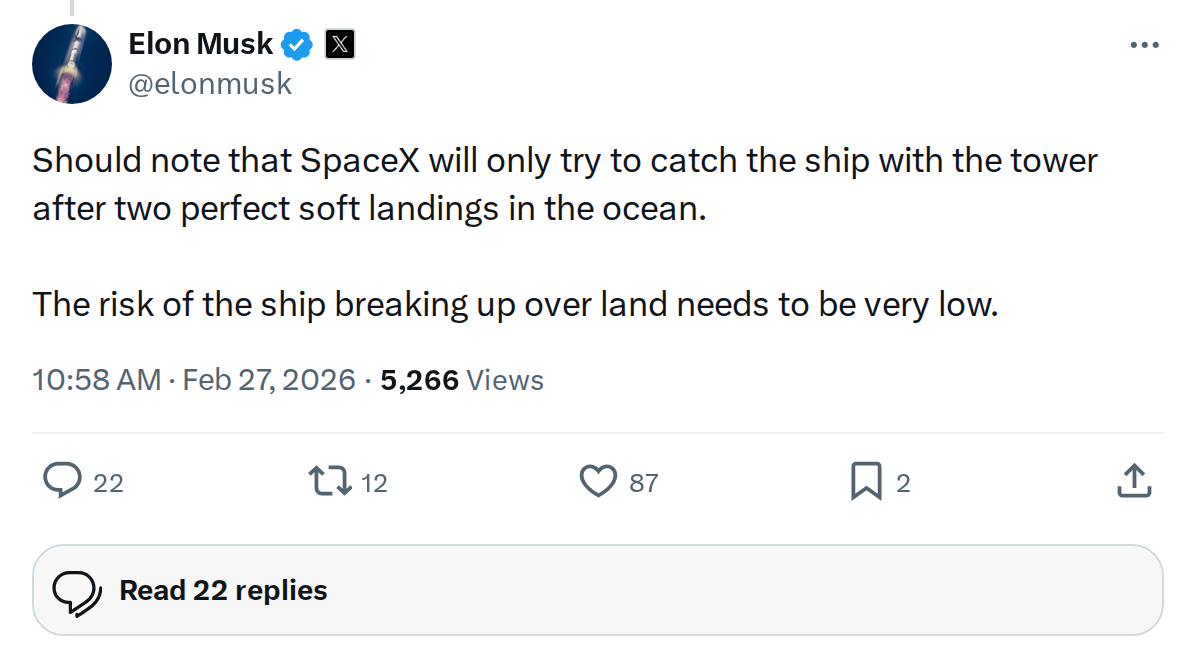
The News: Elon Musk has confirmed that SpaceX will only attempt to catch the Starship upper stage with the launch tower after completing two successful soft landings in the ocean.
Why It Matters: This conservative, safety-first approach sets a clear bar for Starship's full recovery milestone — and signals the program is further away from reusable ship operations than some had hoped.
Source: @elonmusk on X
SpaceX Won't Try to Catch Starship's Ship Until Two Perfect Ocean Landings Are Done
Elon Musk clarified a critical milestone in SpaceX's Starship recovery roadmap late Thursday: the Starship upper stage — the 'Ship' — will not be caught by the Mechazilla arms at the launch tower until it has demonstrated two flawless soft ocean landings. The announcement sets a clear, conservative bar for the next major chapter of Starship reusability.

📊 Key Figures
| Metric | Value | Context |
|---|---|---|
| Successful ship ocean landings required | 2 | Before any tower catch attempt |
| Successful ship ocean landings completed | 1 | Ship 31, Flight 6 (Nov 20, 2024) |
| Remaining ocean landings needed | 1 | Next upcoming Starship flight |
| Super Heavy booster catches completed | 1+ | First catch: Flight 5, Oct 13, 2024 |
Where Starship Stands Right Now
SpaceX's Mechazilla catch system — the giant robotic arms affixed to the orbital launch tower at Starbase — has already proven itself with the Super Heavy booster. The first-stage booster was successfully snagged out of the air on October 13, 2024, during Starship Flight 5, one of the most dramatic engineering demonstrations in spaceflight history.
But the Ship — Starship's upper stage — is a different beast. It re-enters the atmosphere belly-first, experiences extreme thermal and aerodynamic loads, and must flip upright before a precision landing. Ship 31 nailed an ocean splashdown during Flight 6 on November 20, 2024, marking the first time the upper stage survived re-entry intact. That counts as landing number one.
According to Musk's statement, SpaceX now needs one more clean ocean landing before it will even consider guiding the Ship back to the tower for a mechanical catch. The reasoning is straightforward: if anything goes wrong during a tower catch attempt, the spacecraft breaks up over land — not over open ocean. That is a risk SpaceX is not willing to accept until the Ship has proven it can handle re-entry reliably.
Why Two Landings? The Engineering Logic
One successful landing tells you the design works. Two tells you it's repeatable. For SpaceX, repeatability is the entire point — Starship's business case depends on rapid, full reusability of both stages. But before you bring a 50-meter, 100+ tonne vehicle back to a populated launch site, you need high confidence it won't scatter debris over South Texas.
Ocean landings serve as a critical validation step: they stress-test the new hardware — heat shield tiles, the flip maneuver, the engines during the landing burn — under real atmospheric conditions, but with the ocean as a forgiving landing zone. Any anomaly during an ocean landing is a lesson learned, not a catastrophe.
The tower catch, by contrast, demands near-perfection. The Ship must arrive at a precise point in space at the right speed, angle, and orientation for the arms to engage. Musk's two-landing prerequisite is essentially a minimum confidence threshold before SpaceX accepts that level of risk over the launch site.
🔭 The BASENOR Take
| Timeline | Earliest ship tower catch: late 2026, contingent on next flight success |
| Impact Level | MEDIUM-HIGH |
| Confidence | HIGH — Direct Musk Statement |
Musk's tweet is notable for what it reveals about SpaceX's internal risk calculus. The booster catch was attempted after a series of successful booster recoveries over water — the Ship program is now following the same methodical template. This is not a program cutting corners; it is a program that has learned to walk before it runs.
For the broader Starship mission — launching Starlink satellites at scale, the NASA Artemis lunar lander, and eventually crewed missions — full Ship reusability is non-negotiable. Every flight test that ends with a recovered Ship shaves enormous cost off the manifest. The two-landing gate is a small delay in the timeline but a smart one.
Prior reports had suggested a Ship catch could come as early as Flight 8, though timelines in the Starship program have always been fluid. With one successful ocean landing already banked, the next flight is the one to watch: a second clean Ship splashdown would clear the final prerequisite and put a tower catch formally on the agenda.
📰 Deep Dive
The asymmetry between the booster and the Ship catch timelines reflects a fundamental difference in re-entry complexity. The Super Heavy booster never goes to orbit — it separates at altitude, performs a boostback burn, and returns on a relatively predictable ballistic arc. The Ship, by contrast, travels at orbital velocities before re-entering, making thermal management and aerodynamic control exponentially harder to master. A Ship that breaks up during re-entry or a catch abort over land is a categorically different safety incident than a booster anomaly over the Gulf.
SpaceX's approach also reflects lessons from the broader history of reusable spaceflight. Falcon 9's booster landing program began with ocean drone-ship landings for years before SpaceX confidently brought boosters back to land. The institutional knowledge SpaceX gained from those incremental steps is now being applied, deliberately, to Starship. Two ocean landings is not an arbitrary number — it is the minimum data set SpaceX needs to trust that the Ship's re-entry behavior is understood and repeatable.
What this means practically: the next Starship integrated flight test will be mission-critical for the ship catch timeline. A successful ocean landing on that flight would green-light SpaceX to begin planning the first-ever tower catch of an orbital-class upper stage — an event that would rival Flight 5's booster catch as one of the most audacious engineering demonstrations ever attempted. The clock is ticking, and one more clean splashdown is all that stands between now and that moment. For our full SpaceX coverage, visit our SpaceX coverage.
🚀 Following the Starship program? See every test flight, official outcome and the next launch window in our SpaceX Starship Tracker.
Sources & reporting notes
The links below identify the material source records used for this report.
- @elonmusk on X (2026-02-27T02:58:41.000Z) — Direct source
Source links are preserved as published or accessed. See our editorial standards and corrections policy.
The BASENOR Editorial Desk covers Tesla, SpaceX, and related technology, curating reporting from primary sources — official accounts, regulatory filings, and software release data. Every article passes source-record and fact-checking review before publication. About the newsroom.
This report was curated by the BASENOR Editorial Desk from the sources listed above. Read our editorial standards or email editorial@basenor.com to report an error.