📌 UPDATE — February 27, 2026
Elon Musk has officially confirmed that Starship V3 SN1 is now entering ground tests, moving beyond its initial pad arrival into active pre-flight verification. In a post on X, Musk expressed that he is "highly confident" the V3 design will achieve full reusability — marking the first time he has stated this level of confidence publicly for the third-generation vehicle. Full reusability has been a central but elusive goal of the Starship program, and this statement signals SpaceX believes the V3 architecture has resolved the key engineering challenges that limited earlier iterations.

📌 View original post by @elonmusk — 15,135 likes · 1,628 retweets · 1.3M views
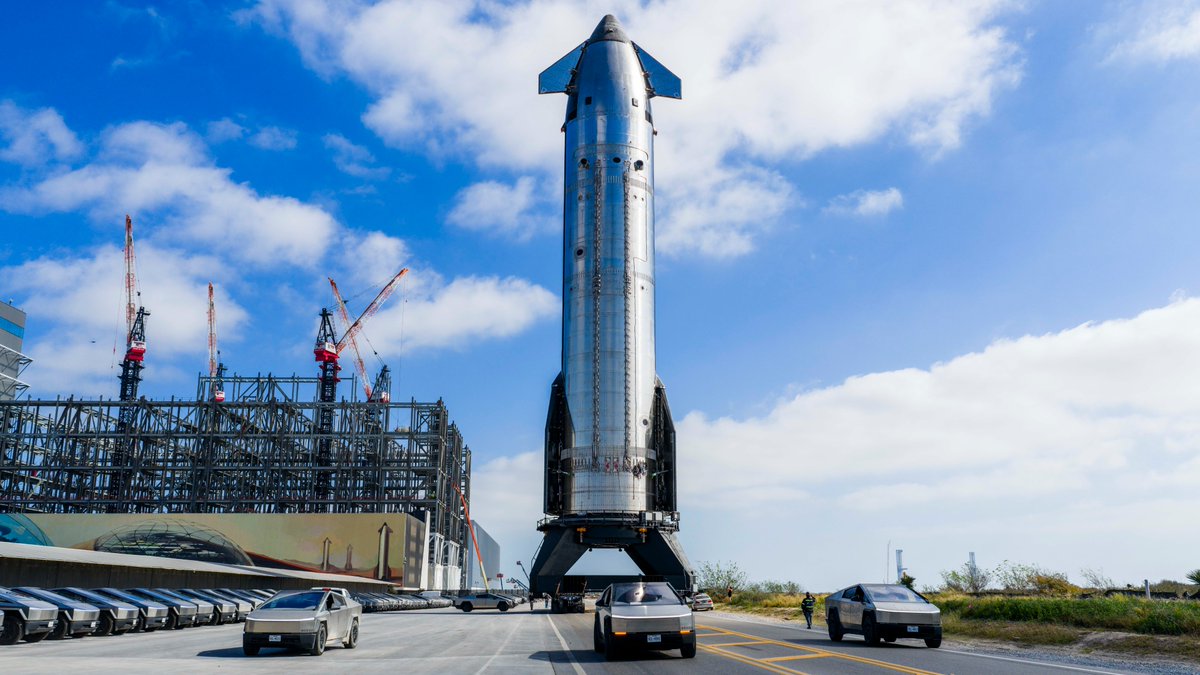
The News: SpaceX's first Starship V3 vehicle has rolled from the build site to the launch pad at Starbase to begin its prelaunch testing campaign.
Why It Matters: V3 is the most capable Starship iteration yet — taller, more powerful, and the first version SpaceX explicitly calls Mars-ready. A successful test campaign puts Flight 12 on track for March 2026.
Source: @SpaceX on X

📊 Key Figures
| Metric | Value | vs V2 |
|---|---|---|
| Height increase | +1.5 m (5 ft) | ↑ Taller |
| Liftoff thrust (33 Raptor 3s) | >9,000 tons | ↑ Higher |
| Saturn V comparison | ~3× Saturn V | — |
| Payload to LEO (fully reusable) | ~100 tons | ↑ Higher |
| Grid fin size vs V2 | ~50% larger | ↑ Bigger |
| Starlink V3 capacity vs Falcon V2 | >20× more | ↑ Larger |
What Makes V3 a Generational Leap
Starship V3 isn't a minor refresh. It's a top-to-bottom redesign built around one goal: making the rocket manufacturable at scale while pushing performance to new limits. The V3 Super Heavy booster — with Booster 18 being the first of its kind — carries 33 Raptor 3 engines, each producing more thrust at lower cost and weight than the Raptor 2s that flew previously.
The airframe itself is about 1.5 meters taller than V2, and the booster's three grid fins are roughly 50% larger — changes that improve aerodynamic control during the high-speed descent and catch maneuver back at the launch tower. An integrated hot stage ring is also part of the V3 architecture, a design choice SpaceX carried forward after validating the concept on earlier flights.
Combined thrust at liftoff exceeds 9,000 metric tons — approximately three times what the Saturn V produced. That figure isn't just a headline number; it translates directly into payload capacity. V3 is designed to lift close to 100 tons to low Earth orbit in a fully reusable configuration, a threshold that opens the door to missions that were previously impractical.
A Rocky Start: The Booster 18 Anomaly
V3 testing hasn't been entirely smooth. According to reporting from Space.com and Gizmodo, Booster 18 experienced an anomaly during gas system pressure testing in November 2025, resulting in damage to its liquid oxygen tank section. SpaceX confirmed no propellant or engines were aboard at the time and no injuries occurred — but the incident underscored that V3's redesigned propellant systems are being stress-tested seriously before any flight hardware is committed to launch.
The cause of that anomaly is still under investigation. Whether it affects the timeline for Flight 12 — currently anticipated for March 2026 according to Elon Musk — depends on what the test campaign now underway reveals about the vehicle's structural integrity and system readiness.
🔭 The BASENOR Take
| Timeline | Flight 12 targeted March 2026 — contingent on prelaunch test results |
| Impact Level | 🔴 High — V3 is the foundation for NASA Artemis HLS, Starlink V3, and Mars architecture |
| Confidence | Medium — rollout to pad is confirmed; flight readiness depends on test outcomes |
The move from build site to launch pad is the first concrete milestone that puts V3 on a credible near-term flight path. It signals that SpaceX has cleared internal manufacturing and integration gates — a meaningful hurdle given the Booster 18 pressure anomaly last November.
But the real story isn't just the rocket. V3 is the first Starship iteration SpaceX has explicitly designed with Mars missions in mind, incorporating docking ports for on-orbit propellant transfer — a capability NASA requires for the Artemis III lunar landing under the Human Landing System contract. Key HLS milestones, including a long-duration flight test and in-space propellant transfer demonstration, are targeted for 2026. Whether that schedule holds depends almost entirely on how cleanly V3's test campaign runs over the coming weeks.
On the commercial side, V3 is also the vehicle that will carry the next generation of Starlink satellites — the V3 Starlinks — which SpaceX says will increase constellation capacity by more than 20 times compared to current Falcon 9 launches of V2 satellites. That's not a marginal upgrade; it's a step-change in the economics of satellite broadband. For SpaceX coverage, this is arguably the most consequential hardware milestone since the first Starship catch maneuver. The pad arrival doesn't guarantee a March launch — but it means the window is real.
🚀 Following the Starship program? See every test flight, official outcome and the next launch window in our SpaceX Starship Tracker.
Sources & reporting notes
The links below identify the material source records used for this report.
- @SpaceX on X (2026-02-26T22:08:39.000Z) — Direct source
- @elonmusk on X (2026-02-27T01:12:04.000Z) — Direct source
Source links are preserved as published or accessed. See our editorial standards and corrections policy.
The BASENOR Editorial Desk covers Tesla, SpaceX, and related technology, curating reporting from primary sources — official accounts, regulatory filings, and software release data. Every article passes source-record and fact-checking review before publication. About the newsroom.
This report was curated by the BASENOR Editorial Desk from the sources listed above. Read our editorial standards or email editorial@basenor.com to report an error.