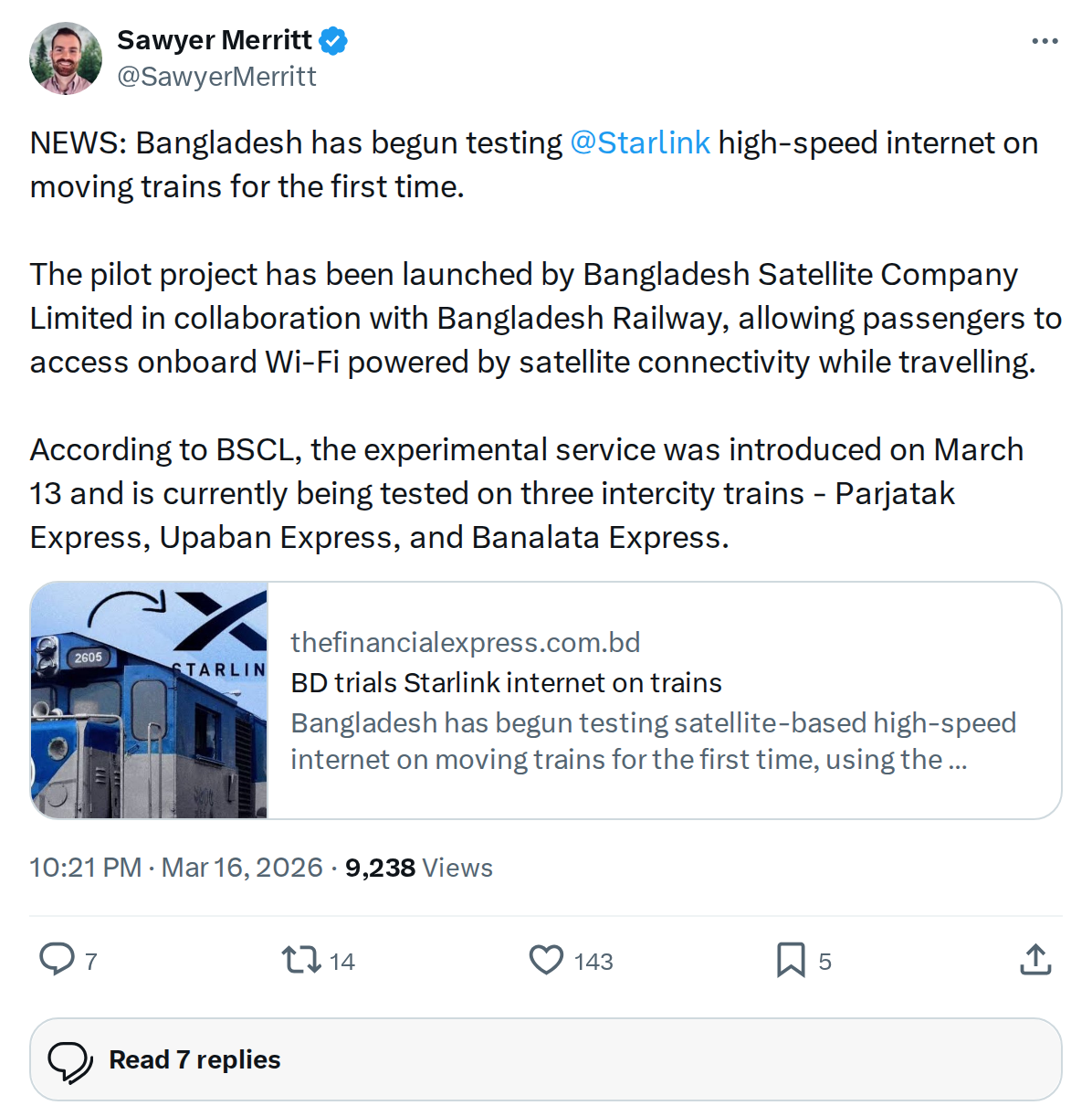
The News: Bangladesh has launched the country's first Starlink-powered Wi-Fi service on moving intercity trains, in a pilot run by Bangladesh Satellite Company Limited (BSCL) and Bangladesh Railway.
Why It Matters: Real-world speed tests recorded up to 136 Mbps download on a moving train — proving Starlink's low-Earth orbit network can deliver genuine broadband on rail, not just marginal connectivity.
Source: @SawyerMerritt on X

Starlink Hits the Rails in Bangladesh — And the Numbers Are Impressive
On March 14, 2026, Bangladesh became one of the first countries in South Asia to run live Starlink satellite internet on a moving passenger train. The pilot, jointly executed by Bangladesh Satellite Company Limited (BSCL) — an authorized Starlink partner — and Bangladesh Railway, is currently active on three VIP intercity routes: the Paryatak Express, Upoban Express, and Bonolata Express, all serving the high-traffic Dhaka–Chattogram–Cox's Bazar corridor.
The service is currently free for passengers. Government oversight came directly from the top: Rehan Asif Asad, adviser to the Prime Minister on Posts, Telecommunications and IT, personally observed the trial operations — a signal that this isn't a quiet internal test, but a nationally backed infrastructure push.
📊 Key Figures
📡 Starlink Rail Trial — Measured Performance
| Metric | Range (Live Journey) | Peak (Starlink App Test) |
|---|---|---|
| Download Speed | 8 – 88 Mbps | 136 Mbps |
| Upload Speed | 13 – 47 Mbps | 31 Mbps |
| Latency | 23 – 47 ms | 31 ms |
Source: Independent assessments during live Dhaka–Chattogram–Cox's Bazar train journey, March 14, 2026.
To put those numbers in context: 88 Mbps on a moving train is faster than the fixed broadband many households receive. The 23 ms latency floor is low enough for video calls and real-time applications — not just casual browsing. Even the floor of 8 Mbps is workable for streaming and productivity. This isn't "airplane mode" connectivity. It's real broadband.
How It Works: Starlink + PoE on Rails
The technical setup combines Starlink's low-Earth orbit satellite terminals with advanced Power over Ethernet (PoE) systems to distribute connectivity throughout train carriages. Unlike geostationary satellite internet — which suffers from 600+ ms latency and struggles with handoffs — Starlink's LEO constellation maintains low latency even as the train moves through different coverage zones. The satellite network continuously hands off connections between overhead satellites, keeping the link stable at speed.
BSCL's role as an authorized Starlink partner means the hardware and service agreements are already in place for rapid scaling — no need to renegotiate from scratch if the pilot succeeds.
What Comes Next
Bangladesh Railway isn't stopping at three routes. According to verified reports, three additional corridors — Dhaka–Rajshahi, Dhaka–Sylhet, and Dhaka–Khulna — are expected to receive Starlink Wi-Fi within days of this article's publication. Beyond rail, the government has announced plans to install high-capacity Wi-Fi at several airports and major railway stations before Eid — a hard deadline that suggests real urgency behind the rollout.
If the pilot is deemed successful, a permanent nationwide rollout across all nonstop and high-demand intercity trains is on the table.
🔭 The BASENOR Take
Timeline: Pilot launched March 14, 2026 — expansion to 3 more routes imminent
Impact Level: 🌍 High — establishes a replicable model for Starlink rail deployments globally
Confidence: ✅ High — government-confirmed, independently speed-tested, multiple verified sources
Bangladesh is a meaningful data point for Starlink's global ambitions, but the real story here is the proof of concept for rail. Moving trains are one of the hardest environments for satellite internet — constant motion, signal handoffs, metal carriages that attenuate signals, and the expectation of hundreds of simultaneous users. If Starlink can deliver 136 Mbps peak and sub-50 ms latency on a Bangladeshi intercity train, the same hardware and configuration is viable on commuter rail in Europe, freight corridors in Africa, and high-speed lines in Southeast Asia.
For SpaceX, every new country that deploys Starlink on public infrastructure is both a revenue contract and a reference customer. Bangladesh joins a growing list of governments treating Starlink not as a consumer gadget, but as national infrastructure. The Eid deadline for airport and station Wi-Fi is particularly telling — this administration wants visible results fast, which means the pressure to declare the pilot a success is real.
The speed variance (8 Mbps to 136 Mbps) is worth watching. That range likely reflects satellite geometry, terrain, and concurrent user load rather than a hardware ceiling. As SpaceX continues launching satellites and densifying coverage over South Asia, the floor should rise. The question for future deployments isn't whether Starlink works on trains — Bangladesh just answered that. The question is whether the economics work at scale, and whether free passenger Wi-Fi eventually transitions to a paid or carrier-subsidized model. For now, the engineering case is made.
For our full SpaceX coverage, including Starlink's expanding global footprint, follow the BASENOR news feed.
Sources & reporting notes
The links below identify the material source records used for this report.
- @SawyerMerritt on X (2026-03-16T14:21:54.000Z) — Direct source
Source links are preserved as published or accessed. See our editorial standards and corrections policy.
The BASENOR Editorial Desk covers Tesla, SpaceX, and related technology, curating reporting from primary sources — official accounts, regulatory filings, and software release data. Every article passes source-record and fact-checking review before publication. About the newsroom.
This report was curated by the BASENOR Editorial Desk from the sources listed above. Read our editorial standards or email editorial@basenor.com to report an error.