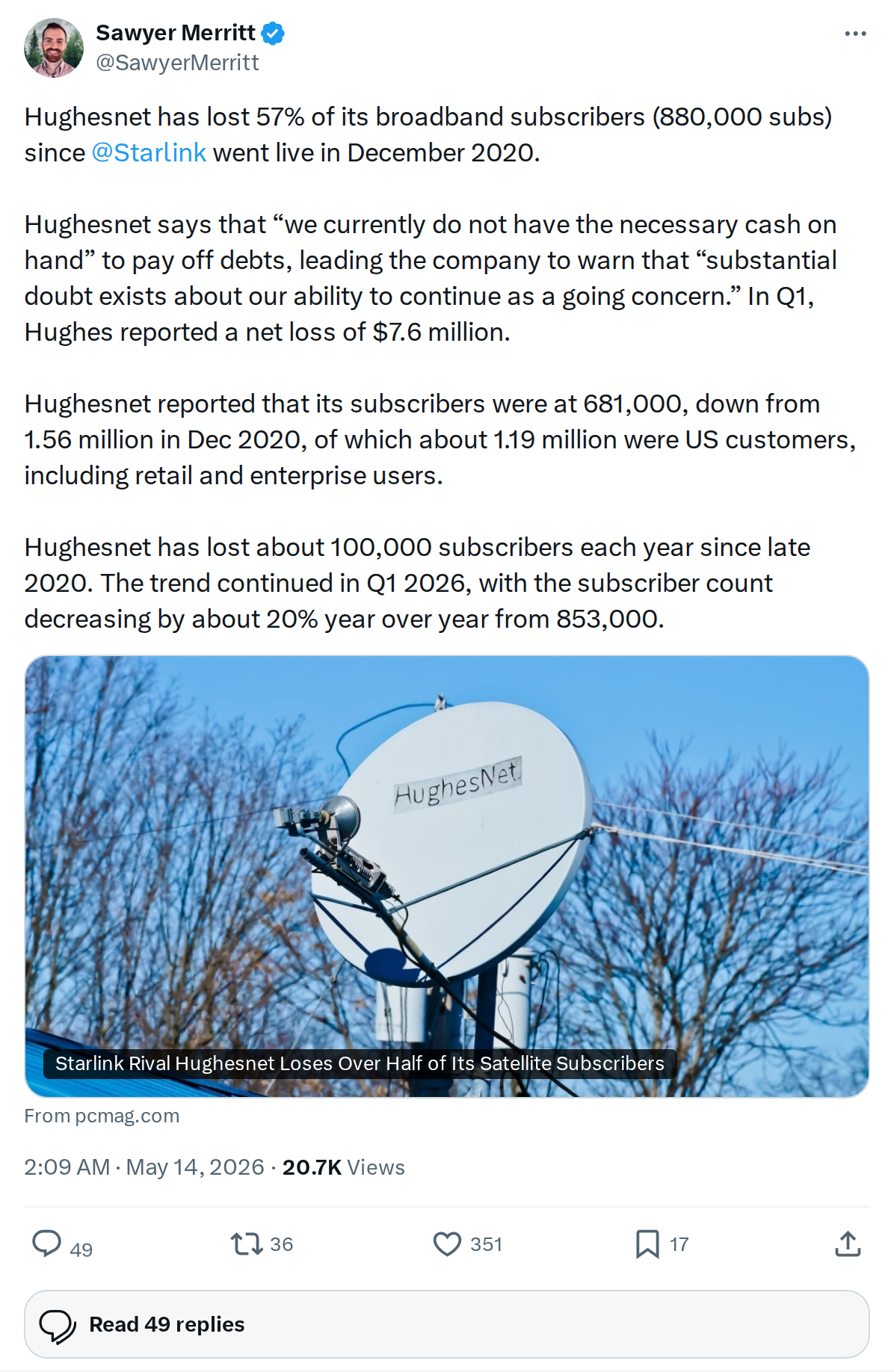
Since Starlink began serving U.S. consumers in December 2020, Hughesnet has lost more than half its broadband customer base. The numbers, confirmed in SEC filings, tell a stark story: 1.56 million subscribers at Starlink's launch, down to 681,000 by March 2026. That's a 57% collapse in five and a half years — and the company is now openly questioning whether it can survive.

The Numbers Behind the Collapse
Hughesnet's decline isn't a slow bleed — it's been accelerating. According to SEC filings, the company lost 100,000 broadband customers in just the nine months ending September 30, 2025, steeper than the 92,000 lost during the same window in 2024. By February 2025, the subscriber count had already fallen to 883,000. By March 31, 2026, it stood at 681,000.
In a November 2025 SEC filing, Hughesnet's parent company EchoStar admitted it lacked the cash or projected cash flows to meet obligations over the following twelve months — language that triggers a formal "substantial doubt" going-concern warning. The immediate pressure point: a $1.5 billion debt obligation maturing in August 2026. The company posted a net loss of $7.6 million in Q1 2026 alone.
| Metric | Figure |
|---|---|
| Hughesnet subscribers (Dec 2020) | 1,560,000 |
| Hughesnet subscribers (Mar 2026) | 681,000 |
| Subscriber loss | ~880,000 (57%) |
| Debt maturing Aug 2026 | $1.5 billion |
| Starlink global subscribers (Mar 2026) | 10.4 million+ |
| Starlink avg. US download speed (Q1 2026) | 127 Mbps |
| Hughesnet avg. US download speed | 48.55 Mbps |
Why Hughesnet Couldn't Compete
The performance gap is unambiguous. Starlink delivers average U.S. download speeds of 127 Mbps with latency in the 20–30 millisecond range. Hughesnet averages 48.55 Mbps with latency that can exceed 600 milliseconds on its geostationary network — a fundamental physical limitation of satellites orbiting 35,000 kilometers above Earth. Starlink's low-Earth orbit constellation operates at roughly 550 kilometers. No amount of pricing adjustment or marketing can close that gap.
For rural and remote customers — Hughesnet's core market — Starlink didn't just offer a better option. It offered a qualitatively different experience: video calls that actually work, gaming that's playable, upload speeds that support remote work. Once that alternative existed at a comparable price point, the migration was predictable.
The SpaceX Lifeline — and What It Means
The most telling development isn't the subscriber loss itself — it's what EchoStar agreed to do about it. The company entered into a $17 billion agreement with SpaceX that includes the sale of spectrum licenses, options for SpaceX to acquire Hughes satellites and regulatory assets, and — critically — an obligation for Hughesnet to refer its remaining subscribers directly to Starlink.
In other words, Hughesnet's exit strategy is to hand its customer base to the company that displaced it. That's not a pivot; it's a surrender formalized in a contract. EchoStar is also shifting its remaining business toward enterprise customers, with enterprise revenue projected to reach 50% of total revenue — up from 35% two years prior. Consumer satellite broadband, as Hughesnet practiced it, is effectively over.
Starlink, meanwhile, crossed 10 million global subscribers in February 2026 — a milestone that took traditional satellite providers decades to approach and that Starlink reached in roughly five years. The trajectory shows no signs of flattening. Whether the remaining 681,000 Hughesnet customers complete their migration to Starlink or find other options, the competitive question in rural broadband has already been answered.

Sarah focuses on Tesla Energy, SpaceX missions, and the broader Musk AI portfolio. Former data analyst in clean energy. Based in San Francisco.
Sources verified at publish time. Spotted an inaccuracy? Email editorial@basenor.com.