📋 30-Second Brief
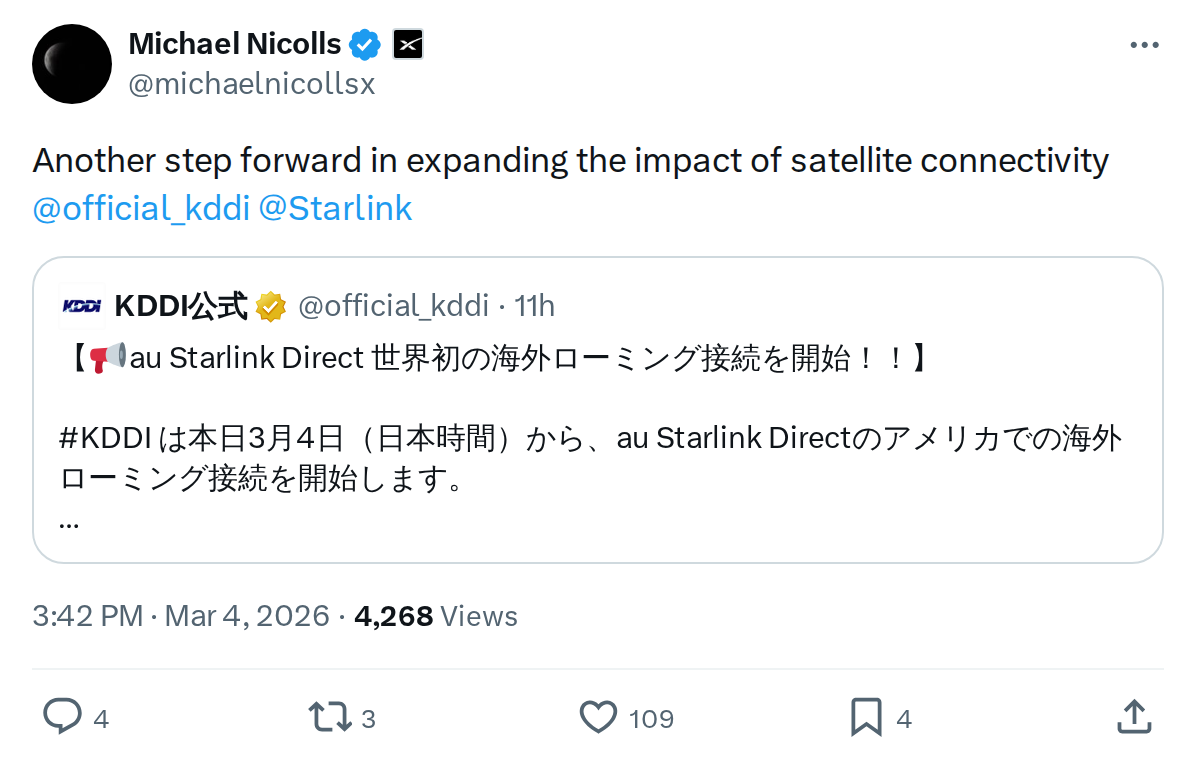
The News: Starlink and KDDI, Japan's major telecom operator, have launched "au Starlink Direct" — a direct-to-cell satellite service that brings connectivity to 40% of Japan's landmass previously unreached by terrestrial mobile networks.
Why It Matters: This is a real-world proof point that Starlink's satellite-to-smartphone technology works at national scale — the same infrastructure that underpins Tesla's future connectivity ambitions and SpaceX's global direct-to-cell rollout.
Source: @michaelnicollsx on X

📊 Key Figures
| Metric | Value | Context |
|---|---|---|
| Japan landmass newly covered | ~40% | Previously zero cellular coverage |
| SMS/Messaging service launch | April 10, 2025 | First direct-to-cell in Asia |
| Data connectivity launch | August 2025 | World's first satellite data service of its kind |
| Compatible smartphones at launch | 50+ models | Android + iPhones with satellite mode |
| iPhone models supported (by Sep 2025) | 21 models | iPhone 13 through iPhone 17 + Air |
| Pricing for non-au customers | ¥1,650/month | First 3 months free (from Sep 1, 2025) |
| Partnership agreement signed | August 30, 2023 | ~18 months from deal to live service |
From Dead Zones to Full Coverage: What KDDI and Starlink Built
Japan is a country where geography makes terrestrial mobile coverage genuinely difficult. Mountains, remote islands, dense forests — roughly 40% of the country's landmass had no cellular signal at all. The KDDI and Starlink partnership set out to fix that, and the results are now live.
The service, branded "au Starlink Direct," launched in two phases. First came SMS and messaging — including RCS, iMessage, and location sharing — in April 2025, making it the first direct-to-cell satellite service in all of Asia. Then, in August 2025, KDDI pushed it further by activating data connectivity, becoming what KDDI claims is the world's first satellite data communication service of its kind.
The data service isn't designed for streaming video. It's built for exactly the use cases that matter most when you're off-grid: Google Maps navigation, weather alerts, emergency broadcasts (including Japan's earthquake and tsunami J-Alert system), and outdoor apps like YAMAP. These are the tools that can genuinely save lives — and that's precisely the point.
🛰️ What "au Starlink Direct" Delivers
- SMS, RCS, and iMessage in areas with zero cell coverage
- Data access for Google Maps, X, Weathernews, NERV Disaster Prevention, YAMAP
- Emergency earthquake, tsunami, and J-Alert notifications
- Google Gemini AI assistant via text (Android users)
- Drone operations support in radio-inaccessible terrain
- International roaming to the US via T-Mobile (planned, FY2025)
Device Support: Who Can Use It Right Now
At launch, the service supported 50 smartphone models. For data connectivity specifically, initial hardware support focused on Google Pixel 10 series and Samsung Galaxy Z Fold 7 and Flip 7. By September 2025, Apple's lineup was fully onboarded — all iPhone 13 through iPhone 17 models, plus the iPhone Air, totalling 21 iPhone models.
For existing au customers, the service was initially rolled in at no extra charge. Non-au users — including those on UQ mobile and povo — can access a standalone plan at ¥1,650 per month, with the first three months free for sign-ups after September 1, 2025. UQ mobile Toku-Toku plan subscribers get a discounted rate of ¥550 per month.
🔭 The BASENOR Take
The KDDI partnership is more than a telecom story. It's a live validation of the direct-to-cell model that Starlink has been building toward — and the same infrastructure that will eventually matter to Tesla owners.
SpaceX's President & COO Gwynne Shotwell called it "game-changing" for connecting the unconnected and enabling disaster response. That's not marketing language — Japan's geography makes it a genuine stress test. If direct-to-cell works reliably across Japan's mountains and remote islands, it works anywhere.
The T-Mobile angle is worth watching closely. KDDI plans to extend au Starlink Direct roaming to the US through T-Mobile during FY2025. T-Mobile is already Starlink's primary direct-to-cell partner in the United States. As these networks interlink, the case for satellite connectivity as a standard vehicle feature — not just a smartphone add-on — gets stronger with every partnership signed. For Tesla owners, that's the long game here. For our broader SpaceX coverage, this is a milestone worth tracking.
📰 Deep Dive
The speed of this rollout is striking. KDDI and SpaceX signed their agreement in August 2023. By April 2025 — roughly 18 months later — a live commercial service was available to millions of Japanese smartphone users. By August 2025, data connectivity was active. That's a compressed timeline for national infrastructure deployment, and it signals that Starlink's direct-to-cell technology is maturing faster than most industry observers expected.
The choice of initial data apps is deliberate and smart. Rather than promising broadband-equivalent speeds (which low-earth orbit direct-to-cell cannot yet deliver at scale), KDDI launched with apps optimized for low-bandwidth, high-utility scenarios. Navigation, disaster alerts, weather — these are the services that matter most when you're in a dead zone. It sets realistic expectations while still delivering genuine value, which is exactly how you build trust in a new technology category.
The disaster preparedness angle deserves particular attention. Japan is one of the world's most seismically active countries. Having a satellite-backed fallback for emergency alerts and location sharing — one that doesn't depend on terrestrial towers that can be damaged in an earthquake — is a meaningful public safety upgrade. Gwynne Shotwell's emphasis on "life-saving capabilities" isn't hyperbole in this context.
Looking ahead, the planned US roaming capability via T-Mobile creates a template for how these partnerships can compound. A Japanese au customer traveling to the US stays connected via Starlink satellites routed through T-Mobile's spectrum. An American T-Mobile customer visiting Japan could theoretically benefit from the same arrangement in reverse. As more national carriers sign similar agreements, Starlink's satellite network becomes the de facto global connectivity backstop — a position that has significant implications for every connected device, including the Teslas in your driveway.

Sarah focuses on Tesla Energy, SpaceX missions, and the broader Musk AI portfolio. Former data analyst in clean energy. Based in San Francisco.
Sources verified at publish time. Spotted an inaccuracy? Email editorial@basenor.com.