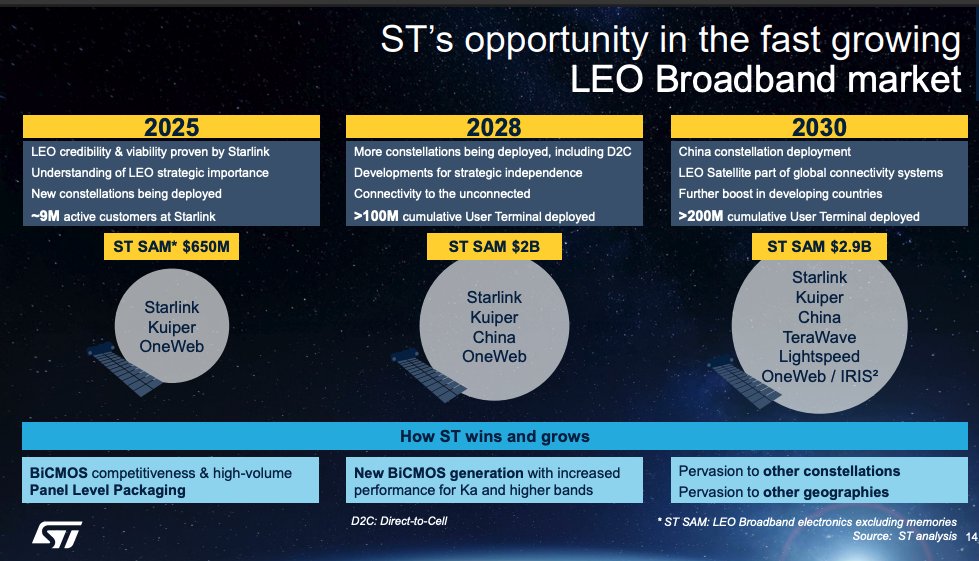
A key chip supplier to SpaceX just put a number on Starlink's ambitions — and it's staggering. STMicroelectronics, which manufactures front-end antenna modules and the STM32 chip used inside Starlink dishes, told investors on May 4 that it expects the broader low-Earth orbit (LEO) satellite internet market to surpass 100 million subscribers by 2028 and 200 million by 2030. The projection underscores just how seriously the semiconductor industry is betting on satellite connectivity as the next major growth platform.

From 10 Million to 200 Million
To appreciate how aggressive this forecast is, consider where Starlink stands today. As of February 2026, SpaceX reported over 10 million active users worldwide. Reaching 100 million by 2028 would require roughly a 10x increase in roughly two years — a pace that makes even optimistic observers pause. Getting to 200 million by 2030 would put Starlink in the same conversation as some of the largest mobile carriers on the planet.
These projections came directly from Remi El-Ouazzane, President of STMicroelectronics, during an investor presentation. It's worth noting that STMicro's forecast covers the broader LEO satellite internet market — not Starlink alone. Competitors including Amazon's Kuiper and emerging Chinese providers are factored into the outlook. Still, given Starlink's commanding head start and global infrastructure, the company would almost certainly capture the lion's share of that subscriber base.
The Chip Numbers Behind the Forecast
STMicroelectronics isn't speculating from the sidelines. The company has a decade-long partnership with SpaceX and has already shipped over 7.5 billion integrated chips for Starlink — up from 5 billion as recently as December 2025. That's a remarkable production ramp in just a few months, and the company projects that figure could reach approximately 10 billion chips by 2027.
On the hardware side, Starlink is currently producing more than 20,000 user terminals per day. That manufacturing throughput is a prerequisite for any subscriber growth at this scale — you can't sign up 200 million users if you can't ship 200 million dishes. The terminal production rate suggests SpaceX is already building toward the demand STMicro is forecasting.
Why a Supplier's Forecast Matters
Analyst projections about Starlink are common. A forecast from a direct hardware supplier carries different weight. STMicroelectronics has visibility into SpaceX's actual purchase orders, production roadmaps, and chip demand curves — the kind of ground-level data that outside analysts simply don't have access to. When a company that makes the physical components of Starlink dishes tells its investors to expect 20x user growth in four years, it's not a guess. It's a signal embedded in real order books.
The broader implication is that the satellite internet market is approaching an inflection point. For years, LEO connectivity was a niche product — expensive, limited in availability, and primarily serving maritime, aviation, and rural customers. A 200-million-user market would make it a mainstream infrastructure layer, competing directly with terrestrial broadband in underserved regions across Africa, Southeast Asia, and Latin America.
Whether Starlink can execute on that scale — navigating regulatory approvals country by country, managing spectrum coordination, and keeping terminal prices accessible — remains the open question. But the supply chain is clearly being built to support it. For our full SpaceX coverage, see SpaceX coverage.

Sarah focuses on Tesla Energy, SpaceX missions, and the broader Musk AI portfolio. Former data analyst in clean energy. Based in San Francisco.
Sources verified at publish time. Spotted an inaccuracy? Email editorial@basenor.com.