📌 UPDATE — March 22, 2026
Following the propellant-loaded igniter test, NASASpaceflight confirms Booster 19 will return to the pad with its full complement of 33 engines for Flight 12 — this time equipped with the new V3 Booster hardware and Raptor 3 engines, marking several simultaneous firsts for the Starship program. Work is also continuing at the newly activated Pad 2 at Starbase, adding yet another milestone to this vehicle's already historic campaign. The combination of upgraded booster structure, next-gen engines, and a second launch pad represents a significant leap in SpaceX's Starship infrastructure ahead of Flight 12.
@NASASpaceflight · Mar 21, 2026
"Following several firsts—ranging from the V3 Booster and Raptor 3 engines to Pad 2 at Starbase—work is continuing ahead of Booster 19's return, next time with 33 engines, ahead of Flight 12."
View on X →
📌 UPDATE — March 18, 2026
SpaceX has officially confirmed the completion of the initial Super Heavy V3 and Starbase Pad 2 activation campaign. In an official statement, SpaceX confirmed the 10-engine static fire test concluded early due to a ground-side (GSE) issue — not a booster problem — and was still deemed successful. Critically, this campaign marked the first-ever cryogenic fuel and oxidizer loading on a V3 vehicle. NSF confirmed the shorter-than-expected burn was a ground support equipment issue, reinforcing that Booster 19 itself performed as expected. Elon Musk followed up with a bullish signal, posting "Getting closer to Starship launch! 🚀" — suggesting Flight 12 preparations are accelerating.


The News: SpaceX completed Booster 19's third test on Pad 2, including a 10-engine spin prime and — for the first time ever — an igniter test performed with propellant already loaded on the vehicle.
Why It Matters: This procedural change signals SpaceX is compressing its pre-launch test sequences, a critical step toward Flight 12 readiness.
Sources: @NASASpaceflight · @CSI_Starbase
Starship Booster 19 Runs First-Ever Propellant-Loaded Igniter Test on Pad 2
SpaceX pushed the boundaries of its Starship test cadence on March 15, 2026, when Booster 19 completed its third consecutive day of testing on Orbital Launch Pad 2 at Starbase, Texas. The session included a 10-engine spin prime and an igniter test — and this time, the igniter test was conducted with propellant already loaded onto the vehicle. That's a first, and it matters more than it might sound.

What Happened on Pad 2 Today
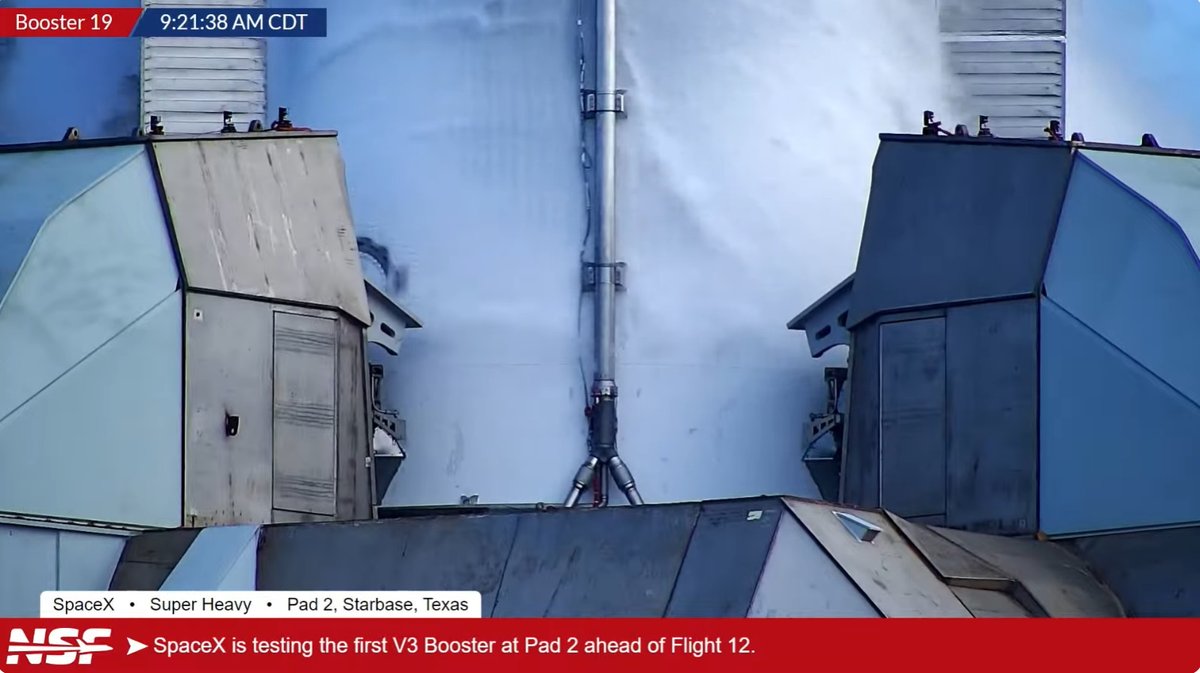
NASASpaceflight reported that Booster 19 was already well into propellant loading as the test day began — a notably fast start. The booster, which is the first V3 Super Heavy and the first flight-intent vehicle to carry next-generation Raptor 3 engines, has now run three back-to-back test days on Pad 2, the newly commissioned second orbital launch pad at Starbase.

Shortly after prop load began, cameras caught a brief, blink-and-you'll-miss-it event at the base of the booster — which NASASpaceflight flagged in real time.

The team quickly identified what they were looking at: an igniter test. What wasn't immediately obvious — until Zack Golden at CSI_Starbase broke it down — was just how significant the timing of that igniter test was.

Why the Propellant-Loaded Igniter Test Is a Big Deal
Here's the key detail, courtesy of @CSI_Starbase's Zack Golden: igniter tests are normally performed hours before propellant is loaded onto the vehicle. Running one with propellant already on board is a procedural departure from everything SpaceX has done with Starship up to this point.

The 10-engine spin prime — where Raptor engines are spun up using the turbopumps without full ignition — combined with the igniter test while propellant was loaded suggests SpaceX is actively testing how these systems behave in a more flight-realistic state. It's the kind of edge-case validation you do when you're getting serious about launch readiness, not just running through a standard checklist.
📊 Key Figures
| Metric | Detail |
|---|---|
| Booster | Booster 19 (V3 Super Heavy — first Block 3 booster) |
| Engines | Raptor 3 (first flight-intent vehicle with this engine generation) |
| Test Location | Orbital Launch Pad 2, Starbase, Texas |
| Test Day | Day 3 of consecutive Pad 2 testing |
| Engines in Spin Prime | 10 |
| Igniter Test Timing | First time performed with propellant loaded (previously done hours before prop load) |
| Target Mission | Starship Flight 12 |
🔭 The BASENOR Take
Timeline: March 2026 — Day 3 of Pad 2 testing for Flight 12
Impact Level: 🟡 Medium-High — procedural milestone, not a static fire
Confidence: High — multiple independent observers confirmed the sequence
Three consecutive test days on Pad 2 is itself a statement. SpaceX isn't just shaking down the new pad — they're running Booster 19 through a compressed, increasingly flight-realistic test campaign. The propellant-loaded igniter test is the clearest sign yet that the team is validating systems in conditions that mirror an actual launch countdown, not just isolated component checks.
Booster 19's significance extends beyond this single test. As the first V3 Super Heavy and the first vehicle flying Raptor 3 engines, it represents a meaningful hardware generation leap. Raptor 3 is designed for higher thrust and improved reliability over its predecessors, and every test day on Pad 2 is building the data package SpaceX needs to certify this new configuration for flight.
What SpaceX is doing here is collapsing the gap between ground testing and launch-day procedures. By running an igniter test while propellant is loaded, they're stress-testing the entire system in a state that's much closer to T-0 conditions. If something unexpected shows up, better to find it now. If everything looks clean — and today's test appeared to go smoothly based on observer reports — that's a green light to keep pushing toward a static fire and, eventually, Flight 12.
For those tracking the broader SpaceX coverage, this cadence — three test days in a row, each one stepping closer to a full static fire — is exactly what you'd expect to see in the weeks before a launch campaign locks in. Flight 12 is getting real.