📌 UPDATE — May 18, 2026
Elon Musk has officially confirmed that Starship V3 represents a far more sweeping redesign than previously understood. In a post on X, Musk stated that "almost every part of Starship V3 is different from V2" — suggesting the five upgrades outlined in this article are just a fraction of the total engineering changes made. This positions V3 less as an iterative update and more as a near-ground-up rebuild, reinforcing SpaceX's aggressive development cadence ahead of extended orbital mission objectives.
Elon Musk @elonmusk · May 18, 2026"Almost every part of Starship V3 is different from V2"
 ❤️ 872 🔁 101 👁️ 150,765
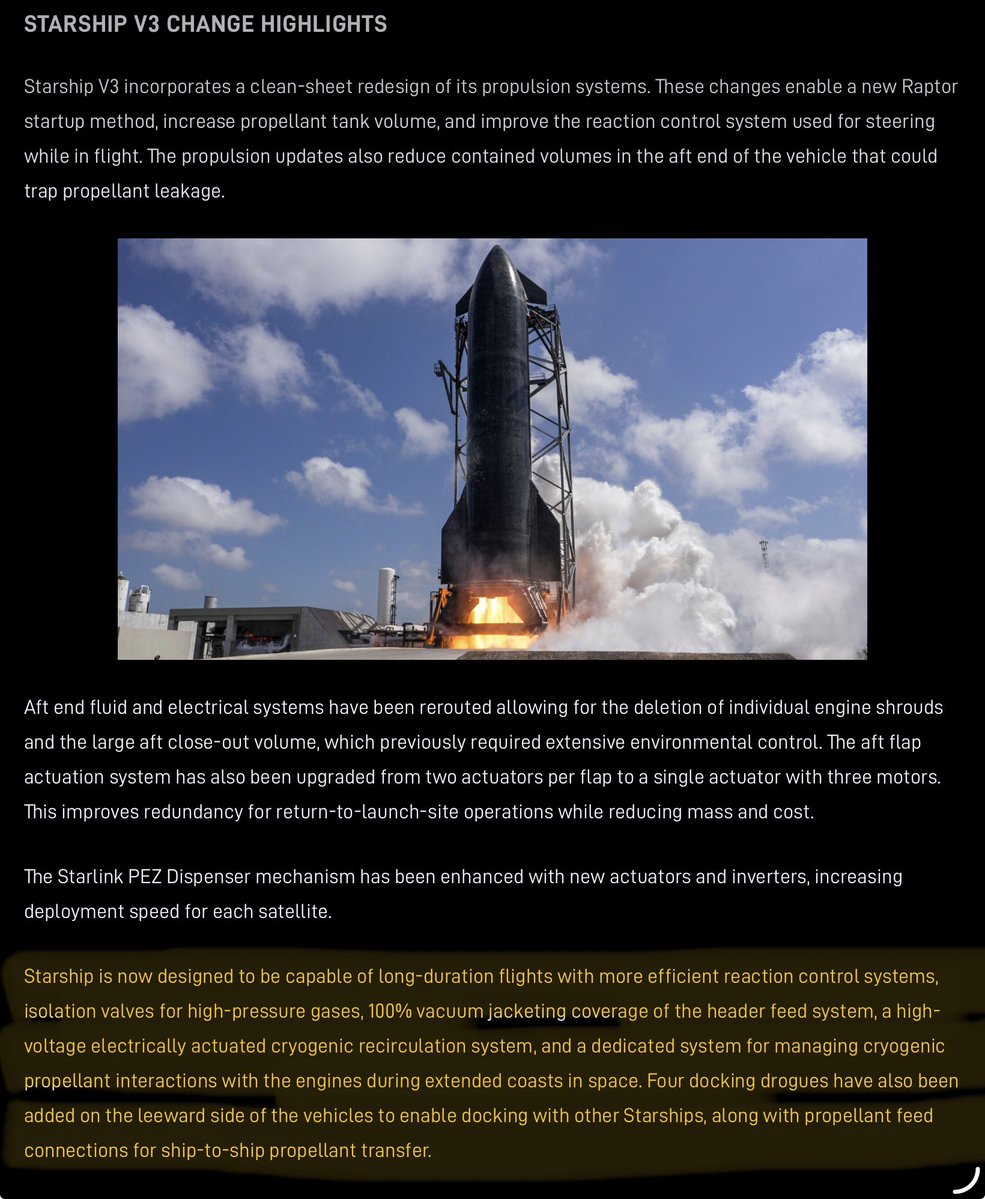
SpaceX has released new technical details on Starship V3, and the headline capability isn't thrust or payload — it's endurance. The redesigned vehicle introduces a suite of systems specifically engineered to keep the ship alive and functional in orbit for dramatically longer periods. The initial target: roughly 48 hours on orbit, with longer durations planned as the architecture matures. Flight 12, Starship V3's debut, is currently targeted for May 19, 2026.

Analyst Joe Tegtmeyer broke down the engineering in a detailed thread, connecting SpaceX's design choices to foundational NASA research on cryogenic propellant management. Here are the five upgrades that matter most.
1. High-Voltage Electrically Actuated Cryogenic Recirculation System
This is the centerpiece of V3's long-duration capability. The system draws subcooled propellant — liquid oxygen (LOX) and liquid methane (LCH4) — from the main tanks, routes it through conditioning lines for heat rejection, and returns it to the header tanks and ullage spaces. The goal is straightforward but technically demanding: prevent vapor pressure buildup inside the tanks during extended coast phases in orbit. Without active thermal management, cryogenic propellants warm, boil off, and create pressure conditions that compromise engine restart reliability. The electrically actuated design means precise, software-controlled management without relying on separate mechanical systems.

2. Upgraded RCS Thrusters Integrated with Cryo Propellant
Previous Starship designs relied on separate cold-gas supplies for reaction control system (RCS) thrusters — the small jets that orient the vehicle in space. V3 integrates the upgraded RCS thrusters directly with the thermally managed cryogenic propellant system. According to Tegtmeyer, this aligns with NASA-supported testing of integrated propulsion and attitude control in cryogenic environments. The practical benefit: fewer separate propellant systems to manage, lower mass, and RCS performance that doesn't degrade as a cold-gas supply depletes over a long mission.

3. Full Vacuum Jacketing and Advanced Thermal Insulation
Starship V3 achieves 100% vacuum jacketing coverage of the header feed system — a significant step up from earlier designs. This is the same principle behind a thermos flask, but engineered for flight hardware carrying hundreds of tonnes of cryogenic propellant. Combined with multi-layer insulation and thermodynamic vent systems (TVS) informed by NASA Marshall Space Flight Center research, the vehicle can dramatically slow the rate at which propellants absorb heat from the environment. Vapor-cooled shields and active cryo-coolers round out the thermal management stack, giving SpaceX multiple layers of defense against boiloff during orbital coast.

4. Precision RF Propellant Sensors and Advanced Avionics
Knowing exactly how much propellant remains in microgravity is a genuinely hard problem — propellant sloshes and doesn't settle the way it does on the ground. V3 introduces new precision radio frequency sensors specifically designed to measure propellant levels in microgravity, enabling accurate monitoring for in-space propellant transfer operations. These sensors feed into an avionics suite that SpaceX describes as approximately 60 custom units integrating batteries, inverters, and high-voltage electrical distribution — capable of delivering around 9 megawatts of peak power with distributed fault isolation. The upgraded multi-sensor navigation system is built for precision autonomous flight with high redundancy, a prerequisite for the uncrewed propellant transfer missions planned for 2026.
5. Ship-to-Ship Propellant Transfer Hardware
The long-duration capability isn't just about surviving in orbit — it's about enabling the propellant depot architecture that makes deep-space missions viable. Starship V3 adds four docking drogues on the leeward side of the vehicle along with propellant feed connections for ship-to-ship transfer. Vehicles can be configured as dedicated tanker ships. SpaceX has targeted both a long-duration flight test and in-space propellant transfer flight tests for 2026. This is the infrastructure layer that eventually enables lunar and Mars missions: a Starship that can be refueled in orbit rather than carrying all its propellant from the ground.

NASA's Fingerprints on the Design
Tegtmeyer's thread makes a compelling case that V3's architecture is not purely SpaceX's invention — it's a commercial translation of decades of NASA research. NASA Marshall's Cryogenic Fluid Management (CFM) program developed the recirculation-type feed systems, zero-boiloff (ZBO) concepts, and low-gravity propellant management techniques that underpin what SpaceX has now built into flight hardware. Tipping Point demonstrations and joint flight tests provided the modeling tools and ground validation data that informed Starship's architecture.

The 48-hour orbital endurance figure SpaceX has cited for this initial V3 configuration is explicitly a starting point. As Tegtmeyer noted, this is likely the first step of many iterations SpaceX will work through to extend mission duration further. The recirculation system and propellant transfer hardware are the foundation — the ceiling on how long Starship can stay in orbit will rise with each successive improvement to insulation, active cooling, and operational procedures.

Flight 12 on May 19 will be the first real test of whether these systems perform as designed. For SpaceX's lunar and Mars ambitions, getting propellant management right in orbit isn't a nice-to-have — it's the entire game. Follow our SpaceX coverage for updates as the launch approaches.

Sarah focuses on Tesla Energy, SpaceX missions, and the broader Musk AI portfolio. Former data analyst in clean energy. Based in San Francisco.
Sources verified at publish time. Spotted an inaccuracy? Email editorial@basenor.com.