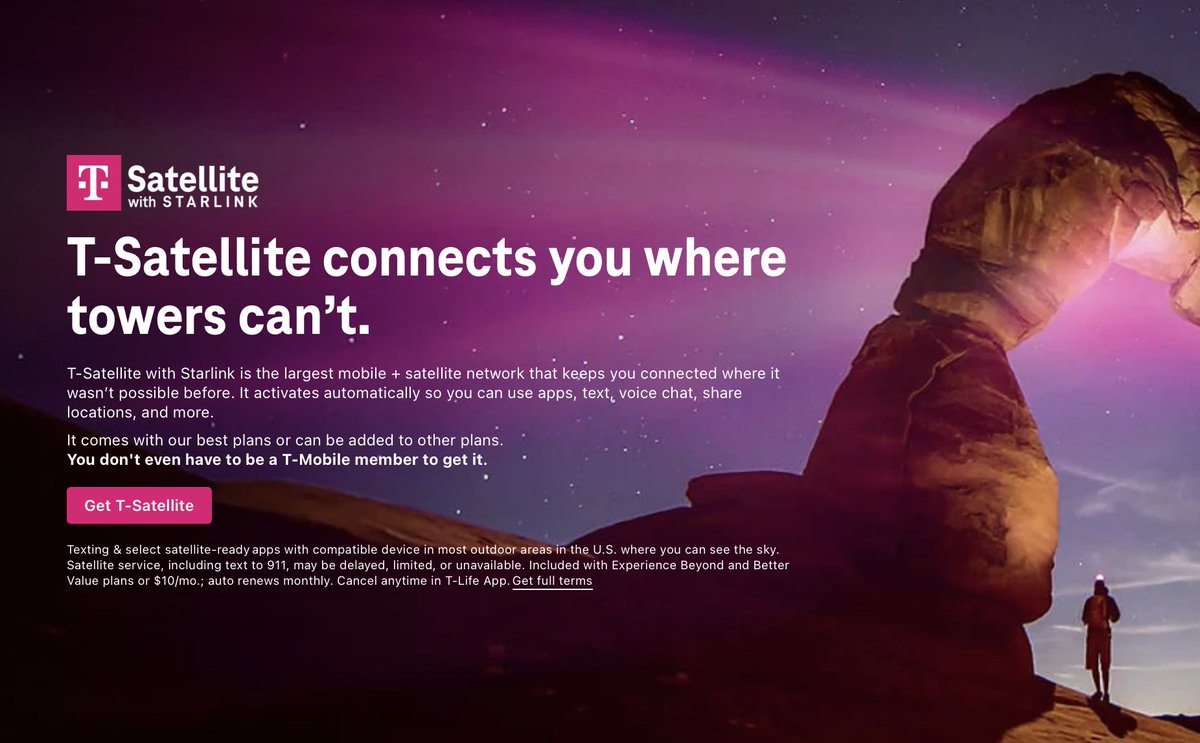
T-Mobile has quietly removed one of the bigger friction points for its Starlink-powered satellite service: you no longer need to visit a store or call customer support to sign up. Online enrollment for T-Satellite — the carrier's $10/month satellite connectivity add-on built on SpaceX's Starlink Mobile network — is now live, opening the door for a much wider pool of customers to get connected in dead zones.

What exactly is T-Satellite?
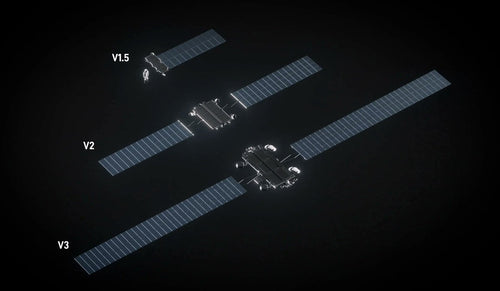
T-Satellite is the commercial name for T-Mobile's partnership with SpaceX's Starlink, which SpaceX has officially rebranded its direct-to-cell technology as Starlink Mobile. The service launched commercially on July 23, 2025 after an extended beta period. It uses over 650 Starlink V1 satellites to deliver connectivity in areas where T-Mobile's ground-based network doesn't reach — covering more than 500,000 square miles of U.S. territory. As of 2026, coverage has expanded to include satellite dead zones in Canada and New Zealand as well.
What does $10/month actually get you?
At this introductory price, T-Satellite supports texting and data for a curated set of apps: WhatsApp (including voice and video calls), Google Maps, AllTrails, AccuWeather, and X. Emergency texts to 911 are free for all T-Mobile customers regardless of plan. It is not full 5G — voice calls over the satellite network and broader data access are planned for a future phase tied to next-generation Starlink V2 satellites, which SpaceX aims to begin launching in mid-2027. For T-Mobile customers on the premium Experience Beyond or Go5G Next plans, T-Satellite is included at no additional charge.
Who can sign up — do you have to be a T-Mobile customer?
No. Customers on rival carriers like AT&T and Verizon can also subscribe for the same $10/month. The catch: you need a compatible, unlocked phone with an available eSIM slot. T-Mobile will issue a secondary eSIM to non-T-Mobile subscribers to make it work. The online enrollment change makes this cross-carrier access significantly more practical — previously, getting a secondary eSIM provisioned required a store visit or a call.
Which phones are compatible?
Device compatibility is the most common sticking point. Currently supported hardware includes iPhone 14 or later, Google Pixel 9, select Samsung Galaxy models, and Motorola phones from 2024 or newer. T-Mobile provides an online IMEI checker so you can confirm whether your specific device qualifies before signing up. Older flagships and mid-range phones from most manufacturers are not yet supported.
Why does this enrollment change matter?
T-Mobile CEO Srini Gopalan acknowledged in April 2026 that T-Satellite usage has been lower than anticipated since launch. Requiring customers to visit a store or call in to enroll was a genuine barrier — particularly for the service's most natural audience: people in rural or remote areas who may not have a T-Mobile store nearby. Enabling online sign-up removes that friction and could meaningfully accelerate adoption among both T-Mobile subscribers and customers of other carriers who want a dead-zone backup without switching their primary SIM.
What's the roadmap beyond current capabilities?
The current V1 satellite constellation is a stepping stone. Full voice and data capabilities — described as indistinguishable from traditional 5G — depend on the Starlink V2 satellite generation, which SpaceX plans to launch using Starship beginning in mid-2027. The goal is global, continuous coverage within six months of V2 deployment. Until then, T-Satellite remains a useful but limited supplement: solid for emergencies and basic connectivity in the backcountry, not a replacement for your primary cellular plan.

Sarah focuses on Tesla Energy, SpaceX missions, and the broader Musk AI portfolio. Former data analyst in clean energy. Based in San Francisco.
Sources verified at publish time. Spotted an inaccuracy? Email editorial@basenor.com.