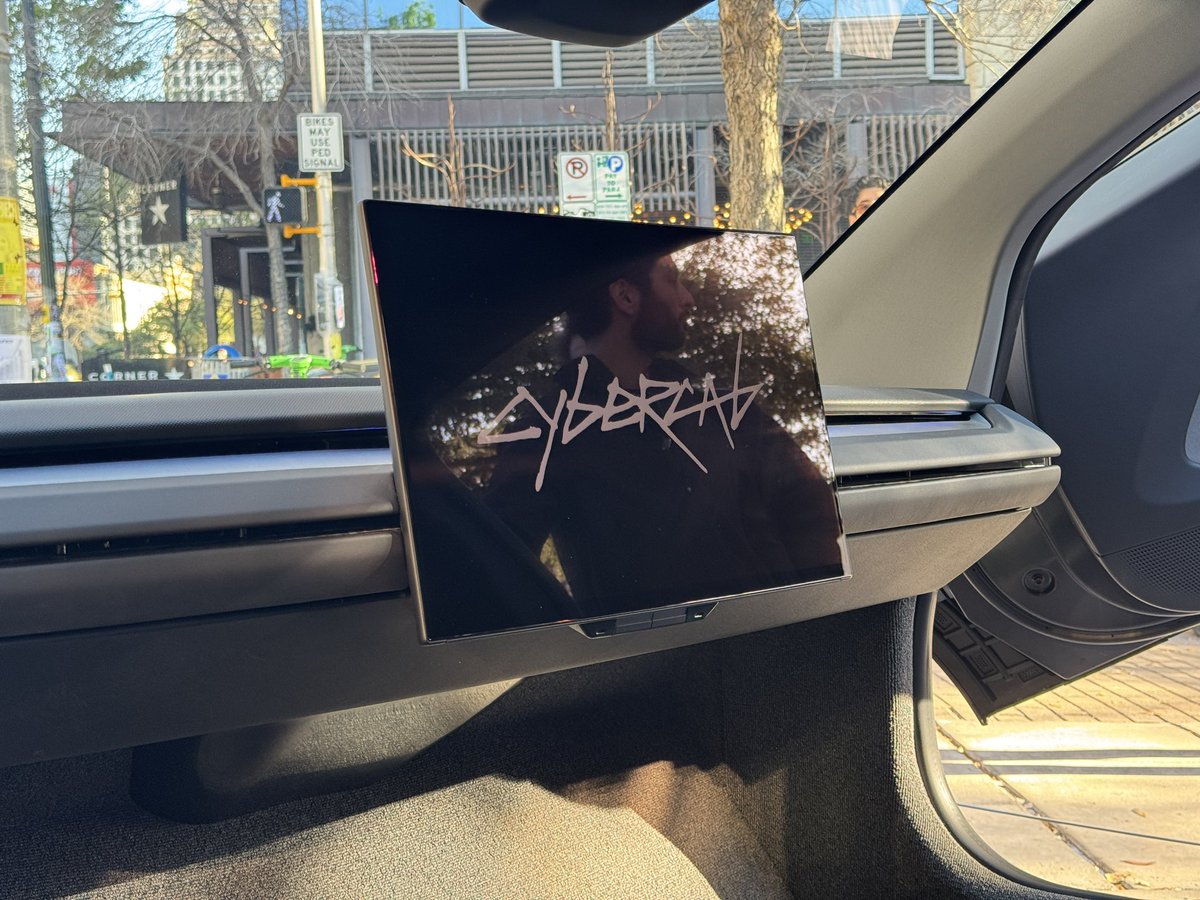
The News: New close-up details of the production-ready Tesla Cybercab have emerged, revealing relocated controls, accessibility-first design, and a brand-new Tesla Robotaxi logo.
Why It Matters: These aren't prototype quirks — this is how the Cybercab will arrive in the real world. The design choices signal Tesla's serious commitment to accessibility and a polished passenger experience.
Source: @TeslaNewswire on X
Tesla Cybercab Production Details Revealed: Braille Buttons, USB-C Ports, and a New Robotaxi Logo
The Tesla Cybercab is no longer a concept — it's a production reality. Following confirmation that the first mass-produced Cybercab rolled off the Gigafactory Texas line in February 2026, new close-up imagery has surfaced showing exactly what passengers will interact with inside the autonomous robotaxi. The details are small, but they tell a big story about how Tesla has engineered this vehicle for real-world, driverless deployment.

📊 Key Details: What We Now Know About the Production Cybercab
| Feature | Detail | Significance |
|---|---|---|
| Window Controls + USB-C | Relocated beneath the 21-inch touchscreen | Keeps the cabin minimal; charging within easy reach |
| Door-Release Button | Physical button with Braille lettering | Accessibility compliance; tactile override for all passengers |
| Emergency Stop Button | Dedicated button with Braille lettering | Safety-critical passenger control in a driverless vehicle |
| Cupholders | Integrated into the cabin | Ride-share comfort feature; production-confirmed placement |
| Robotaxi Logo | New dedicated Tesla Robotaxi branding | Distinct brand identity separate from the consumer Tesla lineup |
A Cabin Designed Around the Passenger — Not the Driver
The most striking thing about these production details isn't any single feature — it's the philosophy behind all of them. Every decision in the Cybercab's interior has been made with the assumption that there is no driver. That changes everything.
Relocating the window controls and USB-C charging port beneath the 21-inch touchscreen is a clean, logical move. In a traditional car, controls cluster around the driver. Here, they're positioned for passenger convenience — central, low, and accessible without reaching across the cabin. The USB-C placement in particular is a practical win: passengers in a robotaxi are likely to be on their phones, and Tesla has made charging frictionless.
The Braille lettering on both the door-release and emergency stop buttons deserves more attention than it's getting. This isn't just a regulatory checkbox — it's a signal that Tesla is engineering the Cybercab for the broadest possible passenger base, including visually impaired riders who would otherwise depend entirely on a human driver for safety. In a fully autonomous vehicle, that tactile emergency stop button is a genuine lifeline.
A New Logo for a New Category

Alongside the interior details, a new Tesla Robotaxi logo has been revealed. The existence of dedicated branding — separate from the standard Tesla wordmark — confirms that Tesla is treating the Robotaxi service as its own product category, not just an extension of the existing vehicle lineup. This matters for how the service will be marketed, how it will appear in the app, and how passengers will identify the vehicles on the street.
Brand separation at this stage of development suggests Tesla is moving deliberately toward a commercial launch, not just a pilot program.
🔭 The BASENOR Take
Timeline: First production unit confirmed off the line in February 2026. These interior detail reveals suggest Tesla is in final production validation — not early prototyping.
Impact Level: 🔴 High — These are production-confirmed features, not renders or concepts.
Confidence: ⭐⭐⭐⭐ — Sourced from direct close-up imagery of the production vehicle. Details are specific and consistent with Tesla's known interior design language.
The Braille buttons are the detail that stands out most from a regulatory and commercial standpoint. The ADA and equivalent international accessibility standards are going to be a major hurdle for any autonomous vehicle service operating at scale. Tesla appears to have baked compliance into the hardware from day one — a smart move that could accelerate regulatory approval in key markets.
The cupholder confirmation is smaller news, but it matters for the ride-share use case. Passengers expect comfort amenities. The fact that cupholders are integrated — not an afterthought — suggests Tesla has studied the ride-share experience carefully.
Taken together, these details paint a picture of a vehicle that is production-ready in the truest sense: not just mechanically capable, but designed for the full passenger experience at commercial scale. The new Robotaxi logo only reinforces that Tesla is preparing to launch a service, not just a car. Follow our FSD and Cybercab coverage for the latest as the commercial rollout approaches.
🚕 Following the Robotaxi rollout? See every operating city, launch date and announced market in our Tesla Robotaxi Tracker.
Related Gear
Gear up your Tesla with tested, custom-fit BASENOR accessories — shop Tesla accessories →
Sources & reporting notes
The links below identify the material source records used for this report.
- @TeslaNewswire on X (2026-03-13T20:01:52.000Z) — Direct source
- @TeslaNewswire on X (2026-03-13T20:24:47.000Z) — Direct source
Source links are preserved as published or accessed. See our editorial standards and corrections policy.
The BASENOR Editorial Desk covers Tesla, SpaceX, and related technology, curating reporting from primary sources — official accounts, regulatory filings, and software release data. Every article passes source-record and fact-checking review before publication. About the newsroom.
This report was curated by the BASENOR Editorial Desk from the sources listed above. Read our editorial standards or email editorial@basenor.com to report an error.