⚡ 30-Second Brief
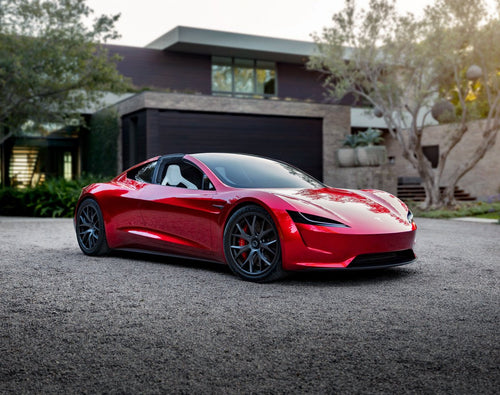
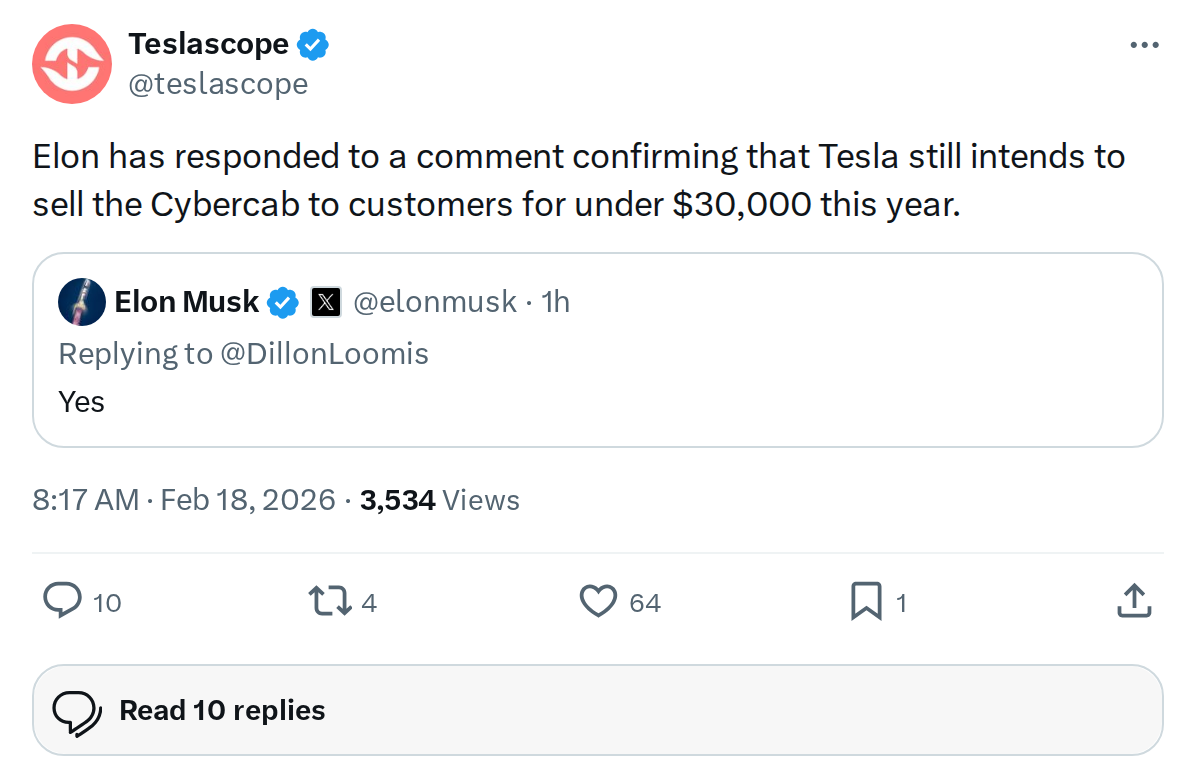
The News: Elon Musk has confirmed Tesla will sell the Cybercab directly to consumers for under $30,000 in 2026, not exclusively for its internal robotaxi fleet.
Why It Matters: This ends speculation that Tesla's first steering wheel-less vehicle would be unavailable for personal ownership, giving potential buyers clarity on the revolutionary autonomous vehicle's retail availability.
Source: @teslascope on X
Retail Path Confirmed for Tesla's Autonomous Future
Tesla has officially put to rest concerns that its revolutionary Cybercab would be restricted exclusively to the company's internal robotaxi fleet. In a recent confirmation, Elon Musk reaffirmed that the autonomous two-seater will be available for direct consumer purchase at the previously announced sub-$30,000 price point, with production targeted for this year.

The clarification comes at a critical juncture for Tesla, as the company recently announced that the first Cybercab production unit rolled off the assembly line at Gigafactory Texas on February 17, 2026. However, continuous production isn't expected to begin until April 2026, according to Musk's recent timeline reaffirmation.
📊 Key Figures
| Metric | Value | Context |
|---|---|---|
| Target Price | Under $30,000 | Confirmed by Musk, making it Tesla's most affordable vehicle |
| Production Start | April 2026 | Continuous production timeline recently reaffirmed |
| First Unit | Feb 17, 2026 | Prototype rolled off Gigafactory Texas assembly line |
| Seating Capacity | 2 passengers | No steering wheel or pedals — Level 5 autonomous only |
Why the Clarification Matters
The community's concerns about fleet-only availability weren't unfounded. When Tesla unveiled the Cybercab in October 2024, the company heavily emphasized its robotaxi service ambitions, leaving questions about whether individual consumers would ever have the opportunity to purchase the vehicle outright.

This dual-path strategy — selling to both consumers and operating a proprietary fleet — represents a significant departure from competitors in the autonomous vehicle space, who have largely focused on commercial fleet operations exclusively. Companies developing similar technology have typically partnered with ride-hailing services rather than offering vehicles for personal ownership.
The under-$30,000 price point positions the Cybercab as Tesla's most affordable vehicle, undercutting even the Model 3 and Model Y. This aggressive pricing strategy assumes significant cost savings from the vehicle's streamlined design: no steering wheel, no pedals, no traditional control systems, and wireless inductive charging instead of a charge port.
🔭 The BASENOR Take
Timeline Analysis
Q2 2026: First customer deliveries possible if April production ramp succeeds
Q3-Q4 2026: Wider availability dependent on FSD Unsupervised regulatory approval
Risk Factor: Production timeline contingent on autonomous driving certification in California and Texas
Impact Level: 🔥🔥🔥🔥 (High)
This confirmation is critical for three reasons: First, it validates Tesla's commitment to democratizing autonomous technology rather than hoarding it for fleet economics. Second, the sub-$30k price represents a potential inflection point for mass-market autonomous vehicle adoption. Third, it forces the entire industry to reconsider the economics of self-driving technology — if Tesla can profitably sell these vehicles to consumers at this price, the fleet-only model may not be the only viable path.
Confidence Rating: 85%
While Musk's confirmation is direct, the actual retail availability hinges on regulatory approval for unsupervised Full Self-Driving operation. Recent reports indicate Tesla's robotaxi pilot in Austin experienced a crash rate nearly four times worse than human drivers, suggesting the autonomous software still faces significant development challenges. The hardware may be ready, but the software certification represents the critical path to consumer deliveries.
The Autonomous Ownership Model
What makes this announcement particularly intriguing is the ownership model it enables. According to previous Tesla communications, Cybercab owners will be able to add their vehicles to Tesla's robotaxi network when not in personal use, potentially generating revenue to offset the purchase price. This creates a unique value proposition: a personal autonomous vehicle that can earn income as a commercial asset.
The economics could be compelling. If a Cybercab owner uses the vehicle for personal transportation 20% of the time and adds it to the robotaxi network for the remaining 80%, the revenue potential could significantly reduce the effective cost of ownership — or even generate net positive cash flow, depending on utilization rates and Tesla's revenue-sharing structure.
However, this model depends entirely on the successful deployment and regulatory approval of Tesla's Full Self-Driving (Unsupervised) software. Real-world testing is currently planned for California and Texas, but no timeline has been provided for broader regulatory approval. The vehicle's design — with no manual controls whatsoever — means it cannot legally operate on public roads without full autonomous certification.
Design Philosophy: Form Follows Autonomy
The Cybercab represents Tesla's first vehicle designed from the ground up for autonomous operation. The absence of steering wheel and pedals isn't just a cost-cutting measure — it's a philosophical statement about the future of transportation. The two-seat configuration with dihedral doors and Cybertruck-inspired aesthetic signals that this vehicle prioritizes efficiency and purpose over traditional automotive conventions.
The wireless inductive charging system eliminates the need for charge ports and manual plugging, essential for a vehicle that may operate in a commercial fleet without human intervention. This design choice, while adding complexity and cost to charging infrastructure, simplifies vehicle operation and maintenance — critical factors for both fleet economics and consumer convenience.
📰 Deep Dive
The retail availability confirmation represents a calculated risk by Tesla to compete on multiple fronts simultaneously. By offering the Cybercab to consumers while also building its own robotaxi fleet, Tesla is essentially betting that the total addressable market is large enough to support both channels — and that consumer ownership won't cannibalize fleet utilization rates.
This dual-market strategy also provides Tesla with valuable data and operational flexibility. Consumer-owned vehicles operating on the robotaxi network create a distributed asset model that requires less capital investment than a fully company-owned fleet. If demand for robotaxi services exceeds Tesla's fleet capacity, consumer-owned vehicles can fill the gap. Conversely, if consumer demand for vehicle purchases is soft, Tesla can allocate more production to its internal fleet.
The sub-$30,000 price point is particularly aggressive when considering the advanced technology package required for full autonomy. The vehicle includes the hardware suite necessary for Level 5 autonomous operation — multiple cameras, neural network processing, and sophisticated sensor fusion capabilities. Achieving this price likely requires both manufacturing innovations at Gigafactory Texas and assumptions about declining costs for autonomous driving hardware as production scales.
However, the biggest uncertainty remains software certification. The first production unit rolling off the line is a significant manufacturing milestone, but it doesn't address the fundamental question of when — or if — regulatory authorities will approve truly unsupervised autonomous operation. Recent performance data from Tesla's Austin robotaxi pilot suggests the technology still requires significant refinement before it can match or exceed human driver safety standards, the threshold typically required for regulatory approval.
For potential buyers, Musk's confirmation provides clarity on availability but raises new questions about timing and practicality. Will early adopters be able to use their Cybercabs immediately upon delivery, or will they need to wait for FSD Unsupervised approval? What happens if regulatory approval is delayed beyond 2026? These questions remain unanswered, but the confirmation that retail sales will happen represents a critical first step toward consumer accessibility of autonomous vehicle technology.

Sarah focuses on Tesla Energy, SpaceX missions, and the broader Musk AI portfolio. Former data analyst in clean energy. Based in San Francisco.
Sources verified at publish time. Spotted an inaccuracy? Email editorial@basenor.com.