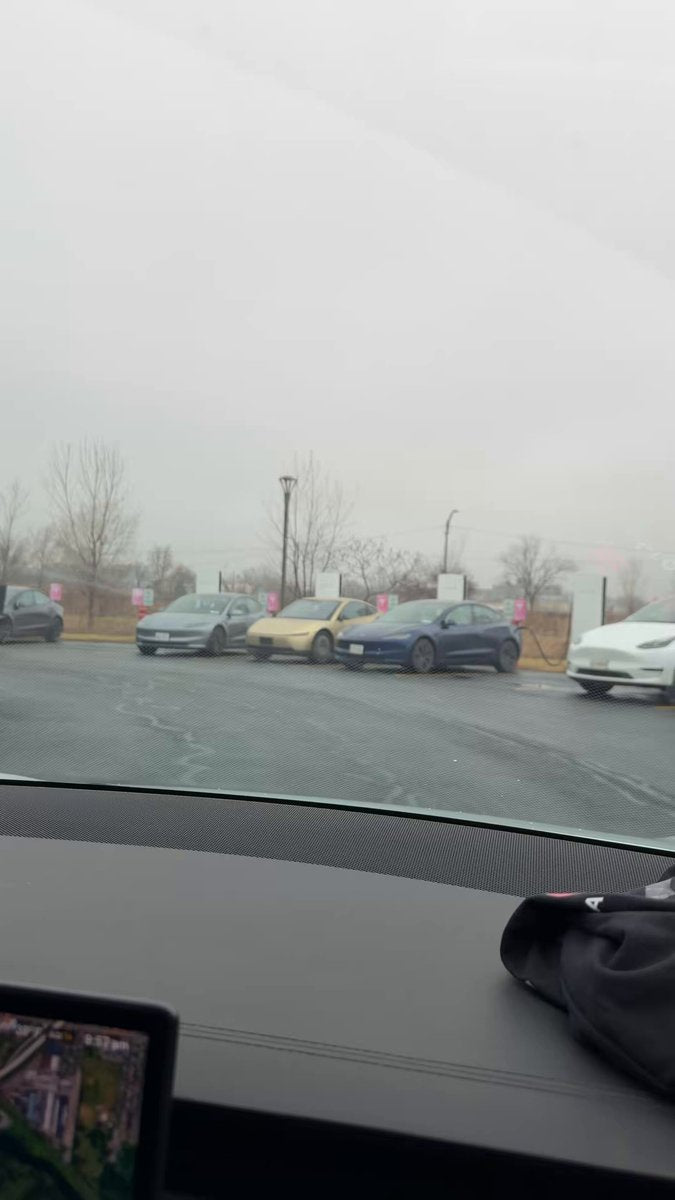
The News: A Tesla Cybercab prototype has been spotted plugging into a Supercharger at Giga New York, captured on video.
Why It Matters: With volume production targeting April 2026 and testing now spanning multiple US states, this sighting confirms the Cybercab's charging infrastructure strategy is being validated across Tesla's own facilities — not just in Texas.
Source: @TeslaNewswire on X
Cybercab Shows Up at Giga New York — With a Charging Cable
Tesla's Cybercab just made an unexpected appearance on the East Coast. A prototype of the fully autonomous two-seater was spotted supercharging at Gigafactory New York in Buffalo — and there's video to prove it. For a vehicle that was originally conceived around wireless charging, the fact that it's actively using Tesla's V4 Supercharger network is one of the more telling details here.

📊 Key Figures
| Metric | Detail |
|---|---|
| First production unit off the line | Mid-February 2026 (Giga Texas) |
| Volume production target | April 2026 |
| Units observed at Giga Texas (early March) | 25+ |
| Battery capacity (reported) | 47 kWh (4680 LFP cells) |
| Estimated range | ~300 miles |
| Target price | ~$25,000–$30,000 |
| Public road testing states | CA, TX, NY, IL, MA |
The Charging Question Gets Answered — Sort Of
When Tesla first unveiled the Cybercab concept, wireless inductive charging was positioned as its primary energy source — park over a pad, walk away, done. Clean and operationally elegant for a robotaxi that never needs a human to plug it in. But real-world testing has complicated that vision.
Recent prototypes have been filmed using Tesla's V4 Superchargers via a concealed NACS port, and this Giga New York sighting adds further confirmation that wired charging is very much part of the Cybercab's operational playbook. The likely outcome: wireless charging handles routine overnight or depot top-ups, while Superchargers handle rapid replenishment between rides. That's a pragmatic hybrid strategy — and it means the Cybercab will be compatible with Tesla's existing 50,000+ Supercharger stall network from day one.
Why Giga New York Matters
The bulk of Cybercab development activity has been centered at Gigafactory Texas, where the first production unit rolled off the line in mid-February 2026 — weeks ahead of schedule. Drone footage from early March showed more than 25 units on the property. So what's a Cybercab doing in Buffalo?
Giga New York (the Riverbend facility) is Tesla's hub for Supercharger hardware manufacturing and energy products. Spotting a Cybercab there suggests Tesla may be conducting integration testing between the vehicle and next-generation charging hardware — potentially validating automated charging capabilities or testing V4 compatibility at the source. It also signals that Cybercab testing is no longer confined to a single geography. Confirmed public road testing now spans California, Texas, New York, Illinois, and Massachusetts, and winter testing has begun at Tesla's Alaska proving grounds. A stop at Giga New York fits that expanding footprint.
🔭 The BASENOR Take
Timeline: Volume production April 2026 → Consumer availability TBD
Impact Level: 🟡 Medium — prototype sighting, but meaningful for understanding deployment readiness
Confidence: High on Supercharger compatibility; Medium on Giga NY's specific role in testing
Analysis: This sighting is a small data point with a larger implication: the Cybercab is being tested across Tesla's entire infrastructure ecosystem, not just on public roads. The fact that it's charging via NACS at a V4 Supercharger — rather than waiting for wireless charging infrastructure to be built out — tells you Tesla is prioritizing operational viability over conceptual purity. For future Cybercab owners and for anyone who uses Tesla's Supercharger network, that's actually good news. It means the robotaxi fleet won't require a parallel charging infrastructure buildout before launch.
📰 Deep Dive
The Cybercab's appearance at Giga New York arrives at a pivotal moment. Tesla has already crossed the first production milestone at Giga Texas, and with volume production targeted for April, the engineering team is clearly in an intensive validation phase. Every new sighting location adds a piece to the puzzle of how Tesla plans to operate a fully autonomous fleet at scale.
The charging infrastructure angle deserves particular attention. Tesla's original wireless charging vision was compelling but logistically complex — it requires precise parking alignment and significant ground-side hardware investment at every depot and staging area. By leaning on the existing Supercharger network as the backbone of the Cybercab's energy strategy, Tesla sidesteps a massive infrastructure bottleneck. The concealed NACS port on recent prototypes isn't a concession; it's a smart operational decision that lets the robotaxi service launch faster and scale more reliably.
Meanwhile, the geographic spread of Cybercab testing — now confirmed across five US states plus Alaska winter trials and a new hardware engineering role posted for Giga Berlin — paints a picture of a program moving faster than most observers expected six months ago. The Giga New York sighting is one more data point suggesting Tesla isn't just building the Cybercab; it's actively stress-testing every dimension of how it will actually work in the real world.
🚕 Following the Robotaxi rollout? See every operating city, launch date and announced market in our Tesla Robotaxi Tracker.
Related Gear
Gear up your Tesla with tested, custom-fit BASENOR accessories — shop Tesla accessories →
Sources & reporting notes
The links below identify the material source records used for this report.
- @TeslaNewswire on X (2026-03-06T19:58:18.000Z) — Direct source
Source links are preserved as published or accessed. See our editorial standards and corrections policy.
The BASENOR Editorial Desk covers Tesla, SpaceX, and related technology, curating reporting from primary sources — official accounts, regulatory filings, and software release data. Every article passes source-record and fact-checking review before publication. About the newsroom.
This report was curated by the BASENOR Editorial Desk from the sources listed above. Read our editorial standards or email editorial@basenor.com to report an error.