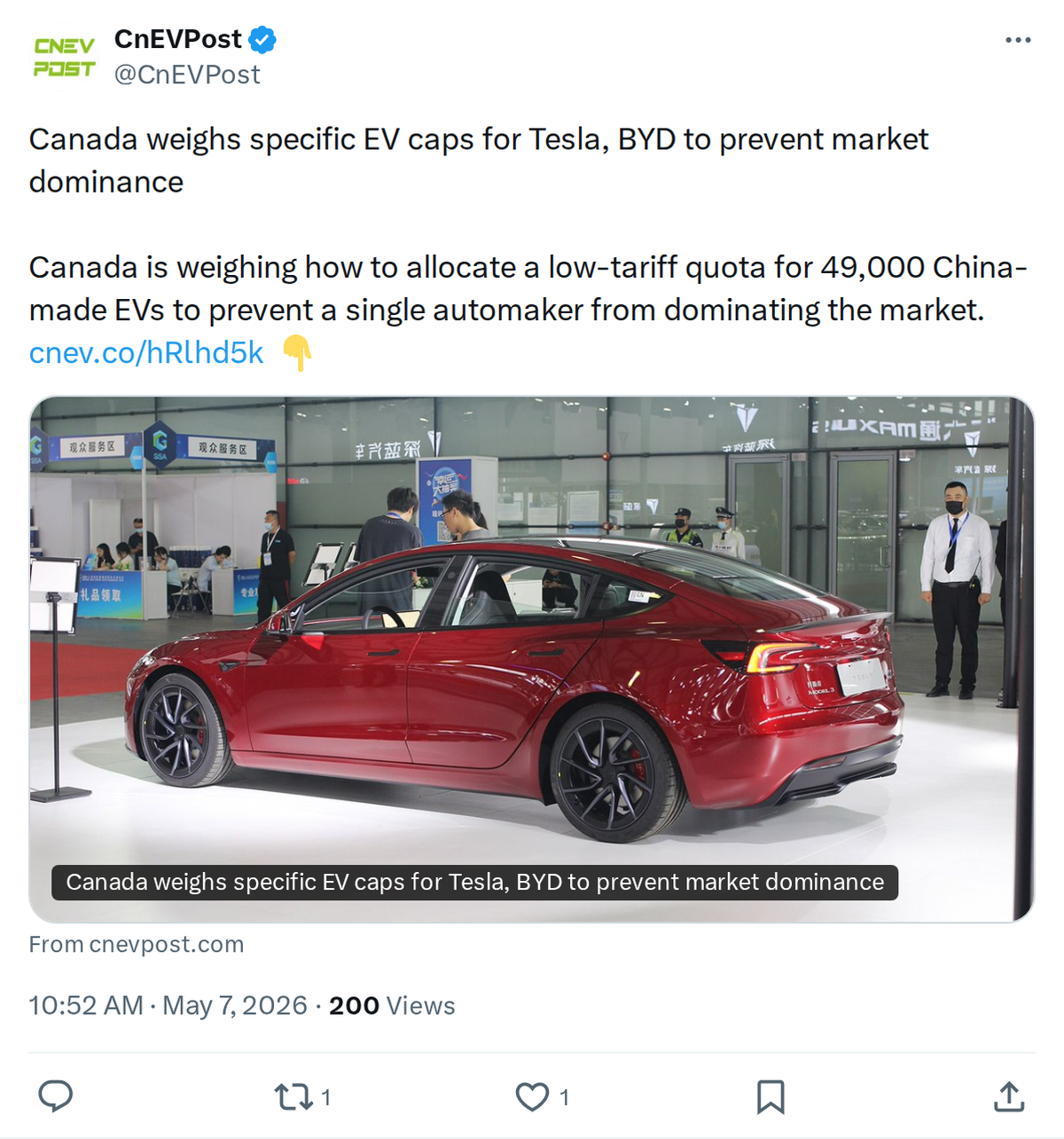
Canada is considering placing per-brand limits on Chinese-made electric vehicle imports — a move that would directly affect Tesla, which manufactures its Model 3 in Shanghai, and BYD. The policy debate centers on how to distribute a new low-tariff import quota without allowing any single automaker to corner the market.

How the Quota Works
Prime Minister Mark Carney agreed in January 2026 to open a low-tariff channel for Chinese-made EVs, and the program officially launched in March 2026. Under the framework, Canada permits up to 49,000 Chinese-manufactured EVs per year at a 6.1% most-favored-nation tariff rate — a dramatic reduction from the 100% punitive tariff that had been in place since October 2024.
The annual quota is structured in two permit windows. The first 24,500 permits were made available on a first-come, first-served basis from March 1 through August 31, 2026. A second tranche of 24,500 permits — plus any unused allocations from the first period — covers September 1, 2026 through February 28, 2027. Only OEMs or their authorized Canadian representatives can apply.
Canada Chinese EV Quota — Key Numbers
| Parameter | Detail |
|---|---|
| Annual quota (current) | 49,000 vehicles |
| Annual quota (by 2030) | 70,000 vehicles |
| Tariff rate (in-quota) | 6.1% MFN |
| Previous tariff rate | 100%+ |
| Quota as % of market | <3% of annual sales |
| Affordable EV reserve (within 5 yrs) | 50% at ≤C$35,000 |
| Quota utilized (as of May 7, 2026) | 0 vehicles |
The Per-Brand Cap Debate
The open question now is whether Ottawa will layer company-specific limits on top of the overall quota. The concern is straightforward: without per-brand caps, a well-organized automaker — Tesla being the most obvious candidate given its high-volume Shanghai factory — could claim a disproportionate share of the 49,000-vehicle allocation in the first-come, first-served windows, effectively locking out competitors.
Tesla's Shanghai Gigafactory produces Model 3 vehicles for export markets, and the company has historically been aggressive about capitalizing on trade windows. BYD, which has been expanding its international footprint rapidly, is the other name explicitly cited in the policy discussions. Neither company has publicly commented on the Canadian quota structure.
Notably, as of the week of May 7, 2026, none of the initial 24,500 permits have been claimed — suggesting that either automakers are waiting for the per-brand cap question to be resolved before committing, or that logistics and compliance timelines are still being worked out.
What This Means for Canadian Tesla Buyers
For Canadian owners and prospective buyers, the policy has a few practical implications worth tracking. A Model 3 imported from Shanghai under the quota would carry a 6.1% tariff rather than the previous triple-digit rate — a cost difference that could translate into more competitive pricing, depending on how Tesla structures its Canadian pricing. The affordable EV reserve (50% of the quota reserved for vehicles priced at C$35,000 or less within five years) is less relevant to Tesla's current lineup, but matters for the broader market dynamic.
The per-brand cap, if implemented, would effectively set a ceiling on how many Shanghai-built Teslas can enter Canada at the reduced rate in any given permit window. Whether that ceiling would be binding in practice depends on demand — and right now, with zero permits claimed, demand appears to be moving slowly.
The quota is scheduled to grow to 70,000 vehicles annually by 2030, giving the program room to scale. How Ottawa resolves the per-brand question in the coming weeks will likely set the template for how Canada manages EV trade relationships with China for the rest of the decade.
Related Gear
Gear up your Tesla with tested, custom-fit BASENOR accessories — shop Tesla accessories →
Sources & reporting notes
The links below identify the material source records used for this report.
- @CnEVPost on X (2026-05-07T02:52:21.000Z) — Direct source
Source links are preserved as published or accessed. See our editorial standards and corrections policy.
The BASENOR Editorial Desk covers Tesla, SpaceX, and related technology, curating reporting from primary sources — official accounts, regulatory filings, and software release data. Every article passes source-record and fact-checking review before publication. About the newsroom.
This report was curated by the BASENOR Editorial Desk from the sources listed above. Read our editorial standards or email editorial@basenor.com to report an error.