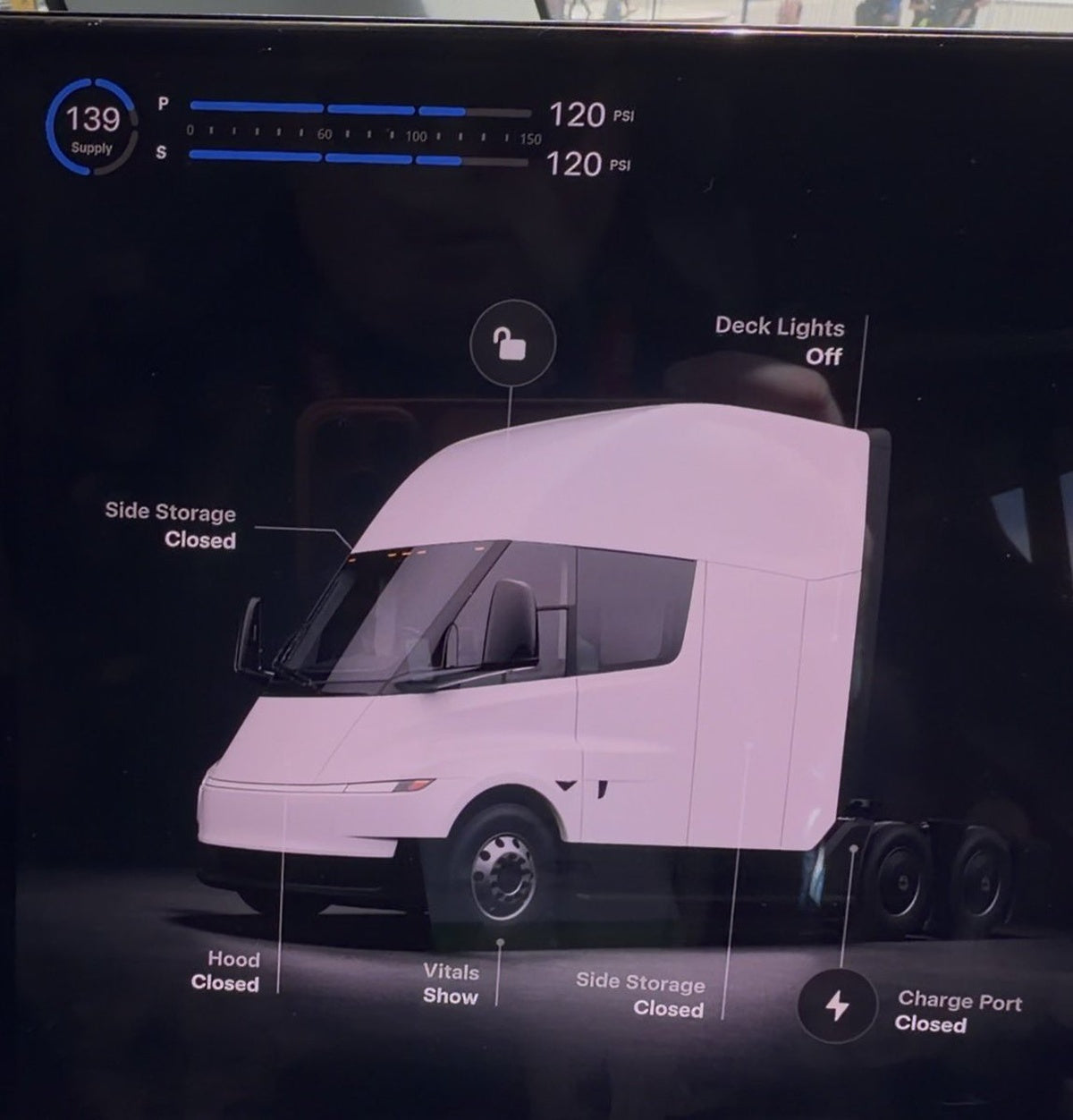
Tesla has shared new images of the refreshed user interface inside the production Semi, offering the clearest look yet at what drivers will actually see and interact with behind the wheel. With mass production underway at the dedicated Semi factory adjacent to Gigafactory Nevada, the updated cabin represents years of driver feedback translated into hardware and software decisions.

What the Refreshed Cabin Actually Looks Like
The production Semi cabin centers on dual 16-inch QHD displays positioned on either side of the steering column. The central driving position — a deliberate design choice — keeps both screens within the driver's natural sightline without requiring head turns. It's a layout that prioritizes situational awareness over aesthetics, which makes sense for a vehicle covering hundreds of miles per shift.
Tesla calls the interior a "Cabin Office," and the ergonomic refinements back that framing. Cupholders have been moved higher for easier reach, side storage has been enlarged, and the steering wheel rockers are positioned for intuitive one-handed operation. Side windows now extend further into the door panel, allowing drivers to reach outside — a direct response to feedback from early prototype testing.
The camera system has also been rationalized. The production Semi uses 10 cameras, down from 26 in earlier prototypes. They're mounted lower on the vehicle, mirroring the placement on the Model 3 and Model Y, and are designed to support Full Self-Driving capabilities. Samsung is the exclusive camera supplier for the platform.
Software Built to Evolve
The UI isn't a static product. Tesla has designed the Semi's software layer for continuous improvement through over-the-air updates — meaning the interface drivers see today can be meaningfully different six months from now without any hardware changes. For fleet operators, that's a significant operational advantage: the truck improves on its own schedule.
The underlying electrical architecture supports this approach. The Semi runs on a 48-volt system, first introduced in the Cybertruck, which uses thinner wiring and more efficient actuators for electric steering assist. Combined with the 4680 battery cells — rated for up to one million miles of lifespan — the platform is built with longevity in mind.
The Numbers Behind the Machine
| Spec | Detail |
|---|---|
| Displays | Dual 16-inch QHD |
| Cameras | 10-camera system (Samsung) |
| Range (Long Range) | ~500 miles at 82,000 lbs GVW |
| Range (Standard) | ~325 miles at 82,000 lbs GVW |
| Max Charge Rate | 1.2 MW (MCS 3.2 connector) |
| Charge Speed | Up to 60% range in 30 minutes |
| Battery Lifespan | Up to 1,000,000 miles (4680 cells) |
| Price (Long Range) | ~$290,000 |
| Price (Standard Range) | ~$260,000 |
| Operating Cost Savings | ~50% cheaper per mile vs. diesel (CA) |
Customer deliveries are expected to begin in 2026. The bigger question now is how quickly Tesla can scale production — and whether the refined cabin experience translates into the fleet adoption numbers the company needs to make the Semi a commercially significant product.
Related Gear
Gear up your Tesla with tested, custom-fit BASENOR accessories — shop Tesla accessories →
Sources & reporting notes
The links below identify the material source records used for this report.
- @TeslaNewswire on X (2026-05-06T05:22:43.000Z) — Direct source
Source links are preserved as published or accessed. See our editorial standards and corrections policy.
The BASENOR Editorial Desk covers Tesla, SpaceX, and related technology, curating reporting from primary sources — official accounts, regulatory filings, and software release data. Every article passes source-record and fact-checking review before publication. About the newsroom.
This report was curated by the BASENOR Editorial Desk from the sources listed above. Read our editorial standards or email editorial@basenor.com to report an error.