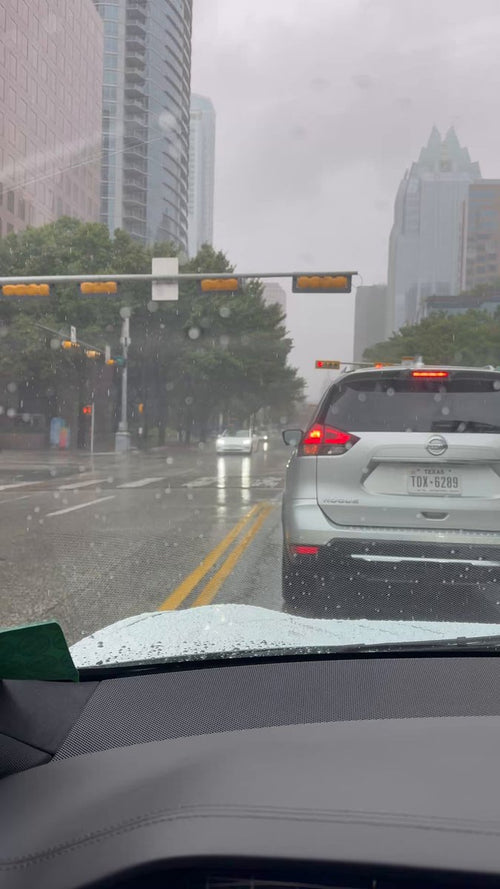
The News: Tesla FSD (Supervised) v14.3.1 completed a Downtown San Francisco to Downtown Los Angeles trip with a single tap — no manual interventions reported.
Why It Matters: Long-distance autonomous travel is the clearest proof yet that FSD has crossed a practical threshold for real-world use, not just urban demos.
Source: @wholemars on X
Tesla FSD 14.3.1 Handles the SF-to-LA Run on a Single Tap — Here's What's Behind It
The SF-to-LA corridor is one of the most demanding real-world driving tests you can throw at an autonomous system: 380+ miles of mixed freeway, city surface streets, lane merges, construction zones, and the chaos of entering downtown Los Angeles. This week, Tesla FSD (Supervised) v14.3.1 handled it with a single tap on the screen.
Whole Mars Catalog — one of the most consistent long-term FSD testers — shared the trip on X, calling it an "amazing way to travel" and noting the growing community conversation around using FSD for long-distance journeys. A second clip followed, showcasing what he described as FSD's ability to "predict the future" — a reference to the system's anticipatory behavior in traffic.

📊 Key Figures
| Metric | Detail | Context |
|---|---|---|
| FSD Version | v14.3.1 (firmware 2026.2.9.7) | Rolled out ~April 22, 2026 |
| Fleet Rollout | ~1% of North American fleet | Expanding after bug monitoring phase |
| Reaction Time Improvement | 20% faster | Via rewritten AI compiler (MLIR) |
| Trip Demonstrated | Downtown SF → Downtown LA | ~380 miles, single tap to initiate |
| Follow-on Version | v14.3.2 (firmware 2026.2.9.8) | Released April 23, 2026 |
What's Actually Powering This Leap
The SF-to-LA demo isn't just a party trick — it reflects a stack of technical upgrades that arrived with v14.3.1 and its follow-on v14.3.2. According to verified sources, three changes stand out:
1. A ground-up AI compiler rewrite. Tesla rebuilt the AI compiler and runtime using MLIR (Multi-Level Intermediate Representation), delivering a 20% faster reaction time. On a 380-mile trip, that improvement compounds across thousands of decision points — merges, exits, pedestrian crossings, and the unpredictable surface streets of downtown LA.
2. An upgraded neural network vision encoder. The system now has stronger 3D geometry comprehension and expanded traffic sign recognition, with particular improvements in rare and low-visibility conditions. Long-distance trips inevitably pass through tunnels, glare, fog, and night driving — exactly the scenarios where the old encoder struggled.
3. Reinforcement Learning (RL) upgrades. The RL training stage has been overhauled, improving behavior in complex intersections and unusual road situations. The system is also better at recovering from temporary degradations without requiring driver intervention — critical for a multi-hour trip where edge cases are guaranteed to appear.

The "predicts the future" framing from Whole Mars isn't hyperbole — it's a reasonable description of what a well-trained anticipatory model looks like in practice. When FSD slows for a car that hasn't braked yet, or holds its lane before a merge that hasn't started, that's the RL-trained model acting on learned patterns rather than reacting to immediate sensor data.
🔭 The BASENOR Take
Timeline: v14.3.1 began rolling out April 22, 2026 — currently at ~1% of the North American fleet. v14.3.2 followed on April 23. Broader rollout is gated on Tesla's bug monitoring phase.
Impact Level: High — this is the most compelling public demonstration of FSD's long-distance capability to date, and it arrives alongside verifiable architectural improvements, not just anecdotal polish.
Confidence: High — technical details corroborated by multiple independent tracking sources. Trip demo is first-person video from a credible, long-term tester.
The significance of the 1% rollout figure shouldn't be underestimated. Tesla deliberately gates major architectural rewrites to a small cohort first — the MLIR compiler rewrite and RL upgrades in v14.3.1 represent the kind of foundational changes that can introduce unexpected edge-case regressions. The fact that v14.3.2 followed within 24 hours suggests Tesla is iterating rapidly on early feedback, which is a healthy sign for broader rollout timing.
For owners who haven't yet received v14.3.1, the wait is likely short. Once Tesla confirms stability, the rollout typically accelerates quickly across the eligible fleet. If you're already on it, a long highway trip is the best way to experience what the new RL and vision encoder upgrades actually feel like in practice — the improvements are most noticeable on sustained, multi-hour drives rather than short city loops. For more context on FSD's progression, see our FSD coverage.
📰 Deep Dive
What makes the SF-to-LA demonstration meaningful beyond the headline is the route itself. The trip begins in dense urban San Francisco — tight lanes, aggressive cyclists, complex signalized intersections — transitions to freeway driving through the Central Valley, and terminates in downtown Los Angeles, which has some of the most chaotic surface street behavior in the country. Completing that end-to-end with a single tap isn't just a range demonstration; it's a systems integration test.
The "predicts the future" clip is worth watching closely. Anticipatory behavior — slowing before a hazard is fully visible, positioning in a lane before a merge is imminent — is one of the hardest behaviors to train because it requires the model to act on probabilistic future states rather than current sensor readings. The RL upgrades in v14.3.1 appear to have meaningfully advanced this capability, which directly translates to smoother, less intervention-prone long-distance travel.
The broader community conversation Whole Mars references is real. FSD long-distance use has been growing steadily as reliability improves, and the SF-to-LA corridor has become something of an informal benchmark in the Tesla community — the same way early aviation enthusiasts tracked coast-to-coast flights. Each successful, low-intervention run shifts the practical calculus for owners deciding whether to engage FSD for a road trip versus driving manually. At v14.3.1's current capability level, the calculus is shifting fast.
📋 Tracking Tesla software? See every firmware, FSD and app version in one place in our Tesla Software Update Tracker.
Related Gear
Gear up your Tesla with tested, custom-fit BASENOR accessories — shop Tesla accessories →
Sources & reporting notes
The links below identify the material source records used for this report.
- @wholemars on X (2026-04-26T16:40:22.000Z) — Direct source
- @wholemars on X (2026-04-26T16:45:43.000Z) — Direct source
Source links are preserved as published or accessed. See our editorial standards and corrections policy.
The BASENOR Editorial Desk covers Tesla, SpaceX, and related technology, curating reporting from primary sources — official accounts, regulatory filings, and software release data. Every article passes source-record and fact-checking review before publication. About the newsroom.
This report was curated by the BASENOR Editorial Desk from the sources listed above. Read our editorial standards or email editorial@basenor.com to report an error.