📌 UPDATE — April 28, 2026
Tesla has refined the FSD intervention menu with the 2026.2.9.9 software update (FSD v14.3.2), adding a dedicated "Navigation" category that replaces the previous catch-all "Other" option. The intervention menu now offers four distinct choices: Preference, Discomfort, Critical, and Navigation — giving drivers a more precise way to flag route-related takeovers. This is a meaningful data-quality improvement: navigation interventions were likely being lumped into "Other," muddying Tesla's feedback signal. With a dedicated category, Tesla can now isolate how often FSD v14 is making wrong turns, missing exits, or routing incorrectly — directly relevant to the disengagement trends discussed below. 🔍
@TeslaNewswire · Apr 28, 2026
"Tesla has added 'Navigation' as an option in the intervention menu with the 2026.2.9.9 software update (FSD v14.3.2)."
📌 UPDATE — April 27, 2026
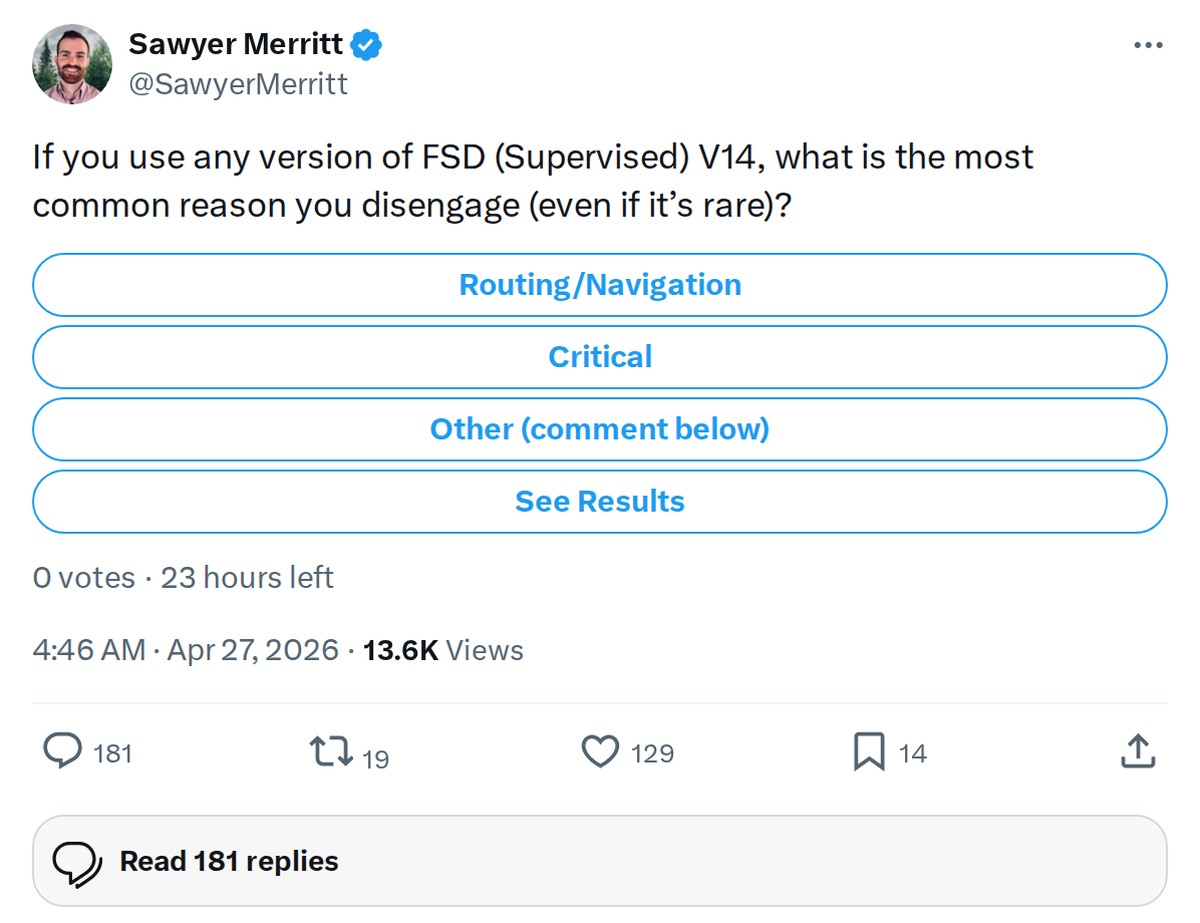
Tesla is adding "Navigation" as a new selectable disengagement reason in the FSD popup UI — a category that was notably absent from the options covered in our original analysis. This means drivers who take over due to route confusion, missed turns, or incorrect lane positioning for an upcoming maneuver will now have a dedicated way to flag that feedback directly to Tesla. The addition suggests Tesla is actively refining how it categorizes driver intervention data, and navigation-related disengagements may have been underreported or lumped into other categories until now. Sawyer Merritt flagged the change on X, noting it appears to be in an upcoming FSD build. 🔍

Source: @SawyerMerritt on X · 14,921 views
30-Second Brief
The News: Prominent Tesla community voice Sawyer Merritt is polling FSD (Supervised) V14 users on the most common reasons they disengage — even if it's rare.
Why It Matters: With V14 still in an early rollout covering roughly 1% of the North American fleet, real-world disengagement patterns are the clearest signal of where Tesla's AI still needs work — and this community data feeds directly into what Tesla prioritizes next.
Source: @SawyerMerritt on X

Why This Poll Matters Right Now
FSD (Supervised) V14 is arguably Tesla's most significant software leap in years. The underlying AI has been substantially rewritten — Tesla rebuilt the AI compiler and runtime from scratch using MLIR, delivering a 20% faster reaction time. The neural network vision encoder was upgraded to better handle rare and low-visibility scenarios. Reinforcement learning was overhauled across the board.
The results in early community testing have been striking. Before the V14.3.x releases, community trackers recorded an average of 1,454 miles between critical disengagements — more than three times the 443 miles logged under V13.2. In city driving specifically, V14 averaged 834 miles between critical interventions, up from just 217 miles in the prior generation. One tracker put the figure even higher, at 1,677 miles per critical disengagement.
That's a generational jump. But the question Sawyer Merritt is asking — what's still making you take over? — is exactly the right one to ask at this stage of rollout.
📊 FSD V14 vs V13.2 — Disengagement Data
| Metric | FSD V13.2 | FSD V14 |
|---|---|---|
| Miles between critical disengagements (overall) | 443 mi | 1,454 mi |
| Miles between critical disengagements (city) | 217 mi | 834 mi |
| Drives with zero interventions | — | 66.3% |
| Miles between any disengagement (non-critical) | — | 25 mi avg |
Source: Community trackers (pre-V14.3.x data). Numbers reflect early real-world testing, not official Tesla figures.
What V14 Already Fixed — And What It Hasn't
The official V14 changelog reads like a direct response to the most common FSD complaints from prior versions. Tesla addressed unprotected turns, lane-change hesitation, vehicle cut-ins, school bus handling, emergency vehicle yielding, and traffic light behavior at complex intersections. V14.3 specifically tackled unnecessary lane biasing and minor tailgating — two behaviors that frustrated even experienced FSD users.
Community reports back this up. Users noted that highway follow distance feels more natural, acceleration from stop signs is snappier, and the system now brakes with near-instant response when a vehicle pulls out of a parking spot — a scenario that previously caught older versions off guard.
But V14.3.2 introduced something that signals Tesla knows the job isn't done: a new in-car feature that lets drivers select a reason for an intervention from a small menu during a disengagement. Tesla is now collecting structured disengagement data directly from the fleet — and Merritt's community poll is the human-readable version of that same question.
What are owners still taking over for? Based on community discussion patterns, the likely candidates include:
- Unusual road markings or construction zones
- Aggressive or unpredictable behavior from other drivers
- Complex multi-lane merges at highway speeds
- Narrow roads or tight parking scenarios
- Comfort-based disengagements (driver preference, not safety)
Tesla's own roadmap for upcoming V14 improvements acknowledges some of these gaps: pothole avoidance is listed as a planned addition, and the driver monitoring system is slated for improvements in eye gaze tracking and variable lighting accuracy — suggesting Tesla is also working to reduce false attention alerts that prompt unnecessary driver intervention.
The Rollout Picture
As of April 22, 2026, FSD V14.3.1 (firmware 2026.2.9.7) had reached approximately 1% of the North American Tesla fleet. V14.3.2 followed the next day. Tesla is deliberately pacing the rollout — major parts of the AI software have been rewritten, and the team is monitoring closely for edge cases before pushing wider.
For HW3 owners, a "lite" version of FSD V14 is confirmed for release by end of June 2026. It will not support unsupervised operation, but it will bring meaningful improvements over the current HW3 experience.
📡 Rollout Status
~1% of North American fleet as of April 22, 2026 • Source: Community trackers
🔭 The BASENOR Take
| Timeline | V14.3.1 / V14.3.2 live now (1% fleet). Wider rollout pending stability confirmation. |
| Impact Level | HIGH — Shapes next FSD training cycle |
| Confidence | HIGH — Multiple verified sources |
This poll is more significant than it looks on the surface. Tesla now has a built-in disengagement reason selector in V14.3.2 — meaning they're already collecting structured feedback from the fleet. But community polls like Merritt's capture something the in-car menu can't: the nuance behind why an owner chose to intervene, including comfort-based decisions that aren't safety-critical but still matter for product feel.
The gap between V14's headline disengagement numbers and the remaining edge cases is where the next phase of FSD development lives. Tesla's training pipeline is designed to source hard examples directly from the fleet — the more owners report specific disengagement patterns, the faster those scenarios get prioritized in RL training. This is the feedback loop that turns a 1,454-mile average into 5,000 miles, and eventually into something that doesn't need supervision at all.
If you're on V14, your disengagements are already being logged. Now Tesla — and the community — wants to know the story behind them. For our full FSD coverage, including previous version breakdowns and owner reports, check the link.
📰 Deep Dive
The timing of this poll is deliberate. V14 is in the hands of a small but vocal slice of the fleet — the kind of early adopters who run FSD on every trip and notice behavioral nuances that most users would miss. Their disengagement patterns right now are a preview of what the broader fleet will experience once rollout accelerates.
What makes V14 structurally different from prior versions is that Tesla didn't just tune the existing system — they rebuilt core components. The MLIR-based AI compiler rewrite alone changes how quickly the model can iterate in response to fleet data. That 20% faster reaction time isn't just a comfort improvement; it's the difference between catching an edge case and missing it. The upgraded vision encoder's improved 3D geometry understanding directly addresses the kinds of spatial misjudgments that have historically caused disengagements in tight urban environments.
The introduction of the in-car disengagement reason selector in V14.3.2 is a quiet but meaningful product decision. Tesla is essentially crowdsourcing a labeled dataset of failure modes in real time, at scale, from paying customers who are motivated to give accurate feedback. Combined with the fleet's existing video and sensor logging, this creates a training signal that's hard to replicate in any other way. The community poll is the qualitative layer on top of that quantitative data — and both matter for understanding where V14 goes next.
For HW3 owners watching from the sidelines, the June 2026 V14 lite target is worth tracking closely. The architecture improvements in V14 — particularly the vision encoder upgrades — are expected to deliver meaningful real-world gains even on older hardware, within the constraints of what HW3 can run. The disengagement patterns that V14 early adopters are reporting today will directly shape what that HW3 experience looks like at launch.
📋 Tracking Tesla software? See every firmware, FSD and app version in one place in our Tesla Software Update Tracker.
Related Gear
Gear up your Tesla with tested, custom-fit BASENOR accessories — shop Tesla accessories →
Sources & reporting notes
The links below identify the material source records used for this report.
- @SawyerMerritt on X (2026-04-26T20:46:17.000Z) — Direct source
- @SawyerMerritt on X (2026-04-27T00:34:06.000Z) — Direct source
- @TeslaNewswire on X (2026-04-28T04:10:09.000Z) — Direct source
Source links are preserved as published or accessed. See our editorial standards and corrections policy.
The BASENOR Editorial Desk covers Tesla, SpaceX, and related technology, curating reporting from primary sources — official accounts, regulatory filings, and software release data. Every article passes source-record and fact-checking review before publication. About the newsroom.
This report was curated by the BASENOR Editorial Desk from the sources listed above. Read our editorial standards or email editorial@basenor.com to report an error.