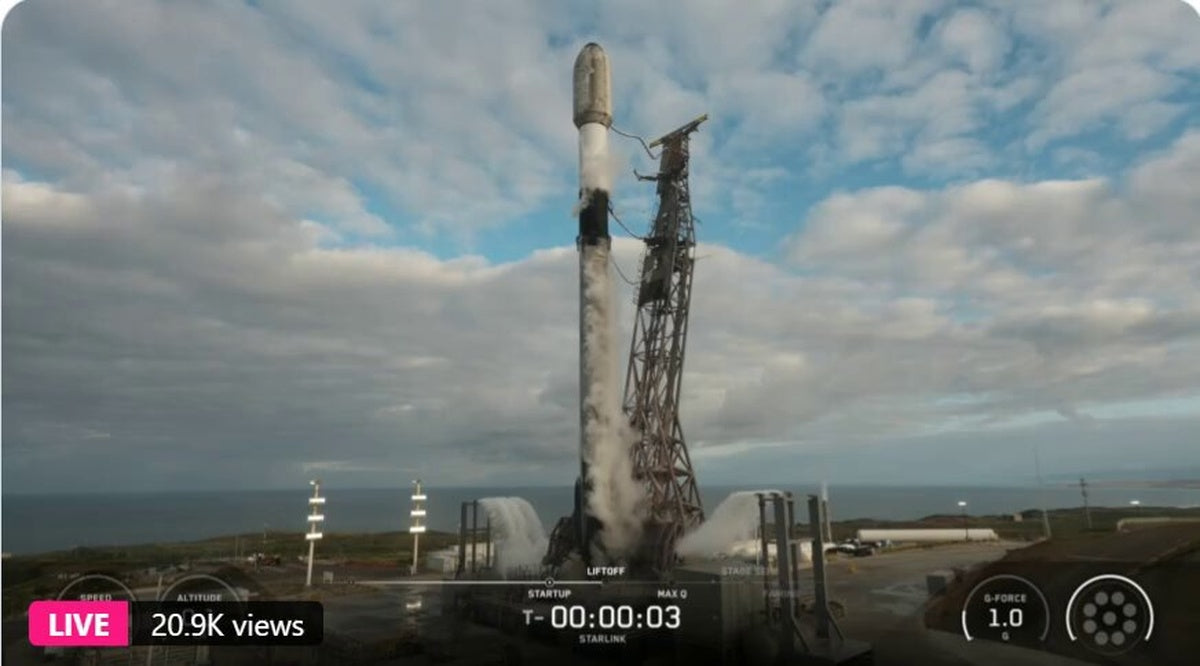
The News: SpaceX launched 25 Starlink Group 17-16 satellites from Vandenberg's SLC-4E on April 26, 2026, with booster B1088 completing its 15th successful flight and landing on drone ship Of Course I Still Love You in the Pacific Ocean.
Why It Matters: Every successful Starlink launch adds capacity and redundancy to the constellation that powers Tesla's in-car connectivity — and each booster reuse pushes SpaceX's cost-per-launch economics further ahead of the competition.
Source: @SpaceX · @NASASpaceflight
Another Clean Day at Vandenberg
SpaceX lit up the California sky on Sunday morning, sending Falcon 9 booster B1088 skyward from Space Launch Complex 4E at Vandenberg Space Force Base at 7:37 a.m. PDT (14:37 UTC). The payload: 25 Starlink V2 Mini Optimized satellites destined for Low Earth Orbit as part of the Group 17-16 shell.
NASASpaceflight noted the unusually cooperative weather — a "non-foggy day at Vandenberg" is worth calling out, because coastal fog regularly complicates both launches and landing visibility at this site.


B1088 Sticks Its 15th Landing
Roughly nine minutes after liftoff, booster B1088 executed a precision landing on drone ship Of Course I Still Love You in the Pacific Ocean. NASASpaceflight confirmed touchdown with a brief but telling note: "Looked good, camera wobble in play" — the camera shake on landing is a familiar sign of a hard, fast, successful touchdown rather than any anomaly.
This was the 15th flight for B1088, making it one of SpaceX's most-flown boosters. Fifteen flights on a single first stage would have been considered science fiction a decade ago. Today it's a Sunday morning routine.

📊 Key Figures
| Metric | Value | Context |
|---|---|---|
| Satellites Deployed | 25 | Starlink V2 Mini Optimized, LEO |
| Booster | B1088 | 15th flight for this core |
| Launch Time | 14:37 UTC, April 26, 2026 | 7:37 a.m. PDT, Vandenberg SLC-4E |
| Landing Zone | Of Course I Still Love You | Drone ship, Pacific Ocean |
| Constellation Group | Group 17-16 | Ongoing Starlink shell expansion |
🔭 The BASENOR Take
Timeline: Launch confirmed 14:37 UTC → Booster touchdown ~14:46 UTC → Satellites deploying to LEO
Impact Level: Incremental — routine constellation expansion with notable reusability milestone
Confidence: High — confirmed by SpaceX official account and NASASpaceflight with video evidence
📰 Deep Dive
B1088's 15th flight is a quiet but meaningful milestone. When SpaceX first introduced booster reusability, the internal target was 10 flights per core. The fact that B1088 has now flown 15 times — with a clean landing to boot — signals that Falcon 9's Block 5 design has exceeded its own engineering targets. Each additional flight on an already-paid-for booster is essentially free rocket hardware, which is why SpaceX can sustain a launch cadence that no other operator can match.
The Starlink V2 Mini Optimized satellites aboard this mission carry more capacity per unit than the original V1 hardware. As these newer-generation satellites fill out the constellation's shells, Starlink's aggregate throughput grows — which matters directly to Tesla owners who rely on the Starlink-powered in-car connectivity system for streaming, navigation data, and over-the-air updates in areas with weak cellular coverage.
Vandenberg's SLC-4E has become SpaceX's workhorse for polar and sun-synchronous orbit missions, and the site's launch tempo has accelerated sharply over the past two years. A clear, fog-free day is genuinely newsworthy at this coastal California pad — the marine layer routinely scrubs or delays launches, so Sunday's clean conditions were a bonus. The Pacific drone ship recovery also keeps the turnaround cycle tight: Of Course I Still Love You is purpose-built for West Coast missions and has supported dozens of B1088's previous landings.
For the broader SpaceX picture, this mission continues the relentless pace of Starlink constellation buildout. Each successful Group 17 shell launch adds orbital redundancy and coverage density, particularly over mid-latitude regions. The cadence shows no signs of slowing — and with Starship's heavy-lift capability eventually taking over bulk satellite deployment, Falcon 9's per-mission satellite count may look modest in retrospect. For now, though, 25 satellites every few weeks, recovered booster and all, is exactly the kind of boring excellence that keeps SpaceX's lead intact. Follow our SpaceX coverage for the latest on Starlink and Starship developments.
Sources & reporting notes
The links below identify the material source records used for this report.
- @NASASpaceflight on X (2026-04-26T14:46:33.000Z) — Direct source
- @NASASpaceflight on X (2026-04-26T14:37:58.000Z) — Direct source
- @SpaceX on X (2026-04-26T14:27:40.000Z) — Direct source
Source links are preserved as published or accessed. See our editorial standards and corrections policy.
The BASENOR Editorial Desk covers Tesla, SpaceX, and related technology, curating reporting from primary sources — official accounts, regulatory filings, and software release data. Every article passes source-record and fact-checking review before publication. About the newsroom.
This report was curated by the BASENOR Editorial Desk from the sources listed above. Read our editorial standards or email editorial@basenor.com to report an error.