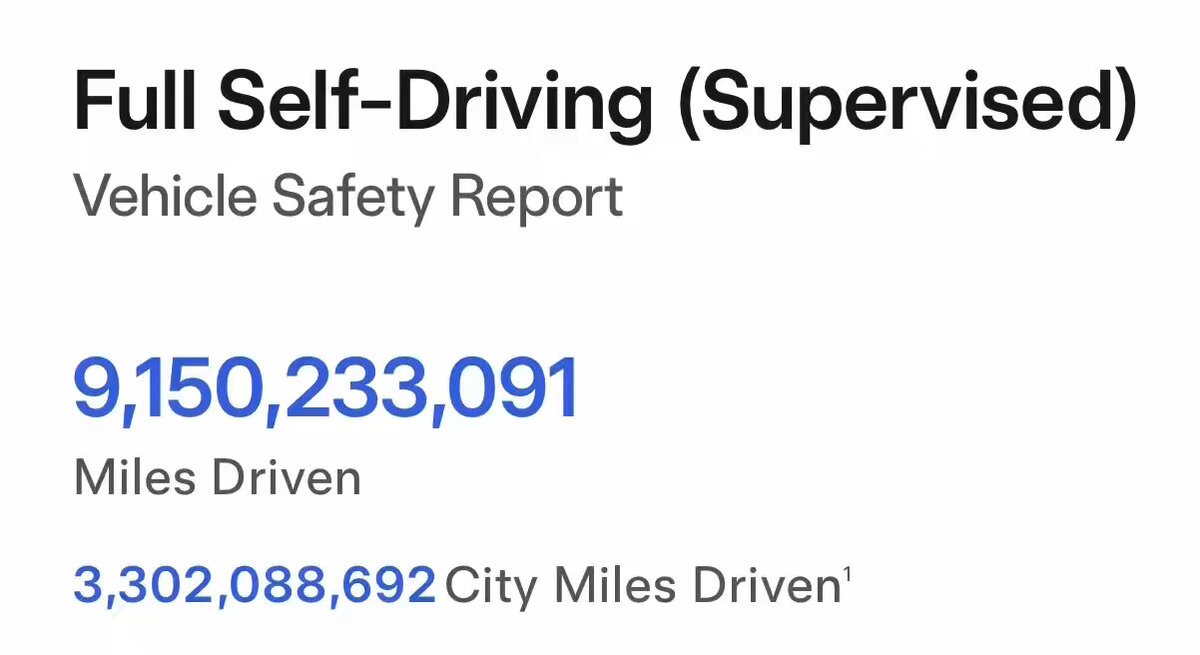
The News: Tesla has updated its FSD miles tracker — the fleet is now accumulating 19.2 million miles per day on Full Self-Driving, up 33% from 14.4 million miles per day just a couple of months ago.
Why It Matters: More miles mean more real-world training data for Tesla's AI, accelerating the path to fully autonomous driving — and validating that FSD adoption is genuinely accelerating, not just a marketing claim.
Source: @SawyerMerritt on X
Tesla FSD Fleet Now Logging 19.2 Million Miles Per Day — A 33% Surge in Months
Tesla's Full Self-Driving system just hit a milestone that deserves more attention than it's getting. The company has updated its official FSD miles tracker to reflect a larger vehicle fleet and surging adoption — and the numbers are striking. Tesla's fleet is now driving an average of 19.2 million miles per day on FSD. That's up from 14.4 million miles per day just a couple of months ago, a 33% jump in daily mileage accumulation.
To put that pace in visceral terms: Tesla's FSD fleet is covering 1,000 miles every 4.5 seconds.

📊 Key Figures
| Metric | Value | Context |
|---|---|---|
| Daily FSD miles (now) | 19.2 million | As of April 2026 |
| Daily FSD miles (prior) | 14.4 million | A couple months ago |
| Growth rate | +33% | In roughly 2 months |
| Miles per second | ~222 miles/sec | 1,000 miles every 4.5s |
| Cumulative FSD miles (Feb 28, 2026) | 8.4 billion+ | Reached 8.5B by Mar 5 |
| Active FSD users (end of 2025) | 1.1 million | ~3x growth since 2021 | d
🔭 The BASENOR Take
Timeline: 33% mileage growth in approximately 2 months (February → April 2026)
Impact Level: 🟠 High — directly accelerates FSD neural network training
Confidence: ✅ High — sourced from Tesla's own updated FSD miles tracker
The 33% jump in daily FSD miles isn't just a vanity metric — it's a direct signal of two compounding forces working in Tesla's favor simultaneously. First, the fleet itself is growing. More vehicles on the road means more FSD-capable hardware in the wild. Second, and arguably more important, adoption within that fleet is accelerating. Owners are actively engaging with FSD more than before.
This matters enormously for how Tesla's AI improves. Every mile driven on FSD generates edge-case data — the unexpected pedestrian, the ambiguous merge, the faded lane marking — that feeds back into Tesla's training pipeline. At 19.2 million miles per day, Tesla is collecting real-world autonomous driving data at a scale that is extraordinarily difficult to replicate in simulation alone. According to background research, the cumulative total surpassed 8.4 billion miles as of late February 2026, with the pace clearly accelerating since.
For context on the user base driving these numbers: Tesla reported approximately 1.1 million active FSD users globally at the end of 2025, nearly triple the 400,000 active users from 2021. That user base, spread across a growing fleet, is what's producing this data velocity.
📰 Deep Dive
The rate of accumulation is worth sitting with for a moment. Going from 14.4 million to 19.2 million daily miles in roughly two months implies that Tesla added roughly 4.8 million FSD miles per day to its run rate — that's more daily mileage than the entire fleet was accumulating not long ago. The compounding nature of this growth is what makes it significant: a larger fleet produces more miles, which generates more training data, which improves the product, which drives more adoption, which grows the fleet. Tesla is deep inside that loop right now.
The timing of this update to the FSD tracker is also notable. Tesla doesn't update this figure casually — doing so signals confidence in the underlying data and a desire to communicate fleet momentum publicly. For owners evaluating whether to subscribe to FSD, these numbers serve as a proxy for how rapidly the system is improving. More miles mean faster iteration cycles, and faster iteration cycles mean the version you try today may be meaningfully different from the one available in 90 days.
Looking at the trajectory: if the fleet continues growing and FSD adoption keeps climbing, the 19.2 million daily mile figure could look conservative by mid-year. The key variable is how aggressively Tesla continues expanding FSD availability across international markets and how the subscription model performs in retaining users beyond initial trial periods. For now, the direction is unambiguous — and the pace is accelerating. Follow our FSD coverage for ongoing updates as these milestones develop.

Marcus covers Tesla's software releases, FSD rollouts, and OTA changes. Background in automotive engineering. Based in Austin.
Sources verified at publish time. Spotted an inaccuracy? Email editorial@basenor.com.