📌 UPDATE — April 23, 2026
Tesla's FSD daily mileage has doubled in just a couple of months, with the fleet now averaging 28.8 million miles per day — up from 14.4 million miles per day recorded earlier this year. That translates to roughly 1,000 miles of FSD data collected every 3 seconds, a pace that dramatically accelerates Tesla's AI training pipeline. Tesla has updated its official FSD miles tracker to reflect the expanded fleet size and surging adoption rates driving this growth.

@SawyerMerritt · Apr 23, 2026
"Tesla's fleet is now driving an average of 28.8 million miles per day on FSD, up from 14.4 million miles per day a couple months ago. That's 1,000 miles every 3 seconds."
View on X →
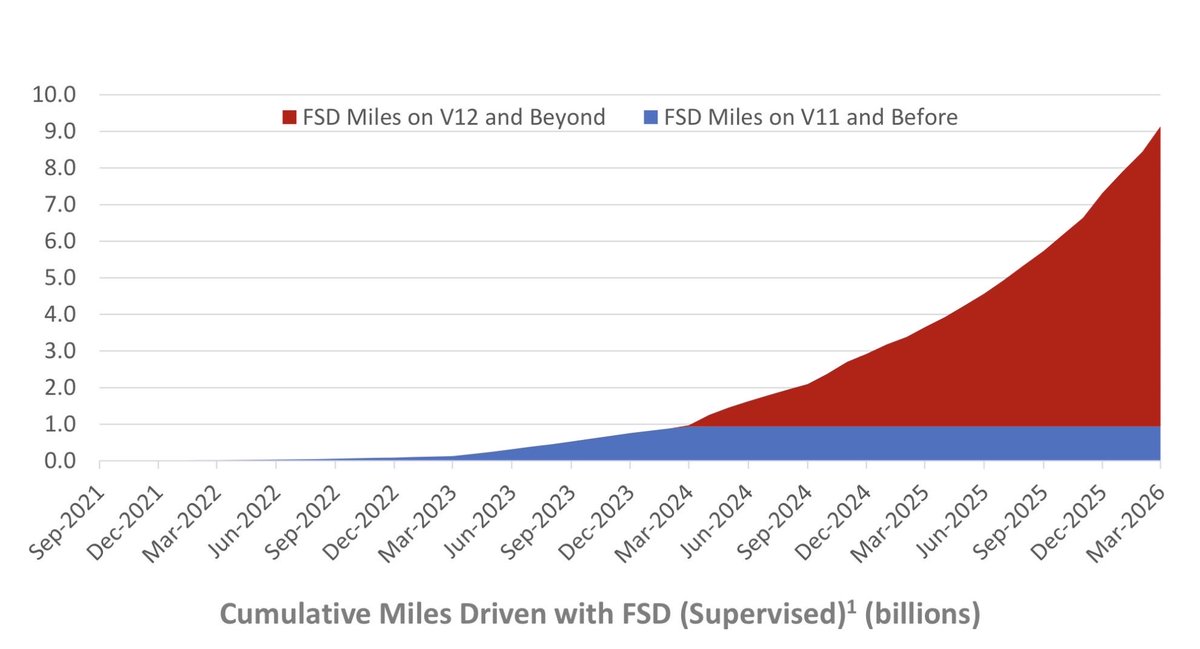
The News: Tesla's Full Self-Driving (Supervised) system has officially crossed 9 billion cumulative miles driven, with the fleet now adding approximately 1 billion miles every month.
Why It Matters: At this pace, FSD is closing in on the ~10 billion miles Elon Musk has cited as a threshold for safe unsupervised self-driving — and Robotaxi rides are already live in Dallas and Houston.
Source: @TeslaNewswire on X

9 Billion Miles — And Accelerating
Tesla confirmed the 9 billion mile milestone for FSD (Supervised) around April 2, 2026, and the numbers behind that headline tell a more compelling story than the milestone itself. The fleet is not just growing — it is compounding. As of April 9, 2026, Tesla's FSD fleet was logging an average of 19.2 million miles per day, a 33% jump from the 14.4 million daily miles recorded just a couple of months earlier.
That kind of acceleration changes the math on every future milestone. At the current rate of roughly 1 billion miles per month, the 10 billion mile mark is on track to arrive by mid-to-late May 2026 — a number that carries particular weight given Elon Musk's previous statements about the data volume needed to achieve safe unsupervised self-driving at scale.
📊 Key Figures
| Metric | Value | Context |
|---|---|---|
| Cumulative FSD Miles | 9 billion+ | As of early April 2026 |
| Highway Miles | ~5.76B (64%) | Majority of total miles |
| City Street Miles | ~3.24B (36%) | More complex driving scenarios |
| Daily Mileage (Apr 9) | 19.2M miles/day | +33% vs. ~2 months prior |
| Monthly Accumulation Rate | ~1 billion miles | Accelerating |
| Safety Record | 1 collision / 5.3M miles | 12-month period, N. America |
| Active FSD Users (end 2025) | ~1.1 million | ~3x growth since 2021 |
| Projected 10B Mile Date | Mid-to-late May 2026 | At current pace |
The Road to Unsupervised: Why 10 Billion Matters
The 10 billion mile figure is not arbitrary. Elon Musk has referenced it as a rough benchmark for the volume of real-world training data needed to make unsupervised FSD safe at scale. With the fleet now adding a billion miles a month, that threshold is weeks away — not quarters.
The split between highway and city miles is worth paying attention to. At 64% highway versus 36% city, the data set is still skewed toward the easier driving environment. City streets — intersections, cyclists, unpredictable pedestrians, construction zones — are where autonomous systems earn their credibility. The city mile count is growing fast, but the gap matters for anyone tracking progress toward true urban autonomy.
Meanwhile, the latest FSD version in focus is V14.3.1, first spotted on April 14, 2026. It builds on V14.3, which introduced a rewritten AI compiler and runtime using MLIR, delivering a reported 20% faster reaction time. More miles feeding a faster-reacting model is a meaningful combination. For more on FSD's software evolution, see our FSD coverage.
Robotaxi Is Already Live — This Is the Proof of Work
The 9 billion mile announcement lands alongside a significant operational reality: Tesla has already launched unsupervised Robotaxi rides in Dallas and Houston as of April 2026. The FSD Robotaxi now accepts passengers aged 8 and above. That is not a pilot program framing — that is a commercial service.
The mileage data is the foundation that made that launch possible. Approximately 1.1 million active FSD users globally at the end of 2025 — nearly triple the 400,000 active users from 2021 — have collectively built the world's largest real-world autonomous driving dataset. No simulator can replicate what 19.2 million daily miles of actual traffic generates.
🌍 Where FSD (Supervised) Is Available
United States • Canada • Mexico • Puerto Rico • Australia • New Zealand • Netherlands (approved April 2026) • South Korea
🔭 The BASENOR Take
Timeline: 9 billion miles confirmed ~April 2, 2026 • 10 billion projected mid-to-late May 2026
Impact Level: 🔴 High — directly tied to the unsupervised FSD threshold Musk has cited publicly
Confidence: ✅ High — figures sourced from Tesla's official safety page and verified reporting
The 9 billion mile milestone is significant not because of the number itself, but because of what the growth rate implies. A 33% acceleration in daily mileage over two months suggests FSD adoption is entering a self-reinforcing cycle: more users generate more data, better data produces better software, better software attracts more users.
The safety figure — one major collision per 5.3 million miles under FSD (Supervised) — will become a central data point as Tesla pushes for regulatory approval in additional markets. The Netherlands approval in April 2026 is a template for that process. Each new market adds more diverse driving conditions to the training set, which in turn strengthens the case for the next market.
The honest question for owners watching this closely: the jump from 9 billion to 10 billion miles is almost mechanical at this point. The more meaningful question is what happens after 10 billion — whether the software improvements that follow justify the unsupervised label in the markets where it matters most.

Marcus covers Tesla's software releases, FSD rollouts, and OTA changes. Background in automotive engineering. Based in Austin.
Sources verified at publish time. Spotted an inaccuracy? Email editorial@basenor.com.