📌 UPDATE — May 22, 2026
Tesla has rebranded its FSD feature in China once more, now calling it Tesla Assisted Driving ahead of the upcoming software rollout. The company notes the function will be "available later," signaling the full launch is still pending. The name change likely reflects ongoing efforts to align with Chinese regulatory language around driver-assistance systems, where the term "Full Self-Driving" has faced scrutiny. No new timeline has been officially confirmed alongside the rebrand.
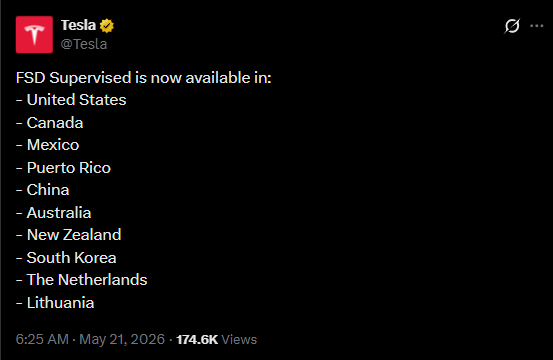
Tesla's Full Self-Driving rollout in China is further along than many realize — but it's not finished. FSD Supervised officially became available in China on May 21, 2026, following a period of limited deployment that began last year. The catch: full regulatory approval to push FSD to every eligible vehicle in the country hasn't arrived yet, and Tesla is now targeting Q3 2026 as the window when that could change.

What's Actually Live Right Now
The distinction here matters. As Sawyer Merritt clarified on X, Tesla has listed China as an FSD-available market since mid-2025 — this isn't a new development. What exists today is a supervised, limited deployment, not a blanket rollout to all vehicles. The official announcement on May 21 formalized FSD Supervised availability in China, but the regulatory framework for a full fleet-wide push is still pending approval from Chinese authorities.
Whole Mars Catalog put it plainly: Tesla is "waiting for approval to send it to every car, which is hopefully coming in Q3."

The Road to Full Approval
Getting FSD approved in China is a different regulatory challenge than anywhere else Tesla operates. The company has had to build out significant local infrastructure to even get to this point. According to verified reporting, Tesla established a dedicated data center in Shanghai and partnered with Baidu for mapping services — both requirements under Chinese data localization rules. The in-car voice assistant has also been adapted for the Chinese market, integrating ByteDance's Doubao model and DeepSeek Chat for AI interactions.
Tesla executives addressed the approval timeline during the Q1 2026 earnings call on April 23, expressing confidence in a Q3 2026 target for broader regulatory clearance. That's a more measured forecast than earlier projections — Elon Musk had previously hoped for full approval around February or March 2026, but those timelines slipped, according to reporting from China Daily citing government sources.
To accelerate localization and real-world testing, Tesla has also launched a recruitment drive for Smart Driving Test Technicians and ADAS Test Operators across nine major Chinese cities, including Beijing, Shanghai, and Guangzhou. That kind of operational investment signals Tesla is treating the Q3 target seriously, not just optimistically.
Pricing and the Subscription Gap
One notable wrinkle for Chinese owners: Tesla globally discontinued the one-time FSD purchase option in February 2026, shifting to a subscription-only model in most markets. China is an exception. The one-time purchase remains available there at 64,000 yuan (approximately $9,400 USD), and a monthly subscription option has not yet been introduced for Chinese customers. That pricing structure will likely need to evolve once full regulatory approval is in place and Tesla can deploy FSD more broadly.
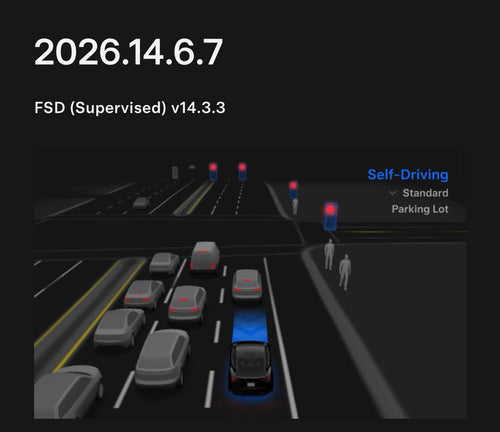
On the software side, Tesla China updated its owner's manual to version 2026.14 in early May, which includes a full introduction to FSD V14. Tesla has already begun rolling out FSD V14.3.3 in overseas markets, so Chinese owners receiving full approval in Q3 would be stepping into a relatively mature version of the system rather than an early build.
What Q3 Approval Would Actually Mean
If Chinese regulators grant full approval on Tesla's hoped-for timeline, it would unlock FSD deployment to all eligible vehicles in one of the world's largest EV markets — a significant commercial and strategic milestone. China is also Tesla's most competitive market, where local automakers have aggressively developed their own advanced driver-assistance systems. Broader FSD availability could become a meaningful differentiator, particularly as the technology matures toward V14 and beyond.
For now, the Q3 window is a target, not a guarantee. Regulatory timelines in China have surprised Tesla before in both directions. The infrastructure is in place, the software is ready, and the recruitment push is underway — the remaining variable is the approval itself.

Marcus covers Tesla's software releases, FSD rollouts, and OTA changes. Background in automotive engineering. Based in Austin.
Sources verified at publish time. Spotted an inaccuracy? Email editorial@basenor.com.