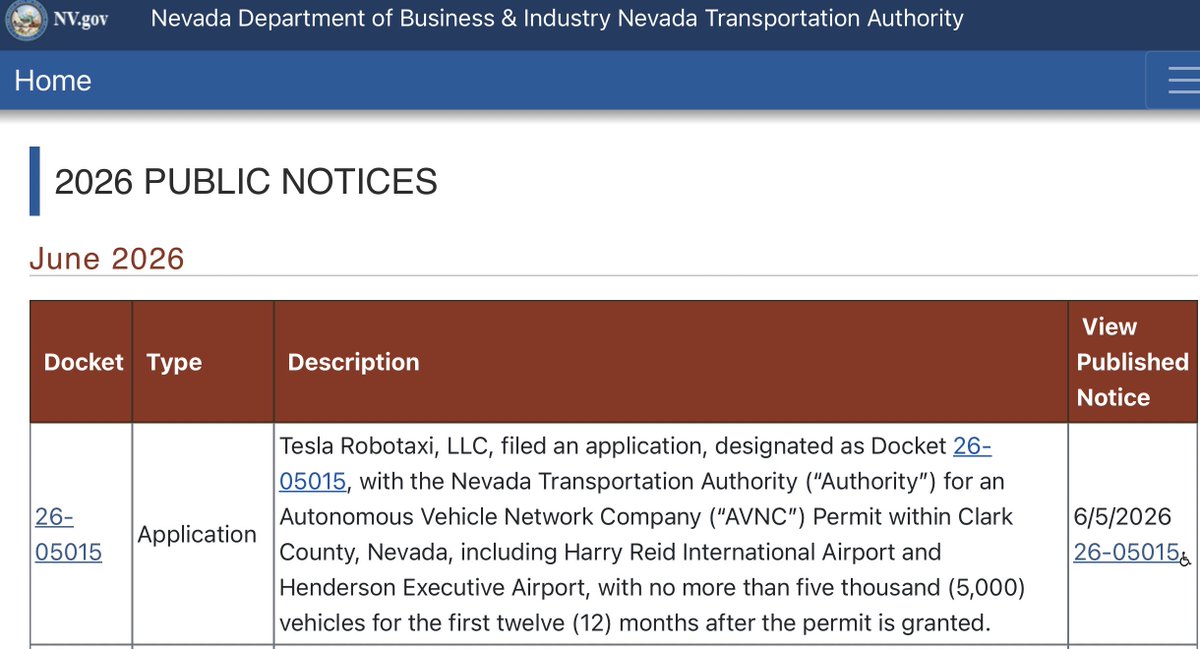
Tesla has officially filed for an Autonomous Vehicle Network Company permit with the Nevada Transportation Authority, marking its most concrete commercial step yet toward a paid robotaxi service in the United States. The application targets Clark County — home to Las Vegas and Harry Reid International Airport — and requests authorization for up to 5,000 vehicles within the first 12 months of approval.

How Tesla Got Here
This permit application is the culmination of a methodical regulatory progression in Nevada that began in late 2025. Tesla submitted its Testing Registry certification to the Nevada DMV on September 3, 2025, receiving approval just seven days later on September 10. That certification allowed Tesla to operate supervised autonomous vehicles on public roads for data collection — but explicitly prohibited carrying paying passengers.
By November 20, 2025, Tesla completed Nevada's self-certification process for autonomous vehicle operations, clearing the next hurdle toward commercial deployment. At that point, a spokesperson for the Nevada Transportation Authority confirmed Tesla had not yet applied for the commercial-tier Autonomous Vehicle Network Company permit. That gap closed with today's filing.
According to background research, Tesla also filed a separate permit with Clark County on May 12, 2026, related to supporting infrastructure — suggesting the Nevada launch has been in active preparation for weeks before today's NTA application became public.

Why Clark County and Why Now
Las Vegas is a logical first market. The city draws tens of millions of visitors annually, operates a dense urban core with predictable grid-style streets, and already hosts a mature rideshare ecosystem that Tesla can position against. Harry Reid International Airport — explicitly named in the filing — is one of the busiest single-terminal airports in the country and represents a high-frequency, high-demand pickup corridor that would generate immediate utilization for a robotaxi fleet.
The 5,000-vehicle ceiling for year one is a significant number. To put it in context: Waymo currently operates a few hundred vehicles across its active markets combined. A 5,000-unit Nevada deployment, if approved and executed, would represent a step-change in autonomous vehicle density in any single metro area.
What Still Has to Happen
Filing is not approval. The Nevada Transportation Authority now reviews the application, and there is no publicly stated timeline for how long that process takes for a first-of-its-kind applicant at this scale. Tesla will need to satisfy the NTA's requirements around safety records, operational protocols, insurance, and likely public comment periods before any commercial rides can begin.
Tesla had previously indicated a target of launching Las Vegas robotaxi service within the first half of 2026. That window is closing — June 6 is already well into Q2. Whether the NTA can process and approve an application of this scope before July 1 is an open question, though the filing itself signals Tesla believes regulatory approval is within reach in the near term.
For Tesla owners and observers, this application is the clearest signal yet that the robotaxi timeline is no longer theoretical. The paperwork is in. Nevada is now deciding. Follow our FSD and robotaxi coverage for updates as the NTA review progresses.
🚕 Following the Robotaxi rollout? See every operating city, launch date and announced market in our Tesla Robotaxi Tracker.
Related Gear
Gear up your Tesla with tested, custom-fit BASENOR accessories — shop Tesla accessories →
Sources & reporting notes
The links below identify the material source records used for this report.
- @SawyerMerritt on X (2026-06-06T00:16:52.000Z) — Direct source
- @wholemars on X (2026-06-06T00:19:33.000Z) — Direct source
- @SawyerMerritt on X (2026-06-06T00:16:52.000Z) — Direct source
Source links are preserved as published or accessed. See our editorial standards and corrections policy.
The BASENOR Editorial Desk covers Tesla, SpaceX, and related technology, curating reporting from primary sources — official accounts, regulatory filings, and software release data. Every article passes source-record and fact-checking review before publication. About the newsroom.
This report was curated by the BASENOR Editorial Desk from the sources listed above. Read our editorial standards or email editorial@basenor.com to report an error.