30-Second Brief
The News: Tesla officially states its glass can withstand four times the weight of the car — a claim just validated in the most extreme real-world test imaginable: a Model Y in Israel survived a direct hit from rocket debris falling from the sky.
Why It Matters: This is more than a marketing stat. It's a live demonstration that Tesla's laminated glass architecture provides meaningful occupant protection in scenarios well beyond standard crash testing.
Sources: @Tesla · @TeslaNewswire
Tesla Glass Can Withstand 4x the Car's Weight — A Model Y Just Proved It Against Missile Debris
Tesla has long made bold claims about the structural integrity of its vehicles. But this week, those claims got a real-world stress test that no engineer could have planned — and the glass held.
On April 3, Tesla's official account posted a direct statement: Tesla glass can withstand four times the weight of the car. That's not a rounding figure. For a Model Y weighing roughly 4,400 lbs, that means the roof glass is engineered to resist over 17,000 lbs of compressive force before the cabin is compromised.

The timing of that post wasn't coincidental. Days earlier, a Model Y owner in Netanya, Israel documented something extraordinary: their parked Model Y had been struck by falling rocket debris — shrapnel estimated at around 10 kg (22 lbs) — during a missile incident on March 30, 2026. The glass roof absorbed the impact, cracked visibly, but did not shatter, did not penetrate, and did not collapse into the cabin. The vehicle was unoccupied. No injuries.

📊 What the Numbers Actually Mean
📊 Tesla Glass: Verified Performance Data
| Metric | Value | Context |
|---|---|---|
| Model Y roof strength (IIHS tested) | 19,000+ lbs | 4x vehicle weight |
| Model 3 roof strength (IIHS tested) | 20,000+ lbs | Highest EV ratio at time of test |
| Missile debris weight (Israel incident) | ~10 kg (22 lbs) | High-velocity impact, unoccupied vehicle |
| Outcome | Cabin intact | No penetration, no injuries |
How Tesla Glass Is Actually Built
The performance isn't magic — it's engineering. Tesla's panoramic roofs use laminated, multi-layer safety glass. The construction involves a chemically strengthened inner layer (0.5–1.1mm thick) for flexibility and strength, bonded to a thicker outer layer (2–5mm) made from low-CTE, high-densification glass — often borosilicate — which absorbs energy and resists thermal shock. An adhesive interlayer holds everything together.
That last part is what matters most in an impact scenario. When the glass cracks, the laminate keeps it bonded. Fragments don't fly. Debris doesn't enter the cabin. The structural integrity of the roof — which is critical in rollover survival — is maintained even when the glass surface is compromised.
This same design philosophy is why, in 2013, a Model S glass floor reportedly broke the NHTSA's crush-test machine. It's why Model 3 roofs have survived falling concrete utility poles with occupants unharmed. The Israel incident is the latest — and arguably most dramatic — data point in that track record.
🚦 Owner's Action Plan
ℹ️ INFORMATIONAL
No action is required. This is not a recall, a software change, or a safety defect. But there are a few things worth knowing as an owner:
- Inspect your glass after any significant impact. Even if the laminate holds and the cabin is intact, cracked glass should be assessed by a Tesla-certified technician. Structural integrity may be reduced after a major impact even if the glass hasn't shattered.
- Cracked glass ≠ failed glass. If your panoramic roof cracks from road debris or hail, it may still be performing its safety function. Don't assume a crack means the roof is compromised — but do get it inspected promptly.
- Understand your coverage. Comprehensive auto insurance typically covers glass damage from falling objects, debris, and weather events. If you're in a region with elevated risk (hail, storms, or otherwise), confirm your policy covers panoramic roof replacement.
- Check Tesla's glass warranty. Tesla's New Vehicle Limited Warranty covers glass defects. Impact damage is generally not covered under warranty but may be covered by insurance. Contact Tesla Service or your insurer for specifics.
📰 Deep Dive
What makes the Israel incident particularly significant isn't just the visual drama of a cracked roof — it's the physics. Rocket shrapnel doesn't fall gently. It arrives at high velocity with irregular edges, concentrating force on a small contact area. Standard IIHS crush tests apply slow, uniform pressure across a broad surface. The fact that the Model Y's glass absorbed a high-velocity, point-impact strike and still maintained cabin integrity suggests the laminated architecture performs well beyond the conditions it's formally tested against.
Tesla's timing in posting the official glass strength stat — within days of the Israel incident gaining attention — reads as deliberate. The company rarely posts standalone engineering facts without a narrative hook. Whether or not Tesla had this specific incident in mind, the juxtaposition is effective: here's the spec, here's the proof.
For owners, the broader takeaway is this: the glass roof isn't a vulnerability. A common concern among panoramic sunroof skeptics is that large glass surfaces represent a structural weak point. The IIHS data and real-world incidents consistently tell the opposite story. Tesla's glass-intensive roof designs — which eliminate the traditional metal roof structure — achieve superior crush resistance precisely because the glass itself is load-bearing. The laminated construction turns what looks fragile into one of the most resilient parts of the vehicle.
That said, no glass is indestructible. The Model Y in Israel sustained visible damage. It would need significant repair or replacement. The point isn't that Tesla glass is impervious — it's that when it fails, it fails safely, keeping occupants protected rather than putting them at additional risk. That's the engineering goal, and by every available measure, it's being met.
Related Gear
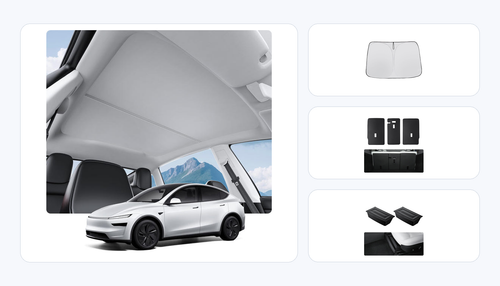
Gear up your Model Y with tested, custom-fit BASENOR accessories — shop Model Y accessories →
Sources & reporting notes
The links below identify the material source records used for this report.
- @Tesla on X (2026-04-03T20:34:24.000Z) — Direct source
- @TeslaNewswire on X (2026-04-03T20:29:04.000Z) — Direct source
Source links are preserved as published or accessed. See our editorial standards and corrections policy.
The BASENOR Editorial Desk covers Tesla, SpaceX, and related technology, curating reporting from primary sources — official accounts, regulatory filings, and software release data. Every article passes source-record and fact-checking review before publication. About the newsroom.
This report was curated by the BASENOR Editorial Desk from the sources listed above. Read our editorial standards or email editorial@basenor.com to report an error.