
📱 30-Second Brief
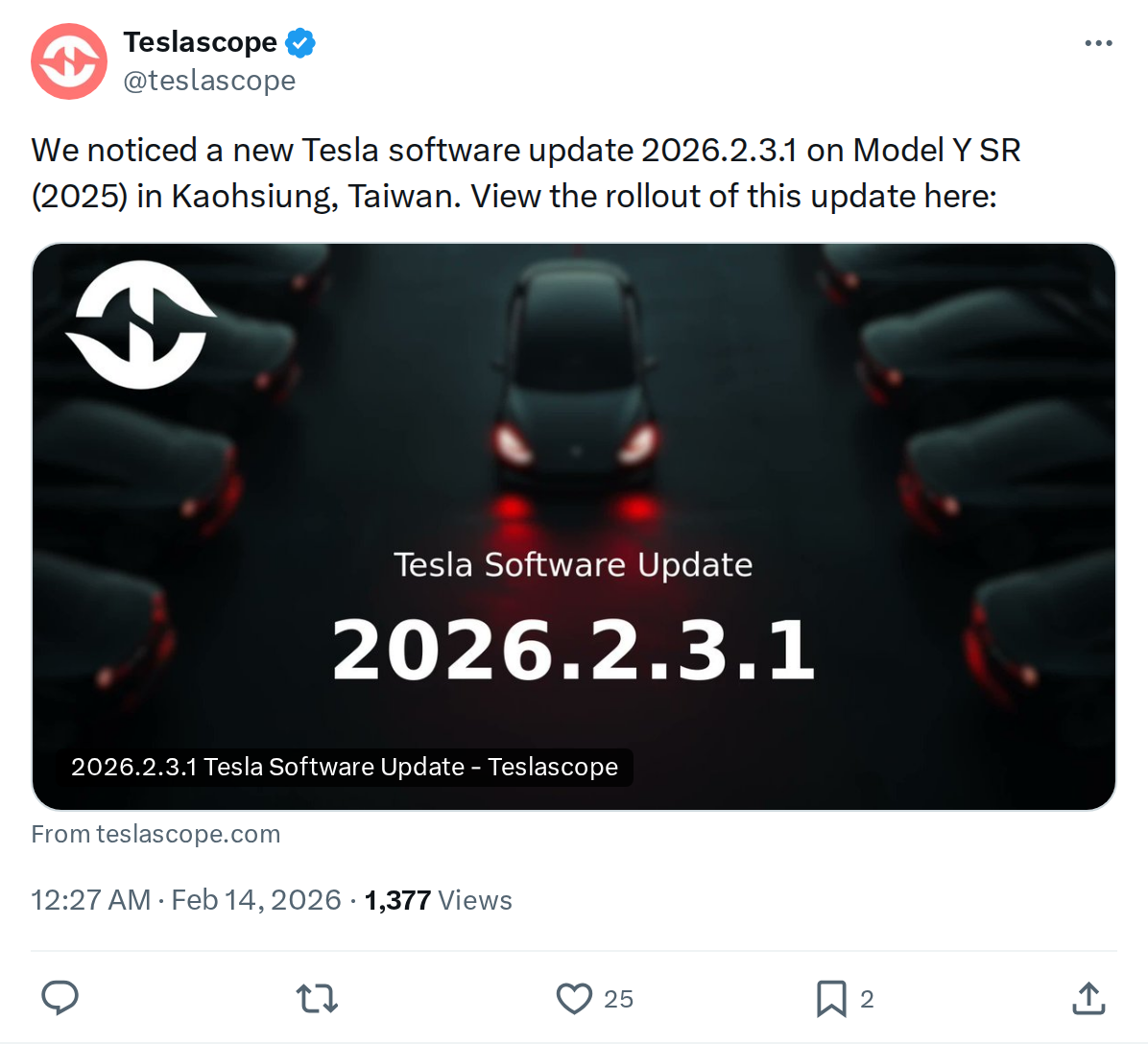
The News: Tesla software version 2026.2.3.1 has been detected on a 2025 Model Y in Kaohsiung, Taiwan, marking the first appearance of this specific firmware branch in global fleet tracking systems.
Why It Matters: This minor point release suggests Tesla is deploying targeted fixes or regional adjustments to the widely-released 2026.2.3 branch, which reached 62% of the global fleet as of February 12.
Source: @teslascope on X
🔍 The Detection
Fleet tracking service Teslascope captured the first instance of firmware version 2026.2.3.1 running on a Model Y Standard Range (2025 model year) located in Taiwan. This marks an extremely fresh deployment — the tweet announcing the detection is just over an hour old at time of publication.

The .1 suffix indicates this is likely an incremental update to the main 2026.2.3 branch, which began its wide rollout just one day prior on February 12. Tesla commonly releases these point updates to address minor bugs, apply regional-specific adjustments, or optimize performance for specific hardware configurations discovered during initial deployment.
📊 Key Figures
| Metric | Value | Context |
|---|---|---|
| Version Number | 2026.2.3.1 | First documented instance globally |
| Parent Branch Fleet Penetration | 62% | 2026.2.3 as of Feb 12 |
| Detection Vehicle | Model Y SR (2025) | Taiwan region deployment |
| Time Since Parent Release | ~24 hours | Rapid iteration cycle |
🧬 Understanding the 2026.2.3 Foundation
To understand what 2026.2.3.1 might contain, we need to examine its parent branch. According to verified release documentation, the main 2026.2.3 update included several significant features:
Child Left-Alone Warning — Now active in North America, this safety feature detects unattended children in the vehicle. When triggered, the car flashes exterior lights, plays an alert tone, and pushes a notification to the Tesla app.
Charge Cable Unlatch Mechanism — Owners can now stop charging and release the cable by pulling and holding the rear left door handle for 3 seconds (vehicle must be unlocked or a recognized key must be nearby).
Enhanced Supercharger Maps — The navigation system now displays 3D views of select Supercharger locations with live occupancy data. According to verified sources, this expansion includes at least two new European sites in Belgium.
Grok Beta Integration — Cybertruck units received integration with Grok for navigation commands, allowing voice-based destination management.
Dashcam Viewer Enhancements — Playback now includes additional telemetry: vehicle speed, steering wheel angle, and active self-driving state during recorded incidents.
Automatic HOV Lane Routing — Navigation can now automatically route through high-occupancy vehicle lanes when the option is enabled.
🔭 The BASENOR Take
📅 Timeline: Detected within 24 hours of parent branch wide release
⚡ Impact Level: Minor — Likely addresses edge cases or regional optimization
🎯 Confidence: High that this is a stability/bug-fix iteration rather than feature addition
Analysis:
Tesla's software deployment strategy typically follows a pattern: wide release of a major branch (2026.2.3), followed by rapid point releases (.1, .2, etc.) to address issues discovered in real-world conditions. The 24-hour turnaround between 2026.2.3 and 2026.2.3.1 is consistent with this pattern.
The Taiwan-specific detection is noteworthy. Regional deployments often serve as controlled testing grounds for fixes before global propagation. The 2025 Model Y Standard Range configuration may have exhibited specific behavior requiring adjustment — perhaps related to the new charge cable unlatch feature or dashcam telemetry display on vehicles with certain hardware configurations.
What's particularly interesting is the hardware context. According to verified sources, the main 2026.2.3 branch is primarily being deployed to Hardware 3 (HW3/AI3) vehicles running FSD v12.6.4 and v13.2.9. Hardware 4-equipped vehicles are receiving a different firmware track (2025.45.9 series). This suggests Tesla is managing multiple parallel software streams optimized for different hardware generations — a complex orchestration that increases the likelihood of minor point releases for specific vehicle configurations.
📰 Deep Dive: What Point Releases Tell Us About Tesla's Development Velocity
The appearance of 2026.2.3.1 within a day of its parent branch reveals something fundamental about Tesla's software philosophy: aggressive iteration with safety nets. Unlike traditional automakers who might batch fixes into monthly updates, Tesla's over-the-air infrastructure allows for rapid response to fleet-wide telemetry.
When 62% of the global fleet receives a major update like 2026.2.3, Tesla's backend systems are processing millions of data points per hour — battery performance metrics, infotainment system crashes, navigation routing anomalies, and autopilot disengagements. The .1 suffix suggests their engineering team identified a pattern significant enough to warrant immediate deployment, but minor enough not to require a full branch increment.
For Tesla owners, this development cadence is both a strength and a consideration. The strength: bugs get squashed fast, often before most owners even notice them. The consideration: early adopters of any software version are effectively participating in a massive, real-world validation process. This is why Tesla's phased rollout strategy — starting with small percentages of the fleet, then expanding — remains crucial to their quality control.
The Taiwan detection also highlights Tesla's global coordination challenges. Features like Child Left-Alone Warning and automatic HOV lane routing may behave differently across regulatory environments. A warning system calibrated for North American car seat standards might require adjustment for international markets. Similarly, HOV lane rules vary dramatically by country, requiring region-specific navigation logic.
As this update propagates beyond its initial Taiwan detection, fleet trackers will reveal whether 2026.2.3.1 remains geographically contained or becomes the new global baseline, effectively replacing 2026.2.3. Either outcome provides insight into whether this is a regional patch or a universal stability improvement.
For now, owners on 2026.2.3 should monitor their update notifications over the coming days. If you're running an earlier version and haven't received 2026.2.3 yet, you may skip it entirely and jump directly to 2026.2.3.1 — a common occurrence when point releases deploy during a parent branch's rollout window.


