30-Second Brief
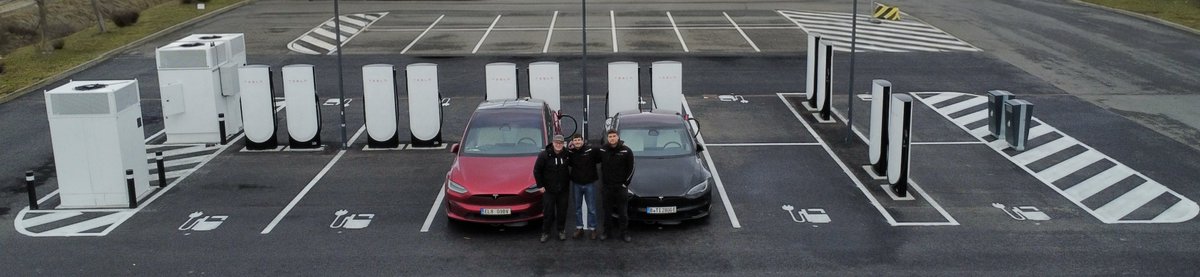
The News: A Tesla Supercharger in the Czech Republic has become the first fast charger ever to receive metrology verification under the country's new metrology law, in collaboration with the Czech Metrology Institute (ČMI).
Why It Matters: This milestone signals that Europe is actively closing the regulatory gap for EV charging infrastructure — and Tesla is leading that effort, which ultimately means more reliable, standardized charging for owners across the continent.
Source: @TeslaCharging on X
Tesla Supercharger Earns First Metrology Certification Under New Czech Law
Tesla Charging has reached a quiet but consequential milestone in central Europe: a Tesla Supercharger in the Czech Republic has become the first fast charger ever to receive metrology verification under the country's new metrology law. The achievement was secured in direct collaboration with the Czech Metrology Institute (ČMI) — and it points to something bigger happening across the continent.

📊 Key Figures
| Metric | Detail |
|---|---|
| Charger Type Certified | DC Fast Charger (Supercharger) |
| Certifying Body | Czech Metrology Institute (ČMI) |
| ČMI DC Testing Range | Up to 200 A / 850 V |
| ČMI Measurement Uncertainty | 0.2% (delivered energy) |
| EU Metrology Framework Approved | February 11, 2026 |
Why Metrology Verification Actually Matters for EV Charging
Metrology — the science of measurement — is not a term most Tesla owners think about when they plug in at a Supercharger. But it governs something fundamental: are you being billed accurately for the energy you actually received?
In the traditional fuel world, every petrol pump is legally required to dispense precisely what the display says. EV charging infrastructure in many European markets has operated without an equivalent mandatory standard — meaning that until now, the verified accuracy of a fast charger's energy measurement was largely left to the operator's good faith. The Czech Republic's new metrology law changes that, and Tesla has just become the first fast-charging operator to formally comply with it.
This matters for two reasons. First, consumer protection: owners paying per kWh now have a legal guarantee that the number on the screen reflects what actually went into their battery. Second, market confidence: verified measurement standards are a prerequisite for broader public investment in charging infrastructure, because governments and regulators won't commit public funds to networks that can't be independently audited.
The EU Regulatory Backdrop
This Czech milestone didn't happen in isolation. On February 11, 2026 — just two weeks before this announcement — EU lawmakers formally approved an overhaul of rules bringing EV charging equipment into the bloc's legal metrology framework, according to EU Perspectives. The updated regulations modernize the directive, clarify how measuring instruments operate in digital environments, and mandate high metrological performance across energy and transport infrastructure.
The Czech Republic, as an EU member state, is required to align with these rules. The ČMI has been preparing for this: it developed a dedicated accuracy-testing standard for EV charging stations back in 2022 and built out testing capabilities specifically for DC fast chargers — the category that Superchargers fall into. Tesla's collaboration with ČMI to achieve this first verification appears to be a direct result of that preparation converging with the new regulatory environment.
Tesla Charging's statement that 'standardized metrology rules across Europe are key for charging deployment to keep up with demand' is a clear signal that the company views regulatory harmonization not as a compliance burden, but as a growth enabler. A patchwork of national standards slows the rollout of new Supercharger sites; a unified European framework accelerates it.
🔭 The BASENOR Take
| Dimension | Assessment |
|---|---|
| Timeline | Near-term — framework is live, expect more EU markets to follow in 2026 |
| Impact Level | Medium-High — lays legal groundwork for faster Supercharger expansion in Europe |
| Confidence | High — confirmed directly by @TeslaCharging; supported by EU regulatory timeline |
📰 Deep Dive
What looks like an administrative checkbox is actually a strategic move. Tesla has consistently used regulatory compliance in key markets as a lever to unlock faster network expansion — and doing so publicly (via an official @TeslaCharging post crediting ČMI by name) is a deliberate signal to regulators in neighboring countries. The message: Tesla is willing to lead on compliance, not just follow.
For owners in Europe, the practical implication is a charging network that should grow faster and with greater accountability. As EU metrology rules standardize across member states, the approval process for new Supercharger sites — which often involves local utility and regulatory sign-off — should become more predictable. Fewer regulatory bottlenecks mean more stalls online sooner.
The Czech Republic is also a strategically interesting first mover here. It sits at the geographic crossroads of central Europe, making it a high-traffic corridor for Tesla owners driving between Germany, Austria, Poland, and Slovakia. Metrology-verified Superchargers in this corridor aren't just a compliance win — they're infrastructure that supports real cross-border travel demand right now.
Watch for similar announcements from other EU member states over the coming months. With the bloc-wide metrology framework now formally approved, the ČMI collaboration gives Tesla a repeatable template. The Czech Republic just became the proof of concept for a pan-European compliance playbook — and for owners who rely on Supercharger reliability across borders, that's genuinely good news.
Related Gear
Gear up your Tesla with tested, custom-fit BASENOR accessories — shop Tesla accessories →
Sources & reporting notes
The links below identify the material source records used for this report.
- @TeslaCharging on X (2026-02-26T08:19:35.000Z) — Direct source
Source links are preserved as published or accessed. See our editorial standards and corrections policy.
The BASENOR Editorial Desk covers Tesla, SpaceX, and related technology, curating reporting from primary sources — official accounts, regulatory filings, and software release data. Every article passes source-record and fact-checking review before publication. About the newsroom.
This report was curated by the BASENOR Editorial Desk from the sources listed above. Read our editorial standards or email editorial@basenor.com to report an error.