30-Second Brief
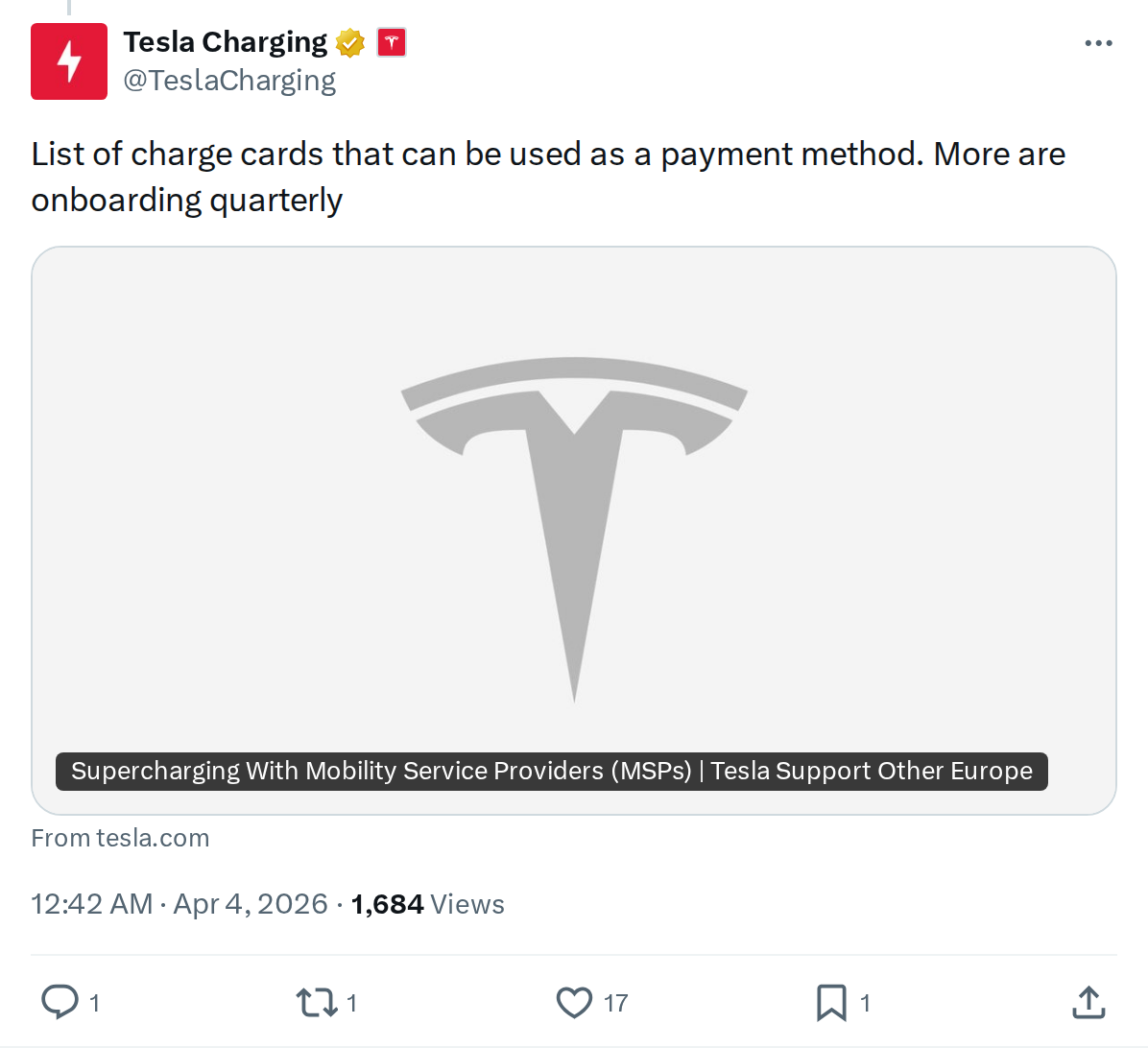
The News: Tesla Charging has published an updated list of charge cards accepted as payment at Superchargers, and confirmed more providers are onboarding on a quarterly basis.
Why It Matters: Non-Tesla EV drivers and owners who prefer card-based payment now have a clearer picture of what works at the pump — and the network is actively expanding those options.
Source: @TeslaCharging on X
Tesla Supercharger Now Accepts More Charge Cards: What's on the List and How to Pay
Tesla Charging just made it easier to know exactly how you can pay at a Supercharger. In a post shared today, the official Tesla Charging account published a reference list of charge cards accepted as payment methods at Supercharger stations — and confirmed that more card providers are being added on a quarterly cadence.
For non-Tesla EV drivers who've been charging at Superchargers since the network opened to other vehicles, and for Tesla owners who sometimes prefer not to use the app, this is a meaningful quality-of-life improvement. Clarity on accepted payment methods removes one of the last friction points in the Supercharging experience.

📊 How You Can Pay at a Supercharger Today
Tesla has built out several distinct payment pathways at Superchargers. Here's how they stack up:
| Payment Method | Availability | Notes |
|---|---|---|
| Tesla App (linked account) | All Superchargers | Best rates; works for Tesla owners and non-Tesla EVs |
| Accepted Charge Cards | Expanding — see list | Quarterly additions confirmed by Tesla Charging |
| Credit/Debit Card (direct) | Select sites | Available at limited locations; may carry a higher rate |
| V4 Centralized Kiosk | Newer V4 stations | Touchscreen kiosk; card/contactless; pricing may differ from app rate |
| Tesla Gift Card | All Superchargers | Can be applied to Supercharging through Tesla account |
🔌 What Are Charge Cards?
Charge cards in this context are EV-specific payment credentials — typically RFID cards or app-based tokens issued by charging networks, fleet operators, or energy providers. They're distinct from standard credit cards and are widely used across public charging infrastructure in Europe and increasingly in North America.
Tesla's decision to publish and maintain a formal list signals a more structured approach to interoperability. Rather than treating third-party charge cards as an afterthought, Tesla Charging is actively managing and growing that compatibility layer — and committing to a quarterly update cycle means the list should stay current as new providers come on board.
Tesla's link in the original tweet points to the official accepted charge card list. Bookmark that page — it will be the most up-to-date reference as new providers are added each quarter. You can follow our charging news coverage for updates each time the list expands.
🚦 Owner's Action Plan
Verdict: Recommended
Worth 5 minutes to verify your payment setup — especially if you charge without the app or drive a non-Tesla EV.
- Check the official charge card list. Visit the link shared by @TeslaCharging to see which charge cards are currently accepted. The list is maintained by Tesla and updated quarterly.
- Confirm your primary payment method is set up in the Tesla app. App-based payment remains the most reliable and typically lowest-cost option at all Supercharger locations.
- If you use a fleet or network charge card, verify it appears on Tesla's accepted list before your next trip. If it's not there yet, check back next quarter — Tesla has confirmed ongoing additions.
- Non-Tesla EV drivers: Create a Tesla account and add a payment method through the Tesla app. This unlocks app-based Supercharging at standard rates and is currently the most consistent experience across the network.
- Heading to a V4 station? These newer sites feature centralized payment kiosks that accept card and contactless payments on-site — useful as a backup if app access isn't available, though rates may vary.
- Bookmark the charge card list page and set a quarterly reminder to check for newly added providers, especially if your preferred card isn't on the list yet.
📰 Deep Dive
Tesla's Supercharger network has undergone a quiet but significant transformation over the past 18 months. What was once a closed ecosystem — pay via Tesla account, full stop — has evolved into a multi-pathway payment environment driven by two forces: the network's opening to non-Tesla vehicles, and regulatory requirements tied to federal NEVI funding. Sites that receive NEVI infrastructure dollars are required to support card-based or contactless payment options, which has pushed Tesla to build out on-site payment infrastructure faster than it otherwise might have.
The V4 Supercharger rollout has been central to this shift. Rather than retrofitting individual card readers to every stall — a maintenance-heavy approach — Tesla has moved toward centralized touchscreen kiosks at newer V4 stations. These kiosks handle card and contactless payments for multiple stalls from a single unit, which is both more reliable and easier to update as payment standards evolve. The tradeoff is that kiosk pricing may run higher than app-based rates, so owners who charge frequently are still best served by keeping the app as their primary payment method.
The charge card compatibility announcement fits neatly into this broader strategy. Charge cards are the lingua franca of commercial EV charging — fleet operators, corporate accounts, and network-agnostic drivers rely on them heavily. By formally publishing and committing to expand the accepted list on a quarterly basis, Tesla is signaling that Supercharger access is no longer a Tesla-only proposition. That's good for network utilization, good for non-Tesla EV adoption, and ultimately good for the charging infrastructure ecosystem as a whole.
The quarterly cadence commitment is the detail worth watching. It transforms what could have been a one-time announcement into an ongoing program. If Tesla maintains that pace, the accepted charge card list could grow substantially by end of 2026 — making Superchargers genuinely accessible to a much wider range of commercial and fleet charging accounts without requiring a Tesla app login.

Marcus covers Tesla's software releases, FSD rollouts, and OTA changes. Background in automotive engineering. Based in Austin.
Sources verified at publish time. Spotted an inaccuracy? Email editorial@basenor.com.